Table of Contents
- What Was Der Blaue Reiter?
- Origins of Der Blaue Reiter
- Why Was It Called The Blue Rider?
- Wassily Kandinsky
- Franz Marc
- August Macke
- Gabriele Münter
- Alexej von Jawlensky
- Paul Klee and the Wider Circle
- Colour, Spirituality and Abstraction
- The Influence of Music
- The Blue Rider Almanac
- The Der Blaue Reiter Exhibitions
- Famous Der Blaue Reiter Artworks
- The First World War and the End of the Group
- Der Blaue Reiter's Legacy
- Der Blaue Reiter Art Prints
- Related Artists and Articles
What Was Der Blaue Reiter?
Der Blaue Reiter, or The Blue Rider, was one of the most important groups associated with German Expressionism and the development of early modern art.
Formed in Munich in 1911 around Wassily Kandinsky and Franz Marc, the circle brought together artists interested in colour, spirituality, symbolism, music and increasingly abstract forms of painting.
Unlike an academic school with a fixed visual style, Der Blaue Reiter was a loose association of artists united by the belief that art should communicate something deeper than the literal appearance of the visible world.
Landscape, animals, human figures and increasingly abstract forms could all become vehicles for emotional and spiritual expression.
Der Blaue Reiter existed for only a few years, but its influence on German Expressionism and the development of abstraction was enormous.
Explore GalleryThane's carefully curated Der Blaue Reiter Prints collection, bringing together selected works from the formative Blue Rider years by Wassily Kandinsky, Franz Marc, August Macke, Alexej von Jawlensky and Marianne von Werefkin.
You can also explore the wider development of the movement in our Expressionist Art Prints collection, which includes Der Blaue Reiter alongside Die Brücke, Austrian Expressionism and important precursors such as Edvard Munch and James Ensor.

Origins of Der Blaue Reiter
The origins of Der Blaue Reiter lie in Munich's rapidly changing artistic culture during the years before the First World War.
Kandinsky, Marc, Gabriele Münter, Alexej von Jawlensky and Marianne von Werefkin had connections with the Neue Künstlervereinigung München — the New Artists' Association of Munich — which had been established in 1909.
Differences soon developed within the association over the increasingly abstract direction being taken by Kandinsky and some of the other artists.
In 1911 Kandinsky and Marc separated from the organisation and began organising exhibitions under the name Der Blaue Reiter.
The new circle was less interested in creating a uniform artistic style than in bringing together forms of art they believed expressed an inner or spiritual necessity.
This openness allowed very different artists to appear alongside one another. Figurative paintings, landscapes, symbolic animals, folk art, children's art and increasingly abstract compositions could all be considered relevant to the group's ideas.
Why Was It Called The Blue Rider?
The precise origin of the name Der Blaue Reiter has acquired an almost legendary status.
Kandinsky and Marc both had a particular attachment to the colour blue, while Marc repeatedly painted horses and Kandinsky had used horse-and-rider imagery in his own earlier work.
The rider could also suggest movement, journey and transformation — appropriate imagery for artists who wanted to move beyond conventional representation towards a new understanding of colour and form.
Whatever the exact origin of the phrase, the Blue Rider became one of the most memorable names in twentieth-century modern art.
Wassily Kandinsky
Wassily Kandinsky was one of the principal intellectual forces behind Der Blaue Reiter and one of the pioneers of abstract painting.
Kandinsky believed that colour and form could communicate directly with the emotions in a way comparable to music.
During the years leading to Der Blaue Reiter, his landscapes around Murnau became increasingly simplified. Mountains, churches, riders and buildings remained recognisable, but colour became less dependent on physical reality.
Blue, yellow, red and other colours could be selected for their expressive effect rather than because they reproduced the actual appearance of the subject.
This process gradually led Kandinsky towards increasingly abstract works such as his Improvisations and Compositions.

Kandinsky's theories were equally important. His writings argued that modern art should respond to an artist's inner necessity rather than simply copy the external world.
This idea became fundamental to Der Blaue Reiter and to the broader development of abstraction.
Read more in our Wassily Kandinsky artist profile.
Franz Marc
Franz Marc was the other central force behind Der Blaue Reiter.
Marc became famous for paintings of animals transformed through vivid, symbolic colour.
Horses, deer, foxes, cows and tigers appear repeatedly in his work, often inhabiting landscapes in which animal and environment seem to merge into one rhythmic composition.
Marc believed that animals offered a form of spiritual purity that modern human society had lost.
His colour was highly personal and symbolic. Blue was associated with spirituality, while yellow and red could carry very different emotional meanings.
This explains why a blue horse or red deer should not be understood simply as decorative fantasy. The unnatural colour was part of Marc's attempt to communicate ideas and emotions beyond conventional representation.
His best-known paintings include Blue Horse I, The Tiger, The Foxes, The Dream and The Yellow Cow.
Browse the complete GalleryThane collection of Franz Marc prints or read Franz Marc: The Visionary Artist of German Expressionism.
August Macke
August Macke developed a distinctive form of Expressionism characterised by brilliant colour and scenes of modern leisure.
His paintings often show people walking in parks, looking into shop windows, visiting cafés or simply enjoying everyday life.
Where Kirchner's modern city can feel nervous and unstable, Macke's world is often calm, harmonious and intensely colourful.
Figures are simplified into clear shapes, while shop windows, trees, clothing and architecture become interlocking areas of colour.
Macke absorbed ideas from French painting, Fauvism, Cubism, Robert Delaunay and the Der Blaue Reiter circle without becoming stylistically identical to any of them.
His journey to Tunisia with Paul Klee and Louis Moilliet in 1914 produced some of the most celebrated colour studies of his short career.
Explore GalleryThane's August Macke prints or read August Macke – Driving Force Behind the Blue Rider Group.
Gabriele Münter
Gabriele Münter was a pioneering German modernist and an important participant in the circle surrounding Der Blaue Reiter.
Her paintings frequently depict landscapes, houses, village streets, interiors and portraits using simplified forms, strong outlines and bold colour.
Münter's work around Murnau is particularly important. The town and surrounding Bavarian landscape became a centre for experimentation by Münter, Kandinsky and their artistic circle.
Buildings, mountains and lakes were reduced to broad shapes and intense colours, helping move German painting away from naturalism towards Expressionism.
Münter also played an important role in preserving the history of the movement. A substantial body of work connected with Kandinsky and the Blue Rider circle survived the Nazi period partly because she safeguarded it at her home in Murnau.
Alexej von Jawlensky
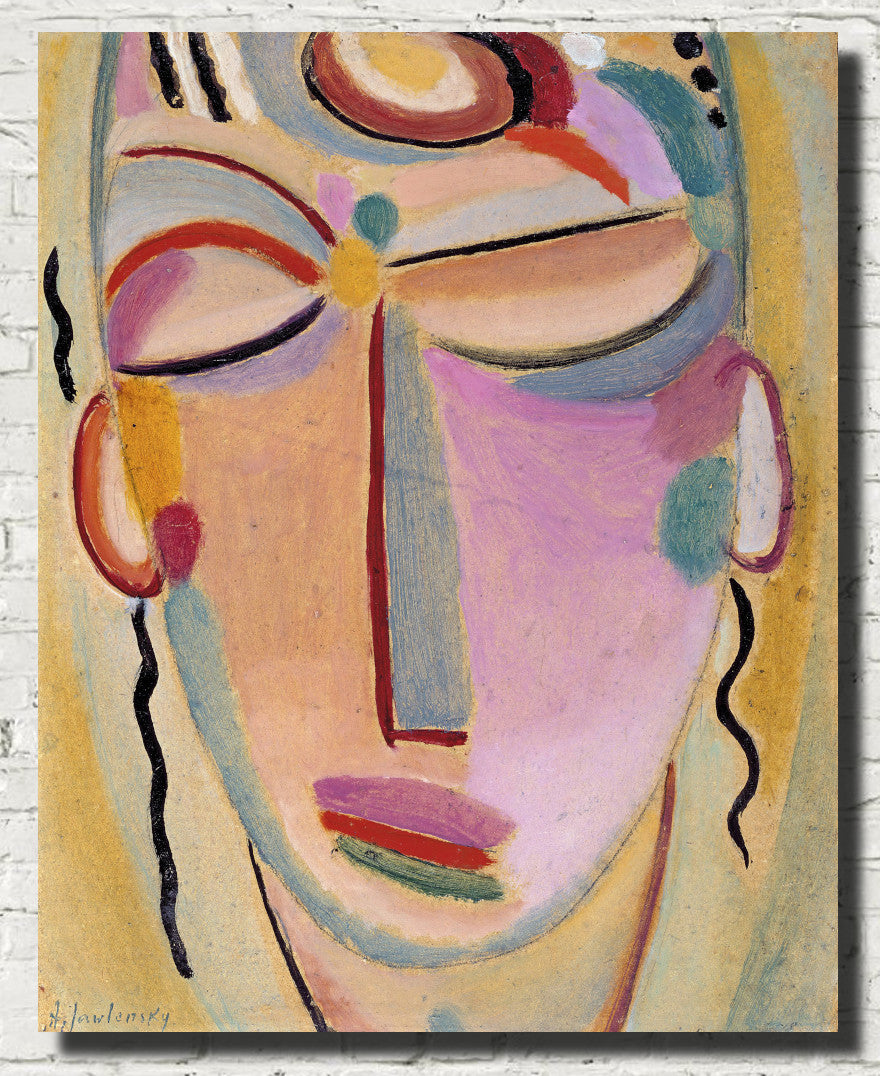
Alexej von Jawlensky was a Russian-born painter who became an important figure within Munich's Expressionist avant-garde.
His early Munich and Murnau-period paintings reveal his growing fascination with intense colour, simplified form and the expressive potential of the human face.
Works such as Portrait of Alexander Sakharoff (1909), Murnau (1910), Head of a Youth (1911) and Head in Black and Green (1913) belong to the period most closely connected with the Blue Rider environment.
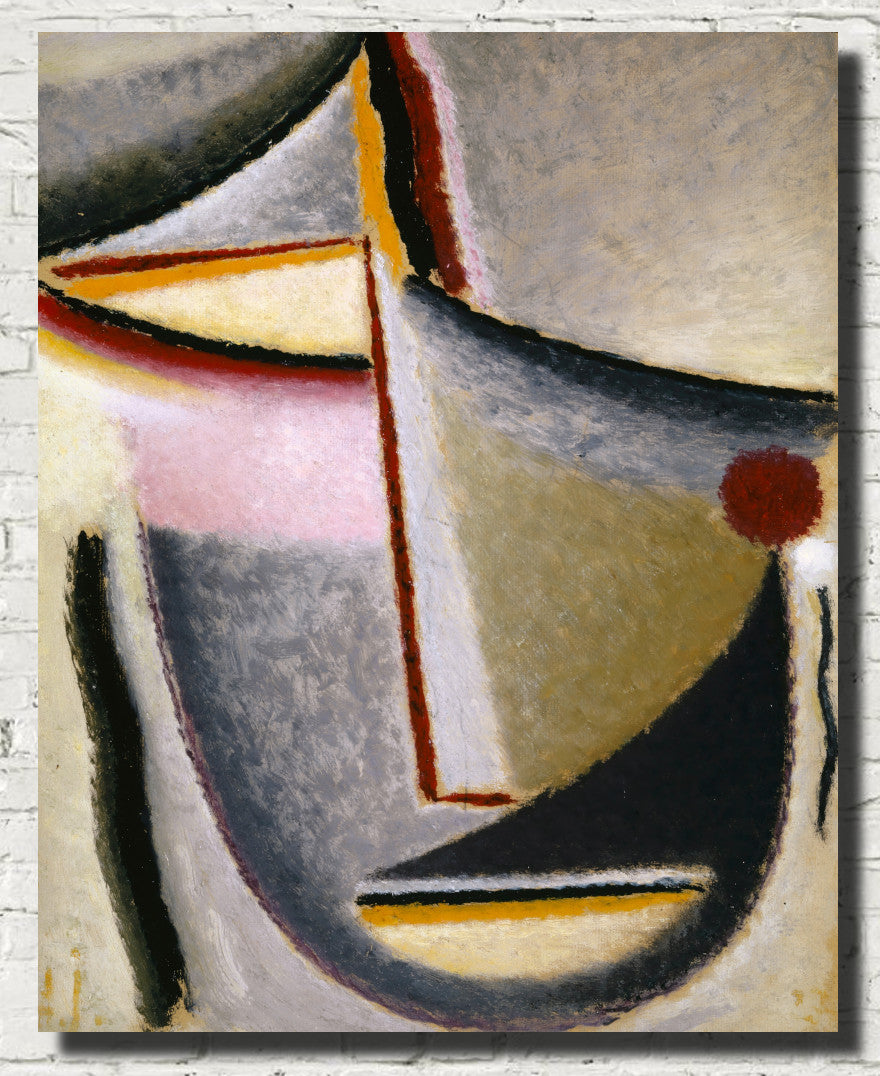
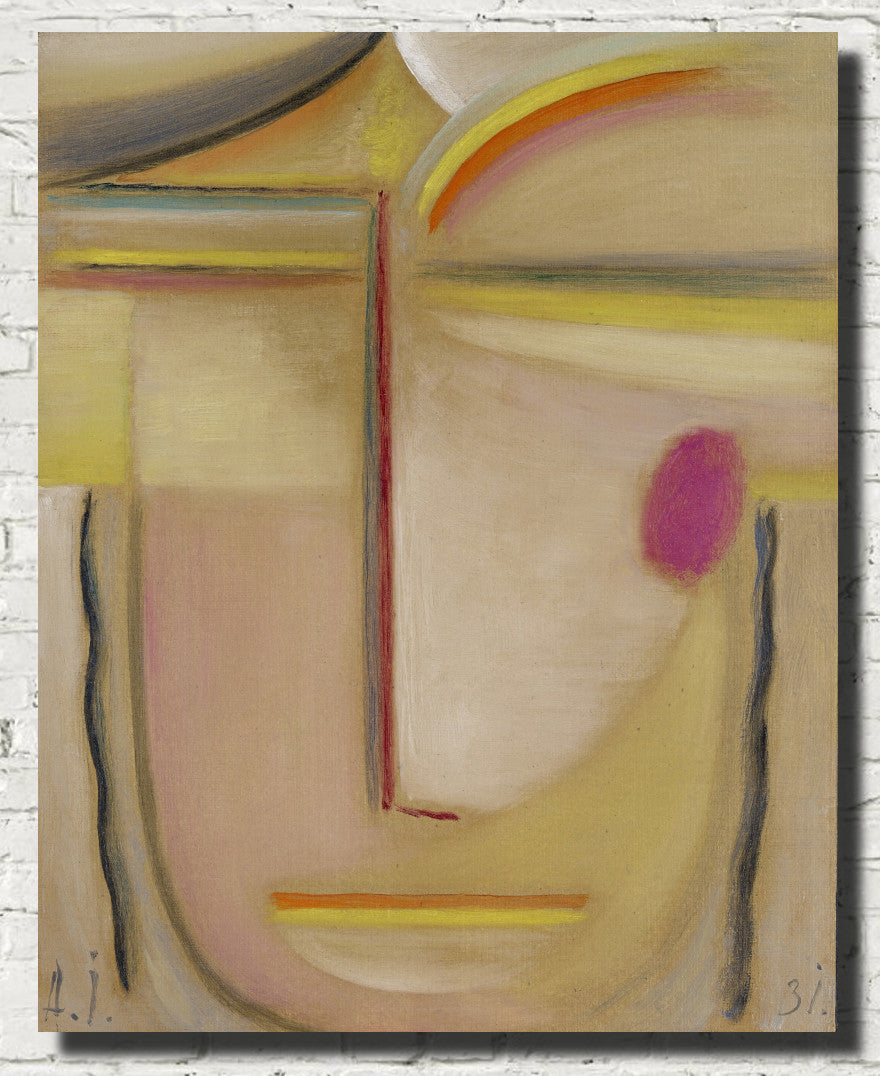
Jawlensky was particularly interested in the human face. His portraits gradually became more simplified and intensely coloured until the head itself approached a form of spiritual symbol.
Eyes, noses and mouths could be reduced to strong lines surrounded by areas of brilliant colour.
In his later Mystical Heads, Abstract Heads and Meditations, the face became increasingly icon-like. These later series developed from ideas already visible in his pre-war work, although they belong to a period after the original Der Blaue Reiter circle had ended.
Paul Klee and the Wider Blue Rider Circle
Paul Klee was associated with the wider Der Blaue Reiter circle, although his long and highly individual career cannot be reduced to Expressionism alone.
Klee was interested in music, symbolism, children's drawing, nature and the relationship between representation and abstraction.
His friendship with artists such as August Macke and his contact with Kandinsky helped connect him with the experimental culture surrounding the Blue Rider.
Later, both Klee and Kandinsky would teach at the Bauhaus, carrying many of the questions raised before the First World War into a new phase of European modernism.
Other important figures associated with the wider Blue Rider environment included Heinrich Campendonk and the composer Arnold Schoenberg.
This diversity is important because Der Blaue Reiter was never simply a group of painters producing one identifiable style.
Colour, Spirituality and Abstraction
One of the most important ideas shared by artists around Der Blaue Reiter was that colour could communicate independently of realistic representation.
A painter did not need to reproduce the actual colour of a horse, mountain, face or building.
Colour could instead respond to emotion, symbolism, rhythm or what Kandinsky described as an inner necessity.
This gave artists enormous freedom.
Marc could paint blue horses. Jawlensky could construct faces from intense coloured planes. Kandinsky could gradually remove recognisable objects altogether.
For many of these artists, abstraction was therefore not simply a formal experiment. It was linked with the belief that painting might express experiences that could not easily be communicated through literal representation.
The Influence of Music
Music had a particularly important influence on Kandinsky and on the intellectual environment surrounding Der Blaue Reiter.
Music does not need to reproduce a visible object in order to communicate emotion. A sequence of sounds can create tension, harmony, rhythm and mood without depicting a landscape or figure.
Kandinsky believed painting could achieve something similar.
His titles increasingly borrowed musical terminology: Improvisation, Composition and Impression.
Rather than treating a painting as a window onto the visible world, he began to think of colours, lines and shapes as elements capable of interacting like musical sounds.
This analogy became one of the intellectual foundations of early abstract art.
The Blue Rider Almanac
Der Blaue Reiter was more than an exhibition group.
In 1912 Kandinsky and Marc edited Der Blaue Reiter Almanac, an extraordinary publication that brought together essays, reproductions and examples of art drawn from very different cultures and traditions.
The editors deliberately challenged conventional hierarchies of European fine art.
Modern painting could appear alongside folk art, medieval art, children's drawings and objects from non-European cultures.
Music was also important, reinforcing the group's belief that different artistic forms could communicate underlying spiritual or emotional truths.
The almanac demonstrates how broad the Blue Rider project really was. Its artists were not simply trying to create a new painting style; they were questioning the entire basis on which modern culture decided what counted as important art.
The Der Blaue Reiter Exhibitions
The first Blue Rider exhibition opened in Munich in December 1911.
It brought together work by artists who did not necessarily share a common visual style but who represented the experimental direction Kandinsky and Marc wanted to promote.
A second exhibition followed in 1912 and concentrated particularly on works on paper and prints.
These exhibitions were important because they presented Expressionism and abstraction as part of a wider international avant-garde rather than an isolated German development.
The exhibitions travelled to other European cities, spreading the group's ideas beyond Munich and helping establish Der Blaue Reiter as one of the defining names of modern art before the First World War.
Famous Der Blaue Reiter Artworks
Franz Marc – Blue Horse I
Painted in 1911, Blue Horse I has become one of the most recognisable images associated with German Expressionism.
The horse is simplified into a monumental curved form while the intense blue colour transforms the animal from an observed subject into something symbolic and spiritual.
Franz Marc – The Tiger
The Tiger demonstrates Marc's movement towards increasingly fractured forms. The animal and surrounding landscape are constructed from powerful angular shapes, combining Expressionist colour with the influence of Cubism.
August Macke – Lady in the Green Jacket
Lady in the Green Jacket represents the lighter side of the Blue Rider circle. Simplified figures, brilliant colour and an everyday leisure subject demonstrate Macke's distinctive approach to modern life.
Wassily Kandinsky – Composition VII
Composition VII, painted in 1913, represents Kandinsky's rapid movement towards abstraction.
Colour, line and shape dominate the enormous composition, while recognisable imagery is absorbed into a complex visual rhythm.
The work demonstrates how quickly the experiments associated with Der Blaue Reiter helped push European painting towards non-objective art.
The First World War and the End of Der Blaue Reiter
The outbreak of the First World War in 1914 brought the brief Blue Rider period to an abrupt end.
August Macke was killed in France in September 1914.
Franz Marc served in the German army and was killed at Verdun in 1916.
Kandinsky, as a Russian citizen, was forced to leave Germany and returned to Russia.
The international artistic network that had flourished in Munich was fragmented by war and nationalism.
Der Blaue Reiter therefore never developed into a long-lived organisation, but the brevity of its existence makes its influence all the more remarkable.
Der Blaue Reiter's Legacy
Der Blaue Reiter helped reshape the direction of twentieth-century art.
Its artists demonstrated that colour could have an expressive or symbolic existence independent of natural appearance.
They challenged established boundaries between figurative and abstract art.
They also treated folk art, children's drawings and non-academic traditions as serious sources of artistic inspiration.
Kandinsky became one of the central figures in the development of abstraction.
Klee and Kandinsky later carried their investigations into colour and form into the Bauhaus.
Marc's animals became enduring icons of German Expressionism, while Macke's brilliant colour and Jawlensky's simplified faces continue to influence how the Blue Rider is understood today.
The group's broader belief that art could communicate directly through colour, rhythm and form became fundamental to many later modernist movements.
Der Blaue Reiter Art Prints
Der Blaue Reiter paintings are particularly effective as wall art because the artists combined historically important experimentation with unusually strong colour and memorable imagery.
Franz Marc's animal paintings provide some of the most vivid examples, with blue horses, red deer, yellow cows and brilliantly coloured landscapes.
August Macke offers colourful scenes of parks, shops and modern leisure, while Jawlensky's early portraits can work especially well in contemporary interiors because of their simplified forms and strong colour contrasts.
Kandinsky provides a route from recognisable Expressionist landscapes towards increasingly abstract compositions, while Werefkin adds atmospheric landscapes and psychologically charged figurative work.
Explore the dedicated GalleryThane Der Blaue Reiter Prints collection for a carefully selected group of paintings connected with the Munich, Murnau and pre-war development of The Blue Rider.
The collection includes selected work by Wassily Kandinsky, Franz Marc, August Macke, Alexej von Jawlensky and Marianne von Werefkin.
Rather than including every later work produced by artists associated with the movement, the collection concentrates on paintings connected with their Blue Rider-era development, from Kandinsky's Murnau landscapes and emerging abstraction to Marc's symbolic animals, Macke's brilliant scenes of modern life, Jawlensky's early Expressionist portraits and Werefkin's psychologically charged landscapes and figures.
GalleryThane artworks are available as fine art paper prints, framed prints and canvas panels in a range of sizes.
For the broader movement, browse GalleryThane's Expressionist Art Prints, which also explores Die Brücke, Austrian Expressionism and the wider development of Expressionist painting.
Related Artists and Articles
Der Blaue Reiter Prints
Browse a curated collection of paintings connected with the formative Blue Rider years, including works by Kandinsky, Franz Marc, August Macke, Jawlensky and Werefkin.
Expressionism: A Guide to the Movement and Its Artists
Explore German and Austrian Expressionism, including Die Brücke, Der Blaue Reiter, Edvard Munch, Egon Schiele, Ernst Ludwig Kirchner and other important figures.
Wassily Kandinsky Artist Profile
Discover Kandinsky's development from expressive landscape painting towards abstraction and his theories about colour, music and spiritual art.
Franz Marc: The Visionary Artist of German Expressionism
Explore Marc's symbolic colour, animal paintings and central role in Der Blaue Reiter.
August Macke – Driving Force Behind the Blue Rider Group
Learn more about Macke's vivid paintings of modern life, colour and his role within German Expressionism.