



Madame Matisse, by André Derain
Couldn't load pickup availability
BUY WITH CONFIDENCE
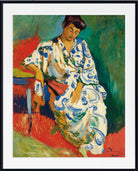
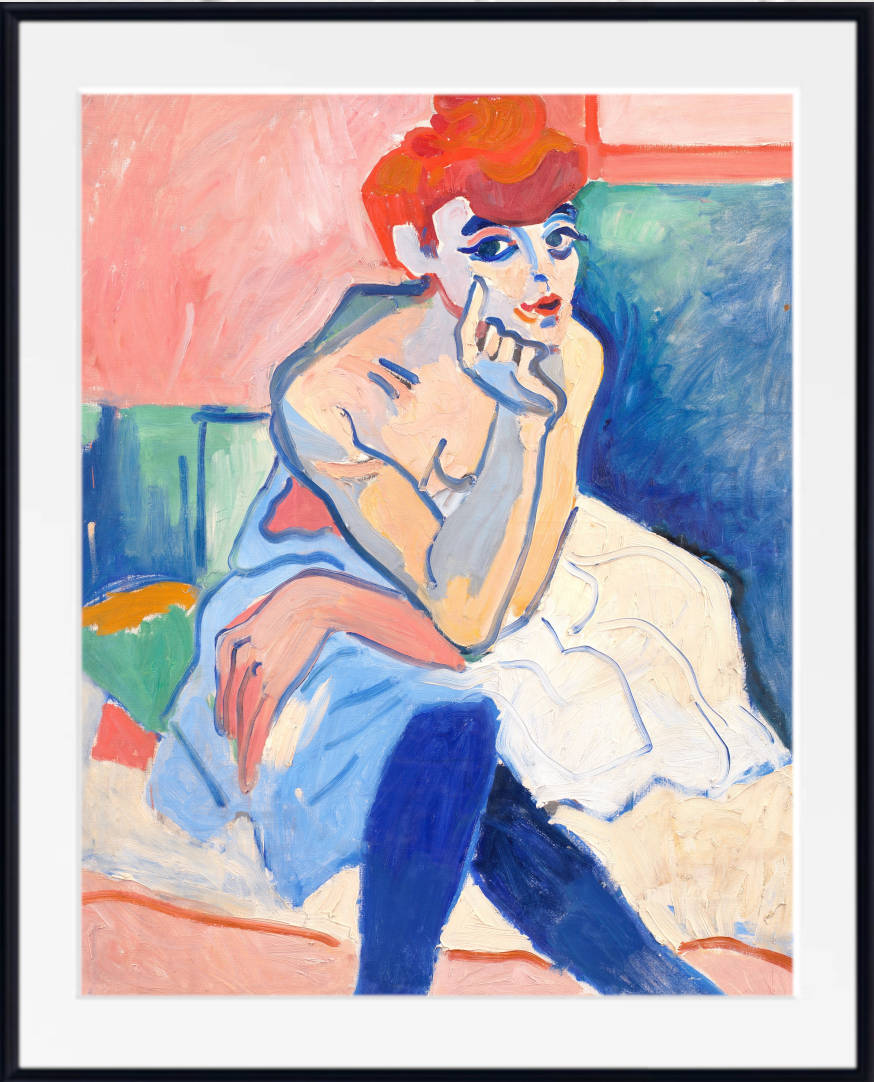
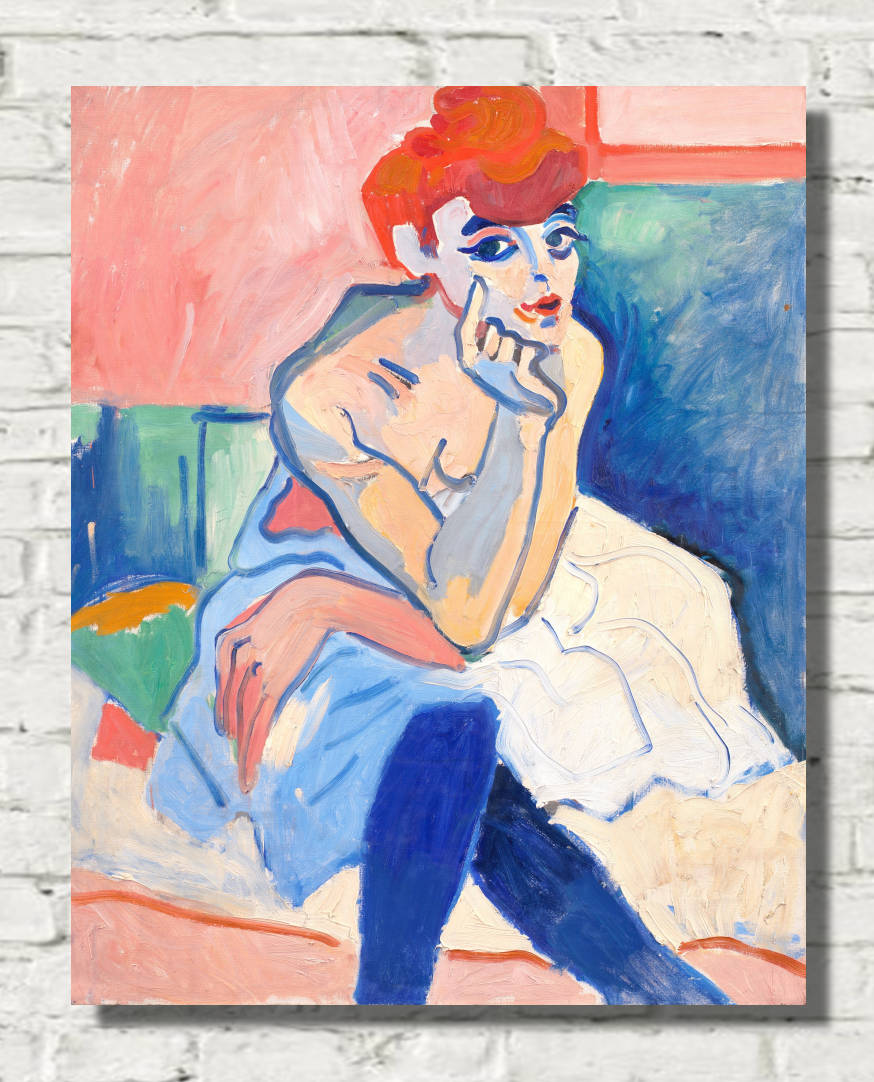
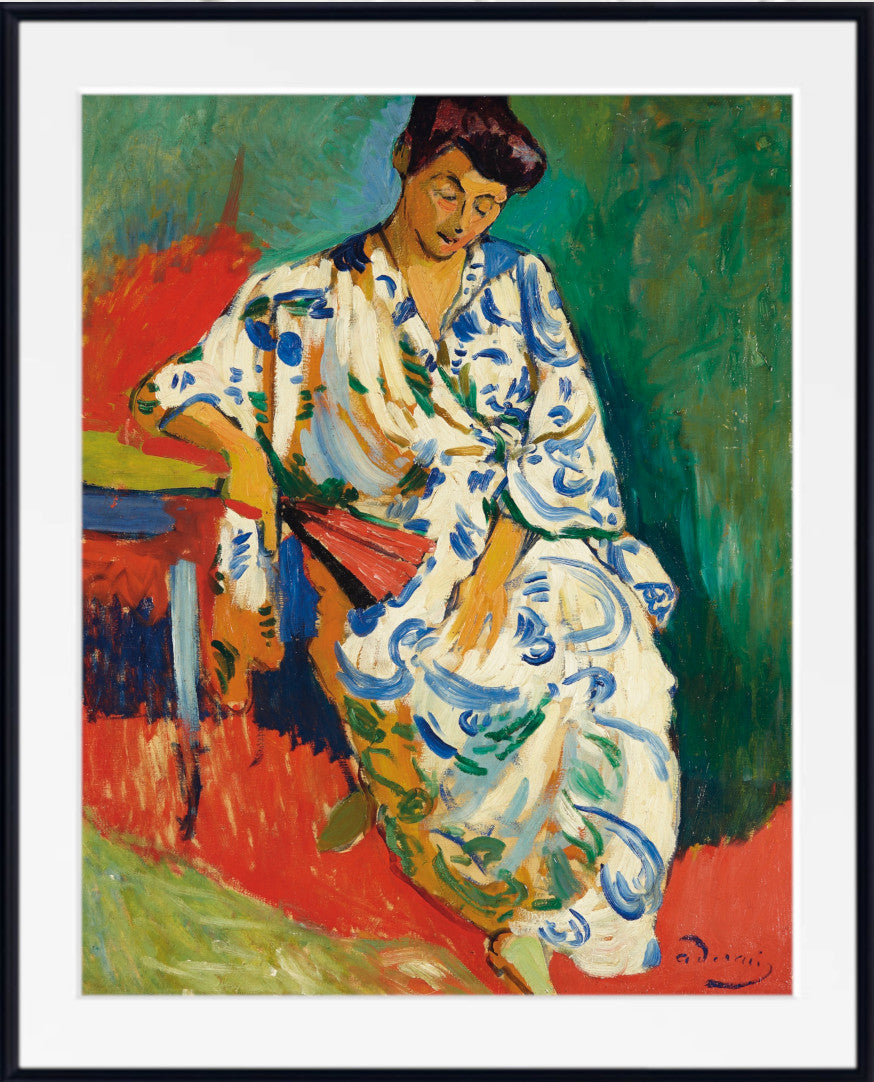
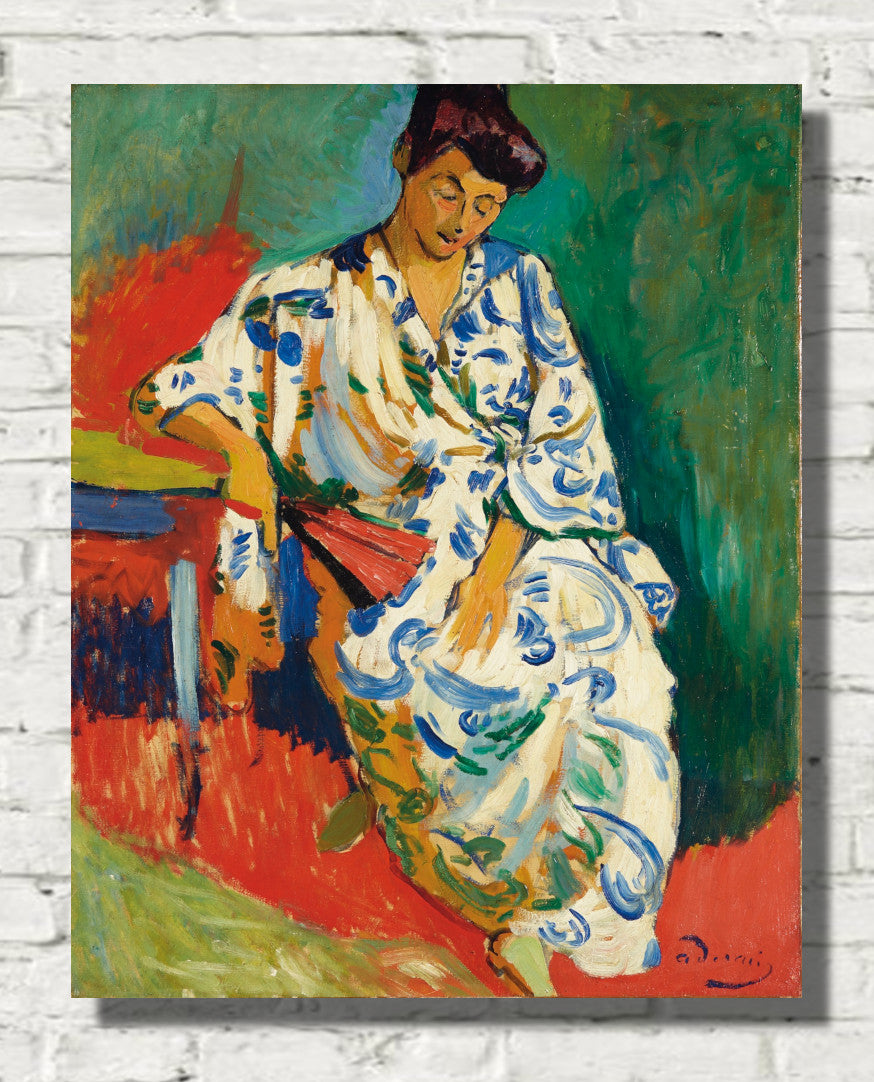
Madame Matisse (1905) by André Derain, also known as Madame Matisse au Kimono and Woman with a Shawl, Madame Matisse in a Kimono, is one of the outstanding portraits of the Fauvist movement. Painted at Collioure during the revolutionary summer Derain spent working alongside Henri Matisse, the portrait shows Matisse's wife Amélie wrapped in an elegant white kimono decorated with sweeping blue patterns and holding a vivid red fan.
This André Derain Madame Matisse print captures Fauvism at the moment of its emergence. Green, orange and red replace conventional portrait shadows, the background dissolves into expressive areas of colour and the patterned kimono becomes almost as important as the sitter herself. Available as a fine art print, framed print or canvas panel, Madame Matisse is an exceptional choice for admirers of Fauvist portraiture, colourful figurative art and early twentieth-century modern painting.
Madame Matisse – A Fauvist Portrait of Amélie Matisse
The woman portrayed is Amélie Matisse, wife of Henri Matisse and an important figure within the intimate artistic circle that gathered around Matisse and Derain during the development of Fauvism.
Derain depicts her seated and wrapped in a striking Japanese-style kimono. One arm rests to the side while she holds a brilliant red fan, creating a pose that is relaxed yet commanding.
The portrait is immediately recognisable as a human figure, but Derain makes little attempt to reproduce the sitter through conventional naturalistic colour.
Her face and body are modelled with unexpected greens, oranges and other intensified hues. Behind her, patches of red and green create an abstracted environment rather than a carefully described room.
The result is a portrait in which likeness remains important, but colour becomes equally significant.
The Kimono at the Centre of the Painting
The white kimono is one of the painting's most distinctive features.
Across its pale fabric, sweeping blue arabesques create strong decorative rhythms. These curving patterns move around Amélie's body, contrasting with the more angular passages of colour in the surrounding background.
Rather than painstakingly reproducing every fold and piece of decoration, Derain uses the garment as an opportunity to explore pattern, line and colour.
The white fabric also provides an important visual contrast with the saturated reds, greens, blues and oranges around it.
This makes the kimono far more than a piece of costume. It becomes one of the major structural elements within the composition.
The relationship between decorative pattern and the human figure would become increasingly important in modern painting, particularly in the work of Henri Matisse himself.
Amélie Matisse and the Fauvist Circle
Amélie Matisse was much more than the wife of a famous artist.
She supported Henri Matisse throughout the difficult early years of his career and frequently modelled for him. During the period surrounding Fauvism, her appearance became familiar through some of Matisse's most radical portraits.
She also sat for Derain during the summer of 1905 at Collioure.
This was an unusually close artistic environment. Matisse and Derain were working together, discussing their experiments and sometimes observing or depicting the same people and locations.
Derain even produced a drawing showing Henri Matisse painting his wife beside the water at Collioure.
Madame Matisse therefore records not only an individual sitter but also the extraordinary collaboration and friendship surrounding the birth of Fauvism.
Collioure in the Summer of 1905
Derain painted Madame Matisse au Kimono in August 1905 during the celebrated summer he spent with Henri Matisse at Collioure.
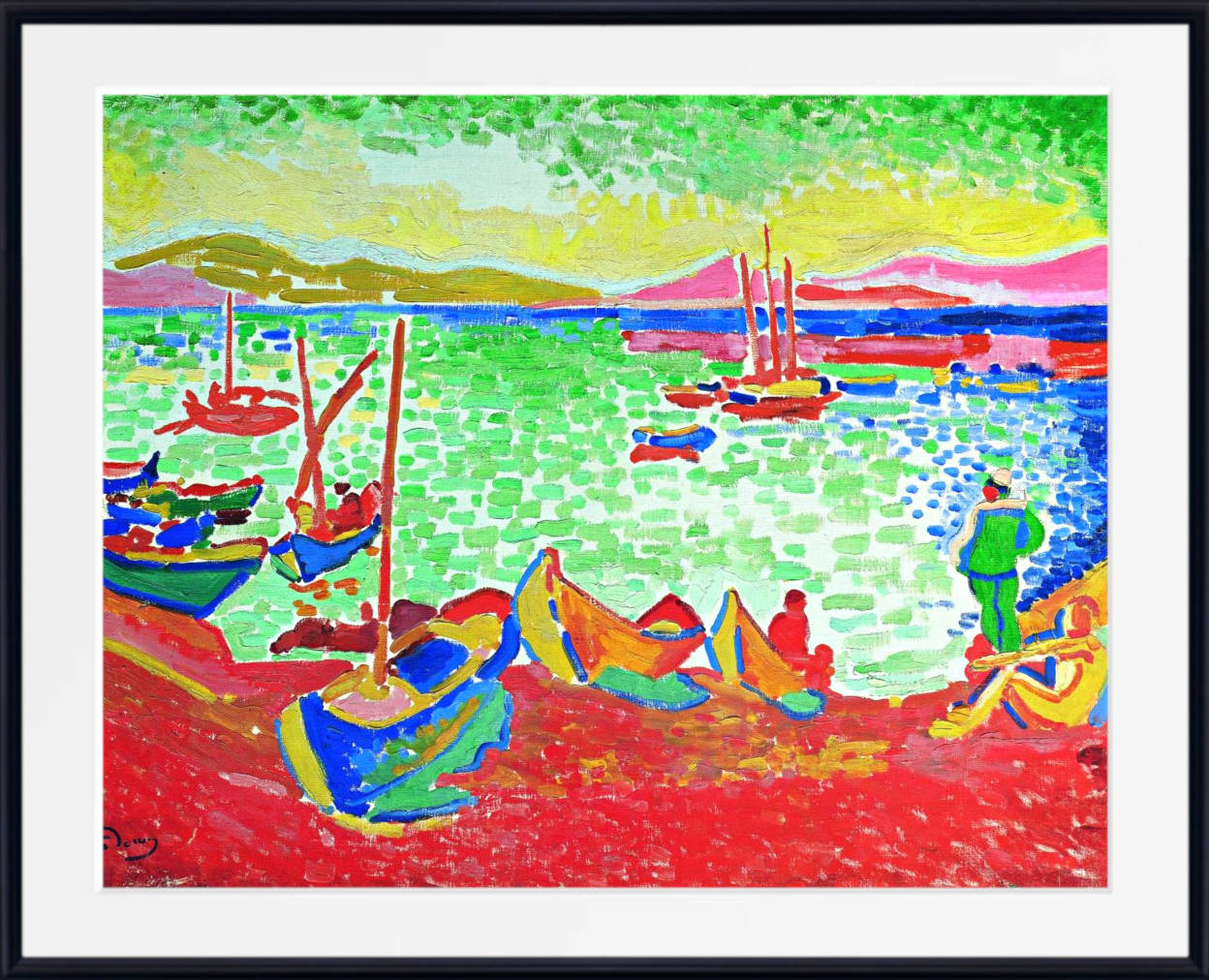
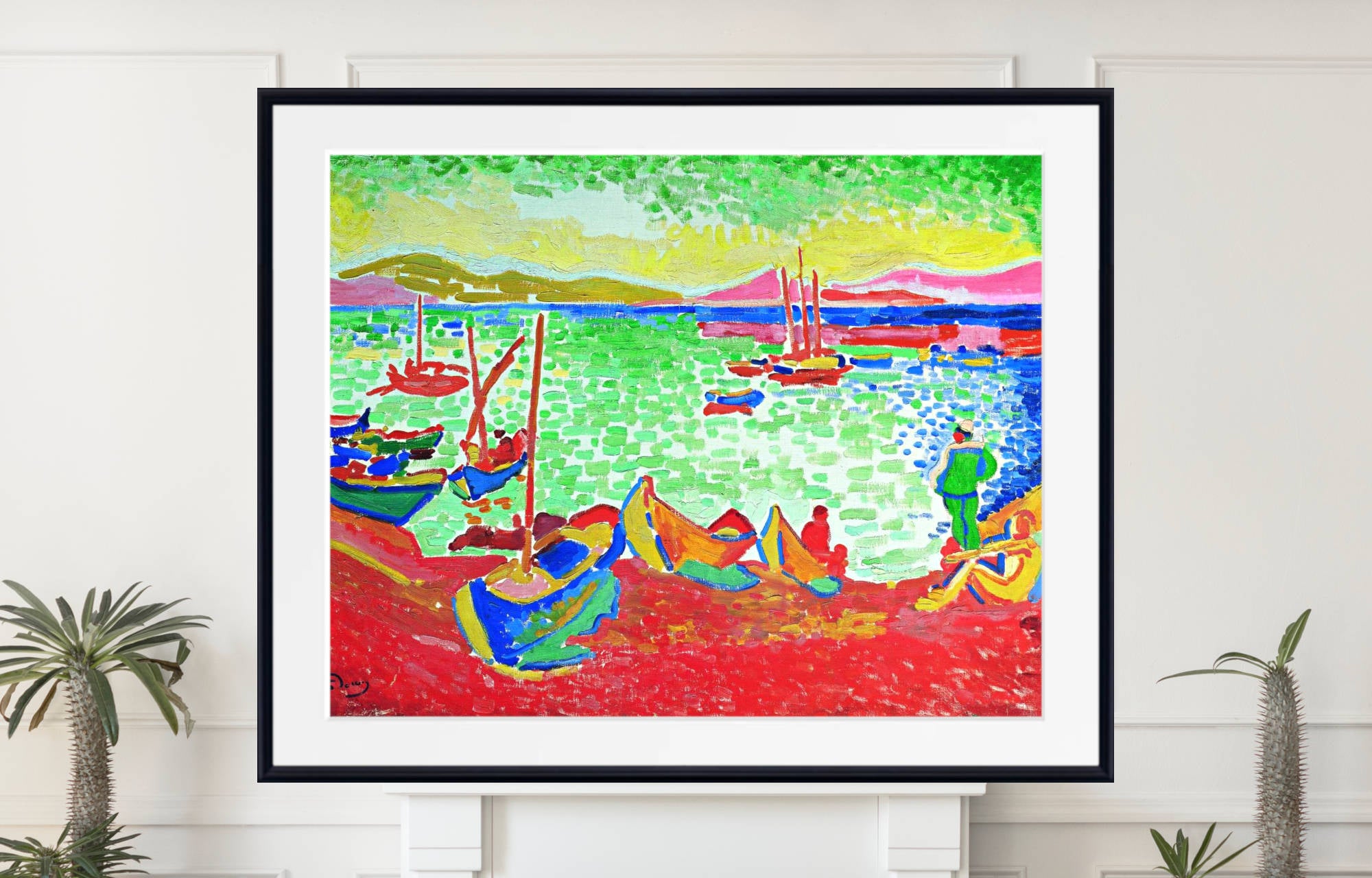
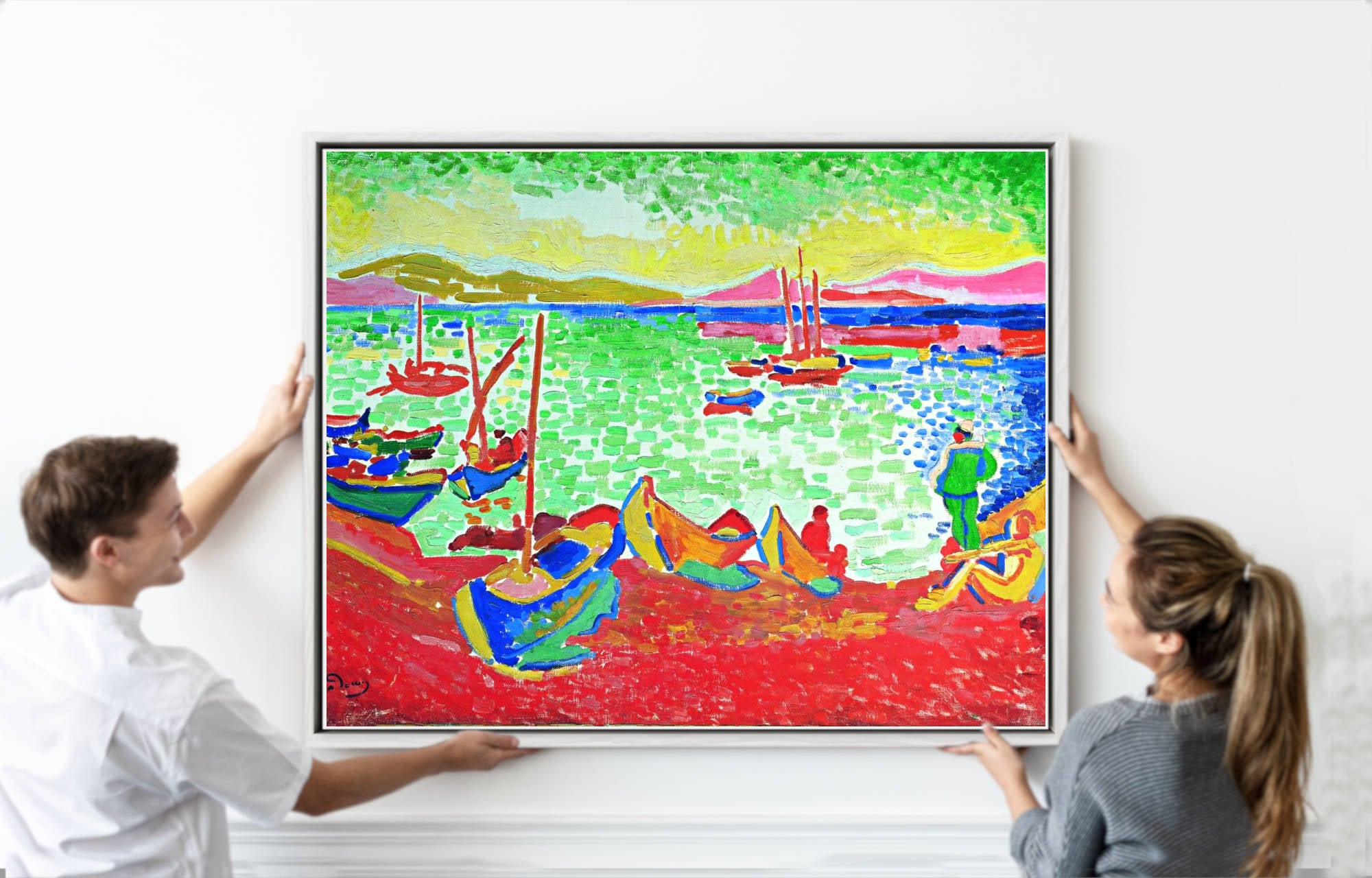
The small Mediterranean fishing town close to the Spanish border became a laboratory for radical experiments in colour.
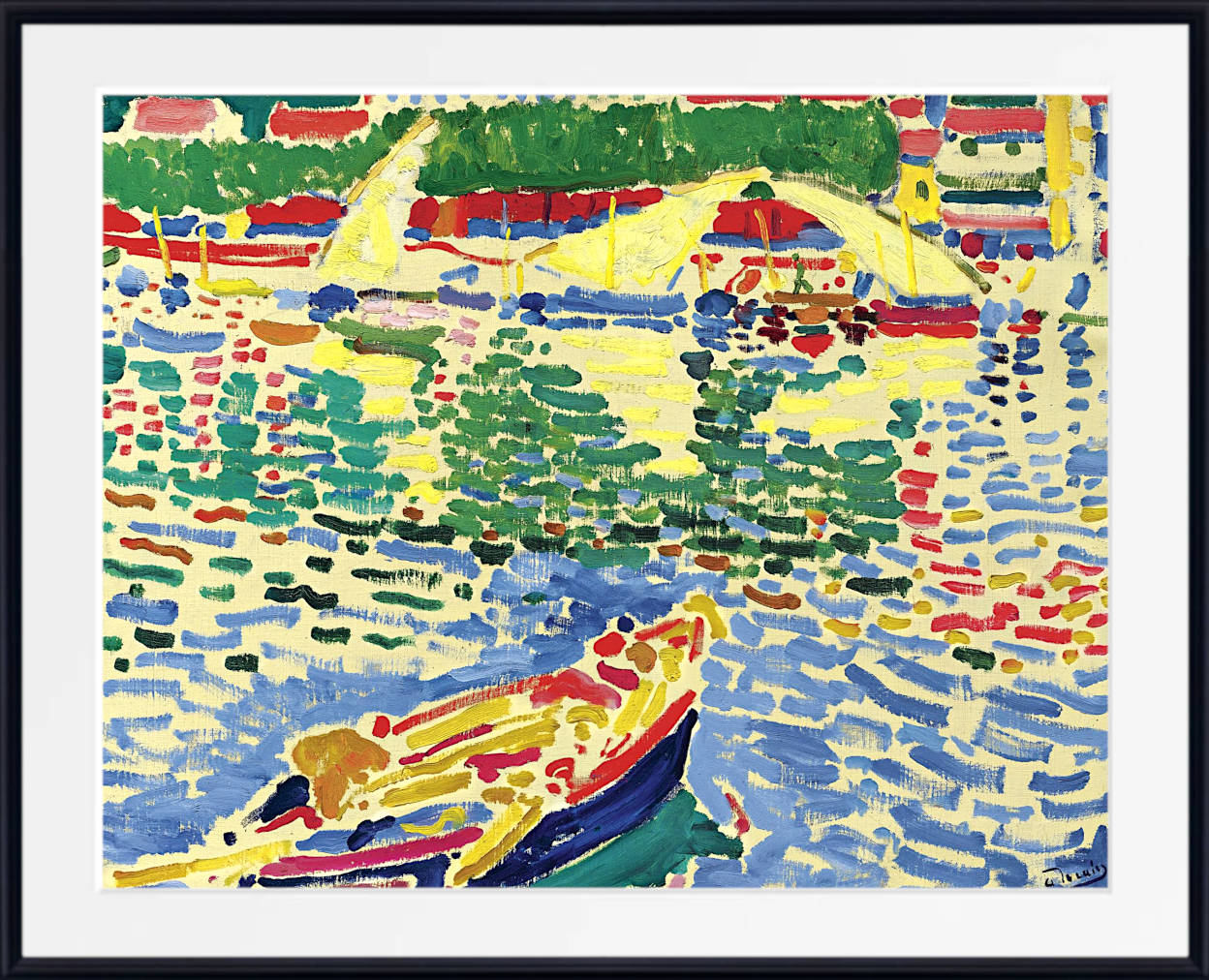
Matisse had invited Derain to join him there, and the two artists painted harbour views, fishing boats, surrounding hills, portraits and figures.
The brilliant southern light encouraged them to move increasingly beyond conventional naturalism.
A tree no longer needed to be brown or green. Shadows could become orange, blue or violet. Skin could contain colours chosen for their relationship with the rest of the composition rather than for literal resemblance.
Although Collioure is best known for the landscapes produced by Matisse and Derain, Madame Matisse shows how the same discoveries could transform portrait painting.
Colour in Madame Matisse
Derain's use of colour is fundamental to the impact of the portrait.
Traditional academic portraiture normally establishes the human form through careful transitions from light to shadow. Derain rejects this approach.
Green and orange can function as shadows just as effectively as darker versions of conventional flesh tones. Red and green passages in the background intensify one another through contrast.
The blue pattern of the kimono becomes stronger against its predominantly white ground, while the red fan introduces another concentrated colour accent.
These relationships create luminosity across the entire painting.
Instead of simply representing light falling onto the sitter, Derain allows colour itself to produce the sensation of illumination.
This was one of the key discoveries of Fauvism.
From Divisionism to Fauvism
The painting also captures an important technical transition in Derain's work.
Before the breakthrough at Collioure, Derain and Matisse had both experimented with ideas derived from Neo-Impressionism and Divisionism.
Artists such as Georges Seurat and Paul Signac had explored how separate touches of pure colour could interact optically rather than being completely mixed on the palette.
Derain absorbed these lessons but gradually became dissatisfied with the discipline of a systematic technique.
In Madame Matisse, brilliant complementary colours still reveal the influence of Divisionist theory, but the handling has become much more fluid.
Brushstrokes sweep through the kimono and background instead of being broken into uniformly controlled touches.
The painting therefore demonstrates Derain moving from a colour system towards the much freer language of Fauvism.
Madame Matisse and The Green Line
Derain's portrait has an especially interesting relationship with Henri Matisse's famous portrait of his wife, Portrait of Madame Matisse: The Green Line.
Matisse painted The Green Line shortly after the Collioure summer of 1905.
Both artists use Amélie as the subject of radical experiments with portrait colour.
Derain surrounds her with powerful red and green contrasts and introduces equally unexpected colours within the modelling of her face and figure.
Matisse would take the idea even further, famously dividing his wife's face with a vertical green stripe.
The two paintings demonstrate the remarkable exchange of ideas occurring between Matisse and Derain during this period.
They were not merely painting similar subjects. They were testing new possibilities together and responding to one another's discoveries.
The Red Fan
The red fan held by Madame Matisse provides a concentrated burst of warm colour within the composition.
Its strong tone attracts the eye and creates an important contrast with the white and blue kimono.
The accessory also contributes to the sophisticated character of the sitter.
Amélie appears not as an anonymous model but as a confidently presented modern woman, surrounded by textiles and colours that reflect contemporary interest in decorative arts and non-European design.
Derain avoids excessive descriptive detail, however. The fan works simultaneously as a recognisable object and as a compact red shape required by the overall organisation of the painting.
This dual role is characteristic of Fauvist art: objects remain identifiable while becoming increasingly important as independent elements of colour and design.
Japanese Influence and Decorative Art
The kimono reflects the widespread European fascination with Japanese art and design during the late nineteenth and early twentieth centuries.
Japanese prints, textiles, ceramics and decorative objects had profoundly influenced European artists since the middle of the nineteenth century.
For modern painters, Japanese art offered alternatives to traditional Western conventions of perspective, modelling and composition.
Patterned fabrics were particularly attractive because they encouraged artists to think about the relationship between three-dimensional figures and flat decorative surfaces.
In Derain's portrait, the flowing blue decoration across Amélie's kimono reinforces this tension.
The garment clearly wraps around a body, yet its pattern continually reminds us that we are looking at shapes arranged across a flat painted surface.
The Birth of Fauvism
Only weeks after Derain painted Madame Matisse, the experiments undertaken by his circle became publicly famous.
At the Salon d'Automne in Paris in 1905, intensely coloured works by Henri Matisse, André Derain, Henri Manguin, Albert Marquet and other associated artists attracted considerable attention.
Critic Louis Vauxcelles famously referred to the painters as les fauves — “the wild beasts”.
The description referred to the apparently uncontrolled intensity of their colour.
The name quickly became attached to the new movement.
Fauvism itself lasted only a few years, but its liberation of colour had a profound influence on modern painting.
Madame Matisse is especially important because it was created immediately before that historic exhibition and embodies the experiments that made the Fauvist breakthrough possible.
Why Madame Matisse Is an Important Fauvist Portrait
The painting combines many of the principal characteristics of Fauvism:
- brilliant non-naturalistic colour
- green and orange used within modelling and shadow
- strong complementary colour contrasts
- fluid, clearly visible brushwork
- simplified modelling of the human figure
- a background reduced to expressive areas of colour
- decorative pattern treated as a major compositional element
- colour used independently of literal observation
It is also unusually important within Derain's career because fully developed Fauvist portraits by the artist are much less numerous than his landscapes.
The work therefore provides a particularly concentrated demonstration of how the radical colour discoveries made at Collioure could be applied to the human figure.
André Derain's Fauvist Painting Style
André Derain was one of the principal founders of Fauvism alongside Henri Matisse and Maurice de Vlaminck.
His early friendship with Vlaminck encouraged experimentation with increasingly strong colour, while the summer with Matisse at Collioure in 1905 brought those investigations to their most radical point.
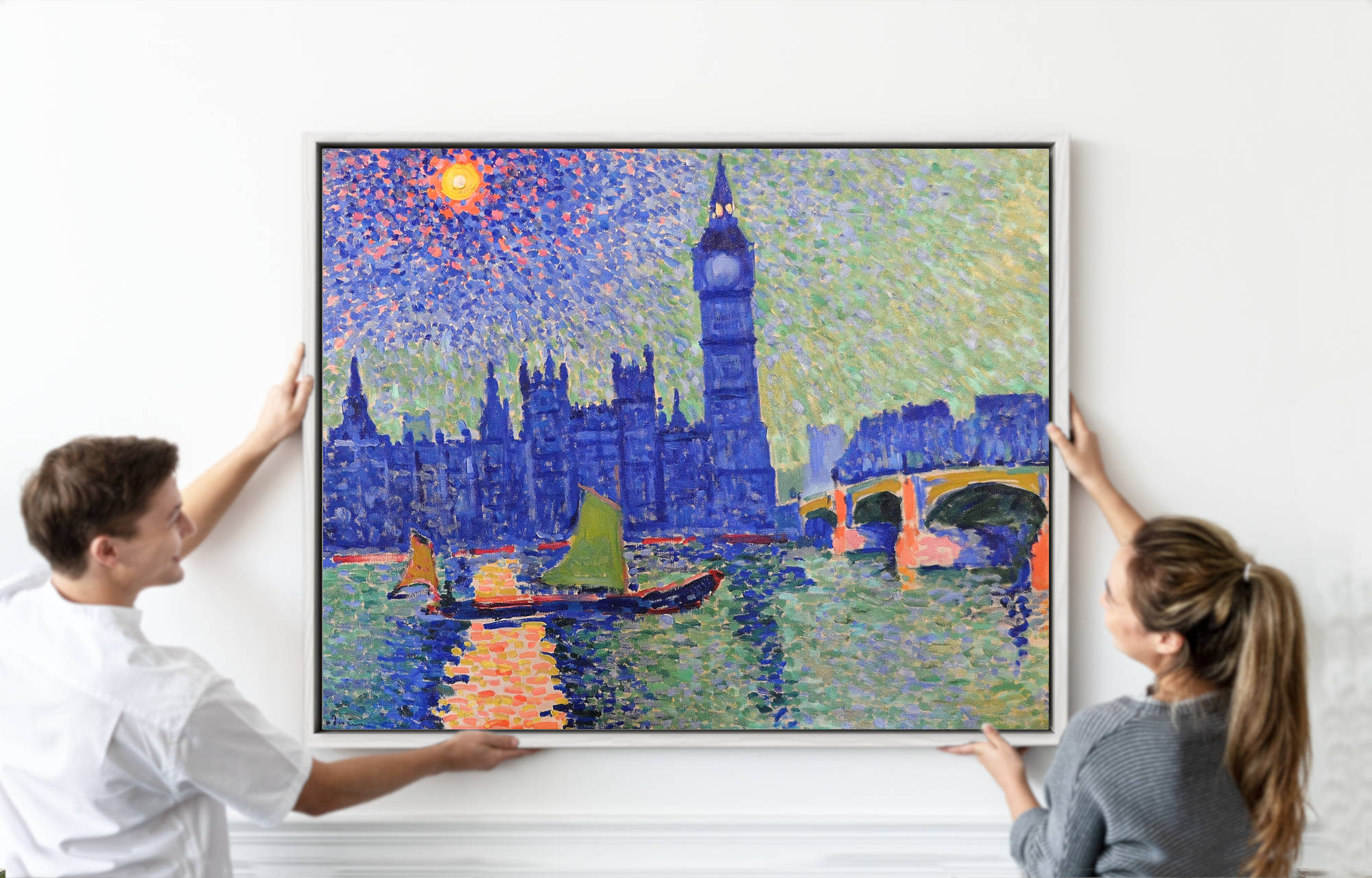
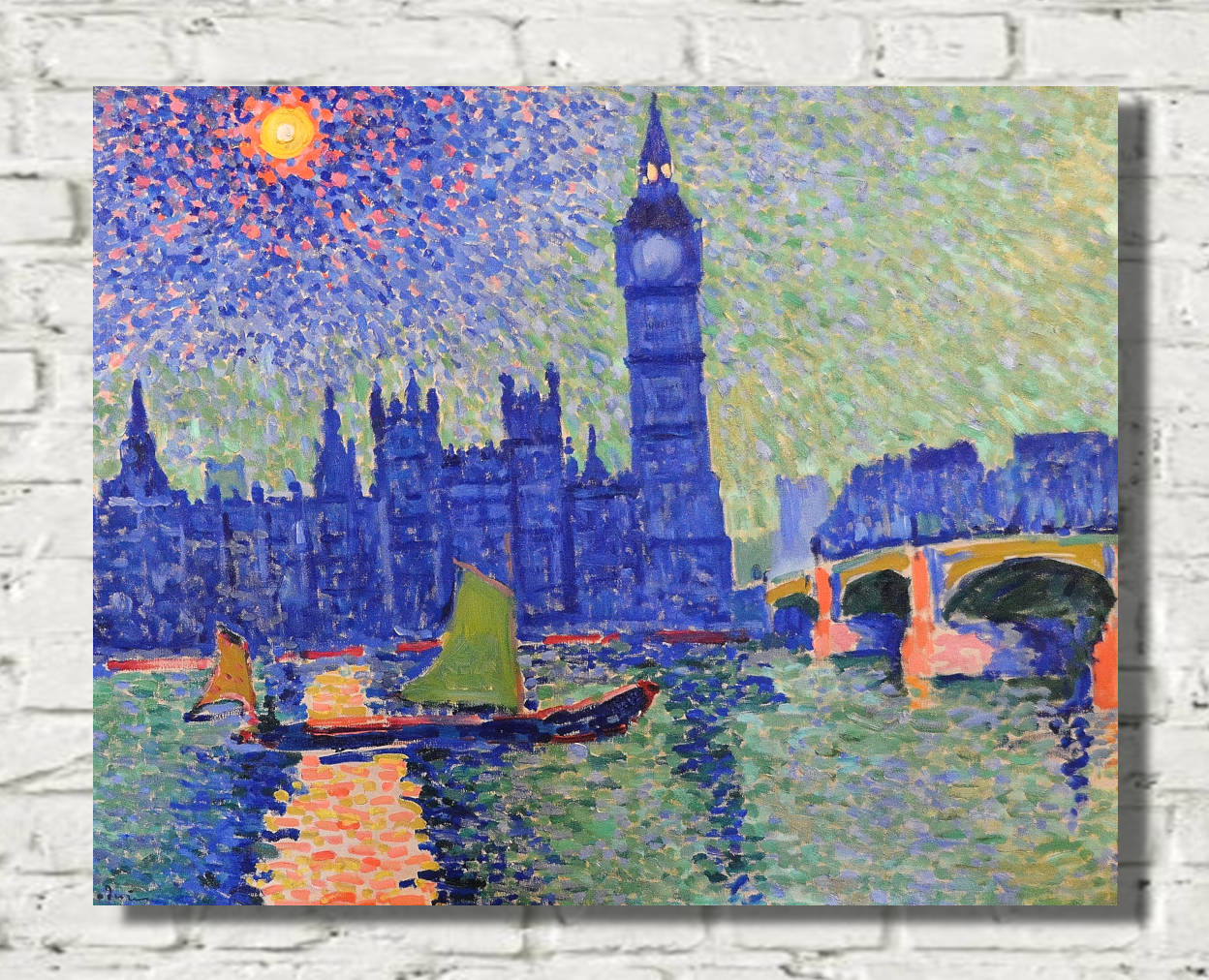
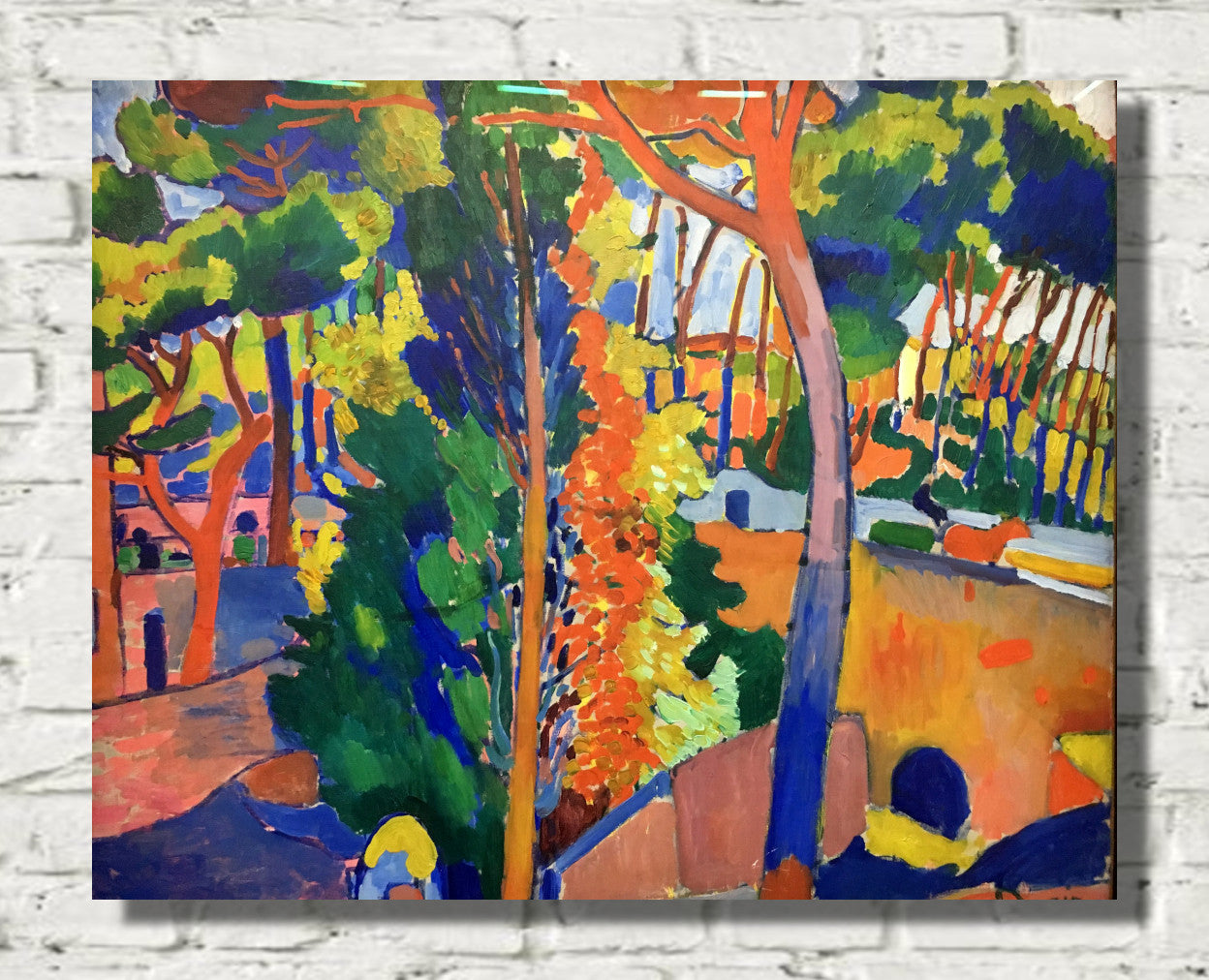
Derain subsequently applied Fauvist colour to landscapes at L'Estaque and to his celebrated series of London views.
His period as a committed Fauvist was relatively brief.
By around 1907–08 he became increasingly interested in greater structural order, Paul Cézanne and traditional European painting.
His colours became more restrained and his style changed considerably.
The paintings of 1905 therefore represent an exceptionally concentrated period of experimentation in which Derain helped redefine the role of colour in modern art.
About André Derain
André Derain (1880–1954) was a French painter, sculptor, printmaker and designer and one of the leading figures in the emergence of twentieth-century modernism.
Born in Chatou near Paris, Derain initially studied engineering while pursuing artistic training.
His friendship with Maurice de Vlaminck led to early experiments with powerful colour and vigorous brushwork. His subsequent collaboration with Henri Matisse placed him at the centre of the Fauvist movement.
The summer of 1905 at Collioure produced some of Derain's most radical landscapes and portraits.
He later painted important landscapes at L'Estaque and created his remarkable group of London views for the dealer Ambroise Vollard.
After the Fauvist period, Derain moved towards a more restrained and classical style influenced by Cézanne, earlier European painting and the Old Masters.
Although his career encompassed many different approaches, his Fauvist paintings remain among his most influential achievements.
The Original Madame Matisse
The original Madame Matisse au Kimono, also known as Woman with a Shawl, Madame Matisse in a Kimono, was painted in August 1905 during Derain's stay at Collioure.
The sitter is Amélie Matisse, wife of Henri Matisse.
Derain created the work in oil on canvas.
It measures approximately 80.9 × 65 cm.
The original is held in a private collection.
The painting has been recognised as one of Derain's most important Fauvist portraits and has appeared in major exhibitions examining the origins of Fauvism.
It was formerly placed on long-term loan to the National Gallery in London, where it was exhibited alongside works demonstrating the development of modern colour in French painting.
The painting was also featured in Vertigo of Color: Matisse, Derain, and the Origins of Fauvism, an exhibition devoted to the extraordinary artistic exchange between Matisse and Derain during the Collioure summer of 1905.
Christie's offered the work in New York in 2013, describing it as a major Fauvist portrait and emphasising its importance as a record of the collaboration between Derain and Matisse.
An André Derain Madame Matisse Print for Your Interior
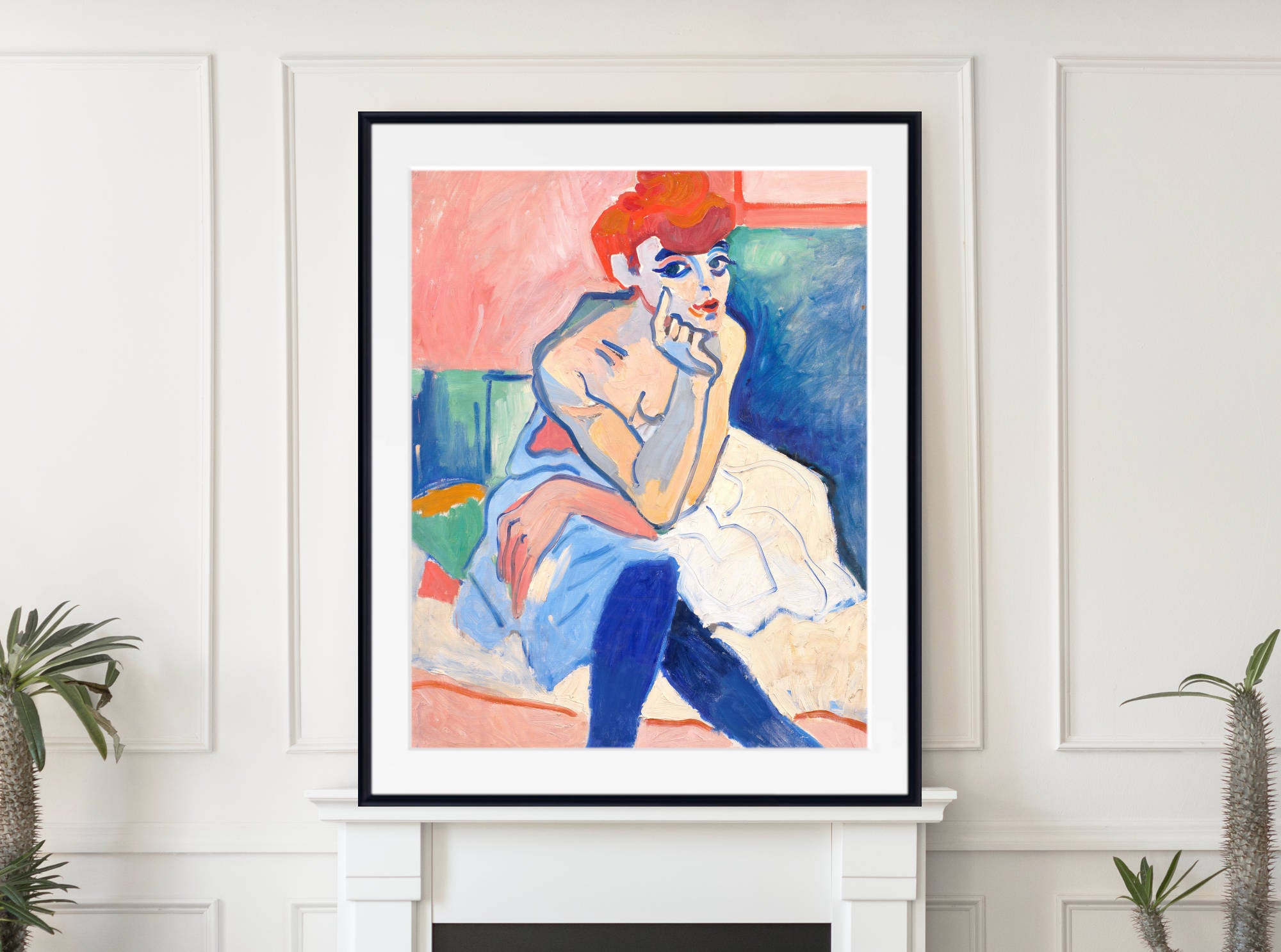
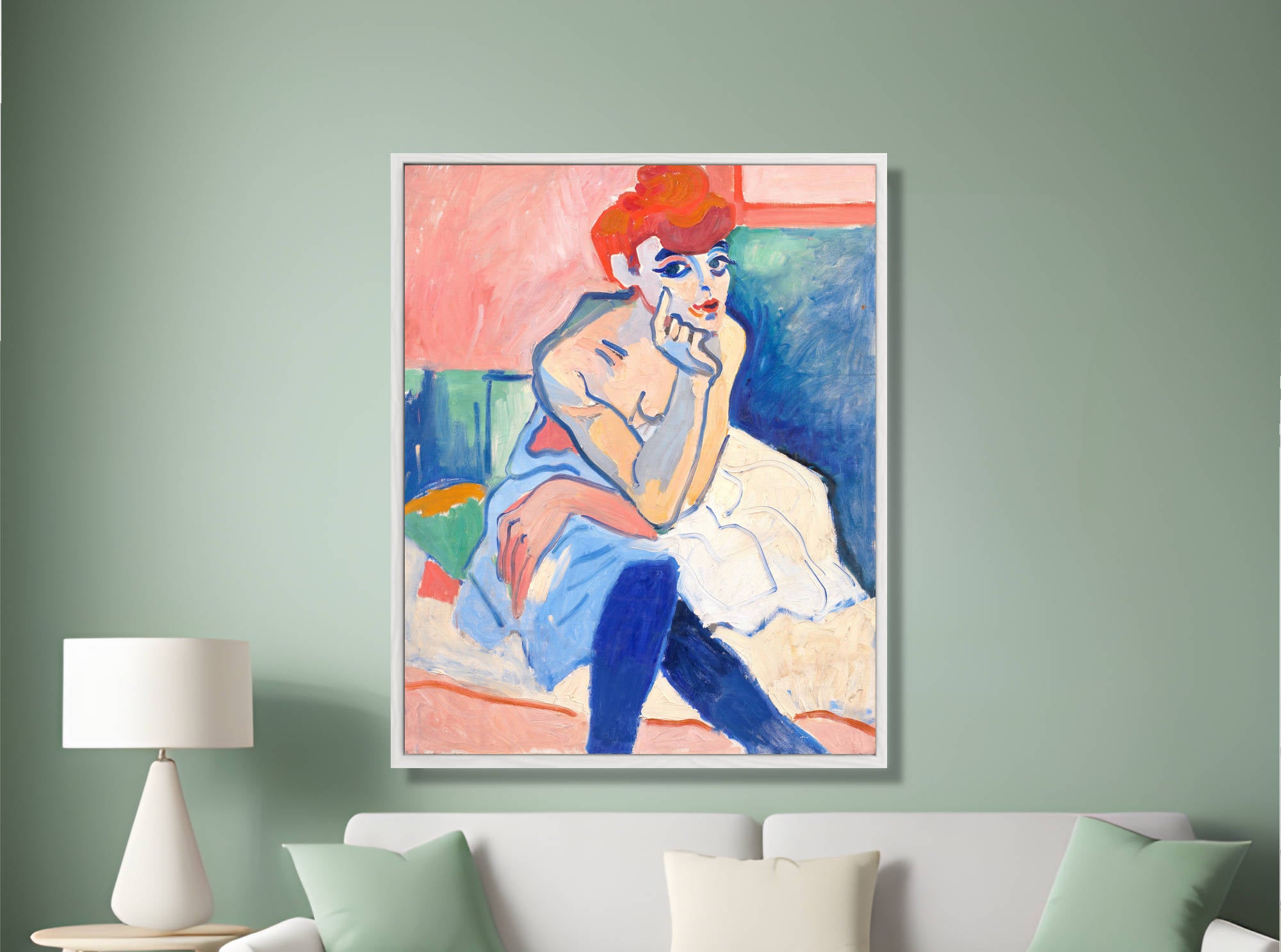
An André Derain Madame Matisse print combines striking portraiture with the intense colour and decorative character of Fauvism.
The strong vertical format makes it especially useful for walls where a landscape-format artwork would be difficult to accommodate.
The blue-and-white kimono, red fan, greens, oranges and surrounding background colours create a broad palette capable of interacting with many interior schemes.
Against white, cream, putty or pale grey walls, the Fauvist colours become particularly prominent.
The painting also works effectively with natural timber, contemporary furniture and Scandinavian-inspired interiors, where the decorative kimono pattern provides visual complexity against otherwise restrained surroundings.
Its figurative subject makes it suitable for living rooms, bedrooms, dressing areas, dining rooms, hallways and home offices.
For admirers of Fauvism, Matisse and Derain, however, the painting carries an additional historical appeal: it portrays a central member of the Matisse family during the extraordinary summer in which modern colour was being reinvented at Collioure.
All orders for unframed fine art prints and original paintings are dispatched within 2 working days of receipt of payment.
Orders for custom framed prints are dispatched within 4 working days.
All orders are fully tracked from dispatch to delivery at your home or business.
All print and original painting orders are fully insured against loss or damage in transit. We refund or replace any damaged or lost orders.
Buy with confidence - read what our satisfied customers have to say - Reviews
Fine art papers are printed without any additional white border Please let us know at the time of ordering if you would like a small additional white border.
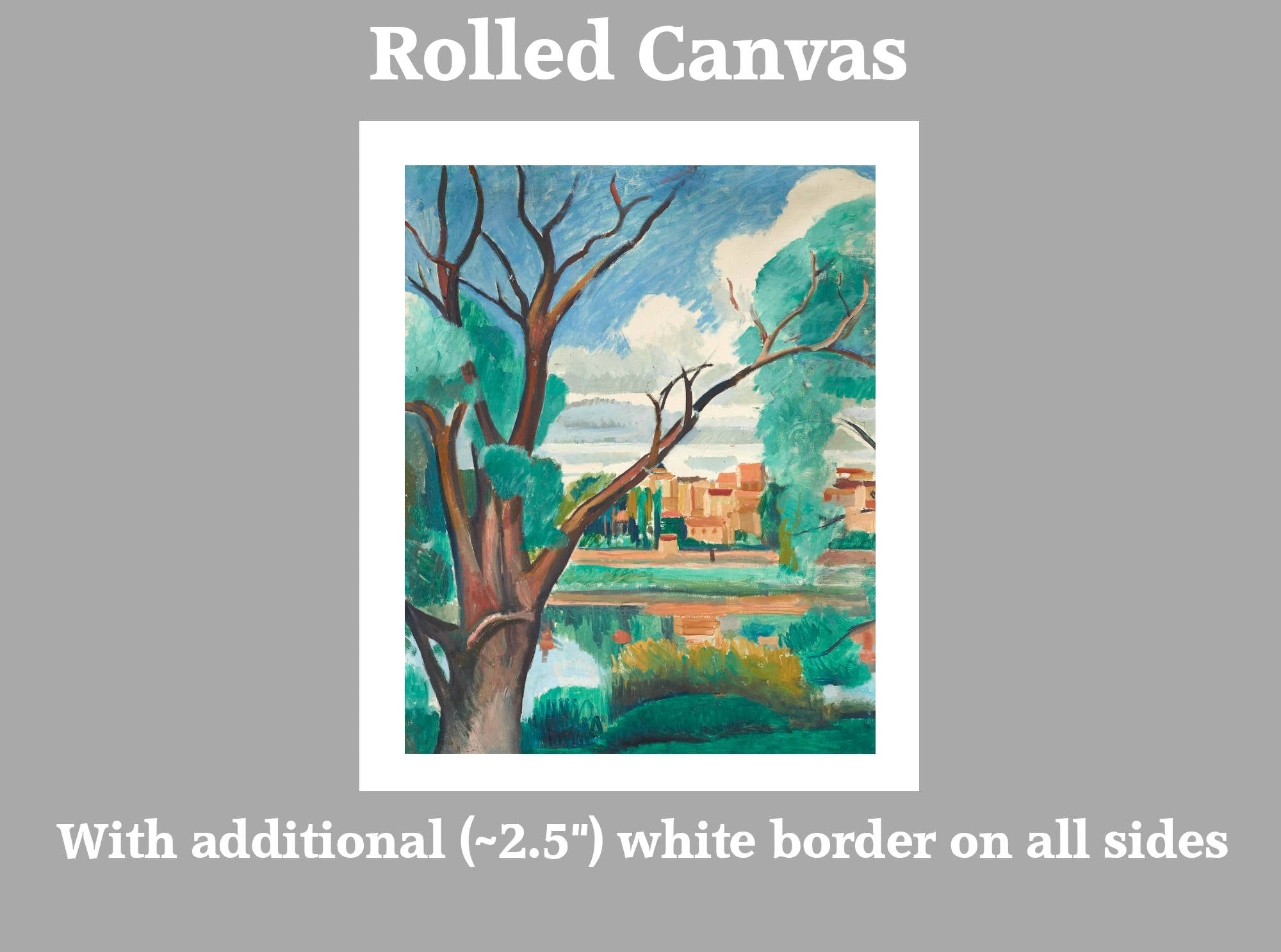
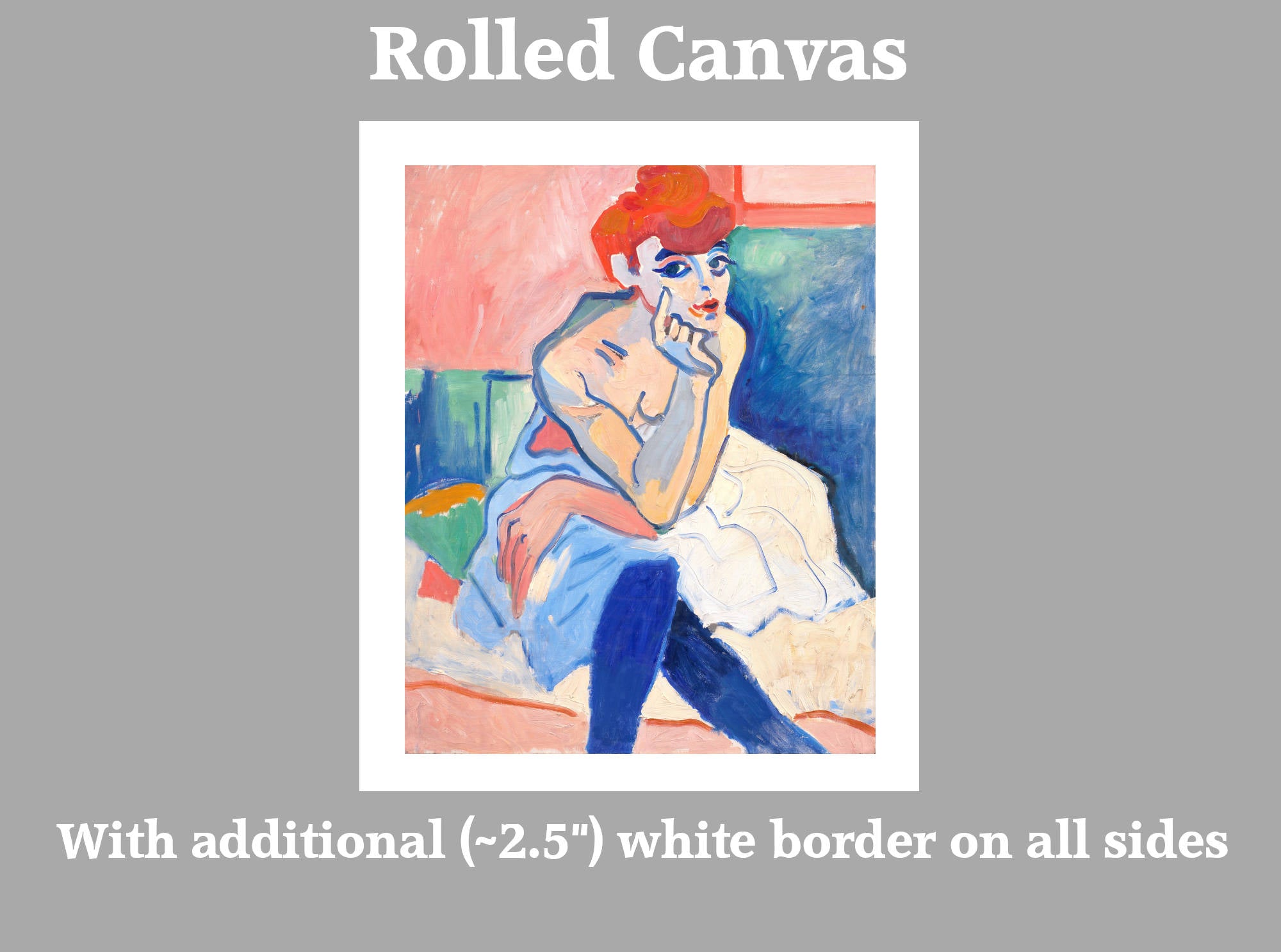
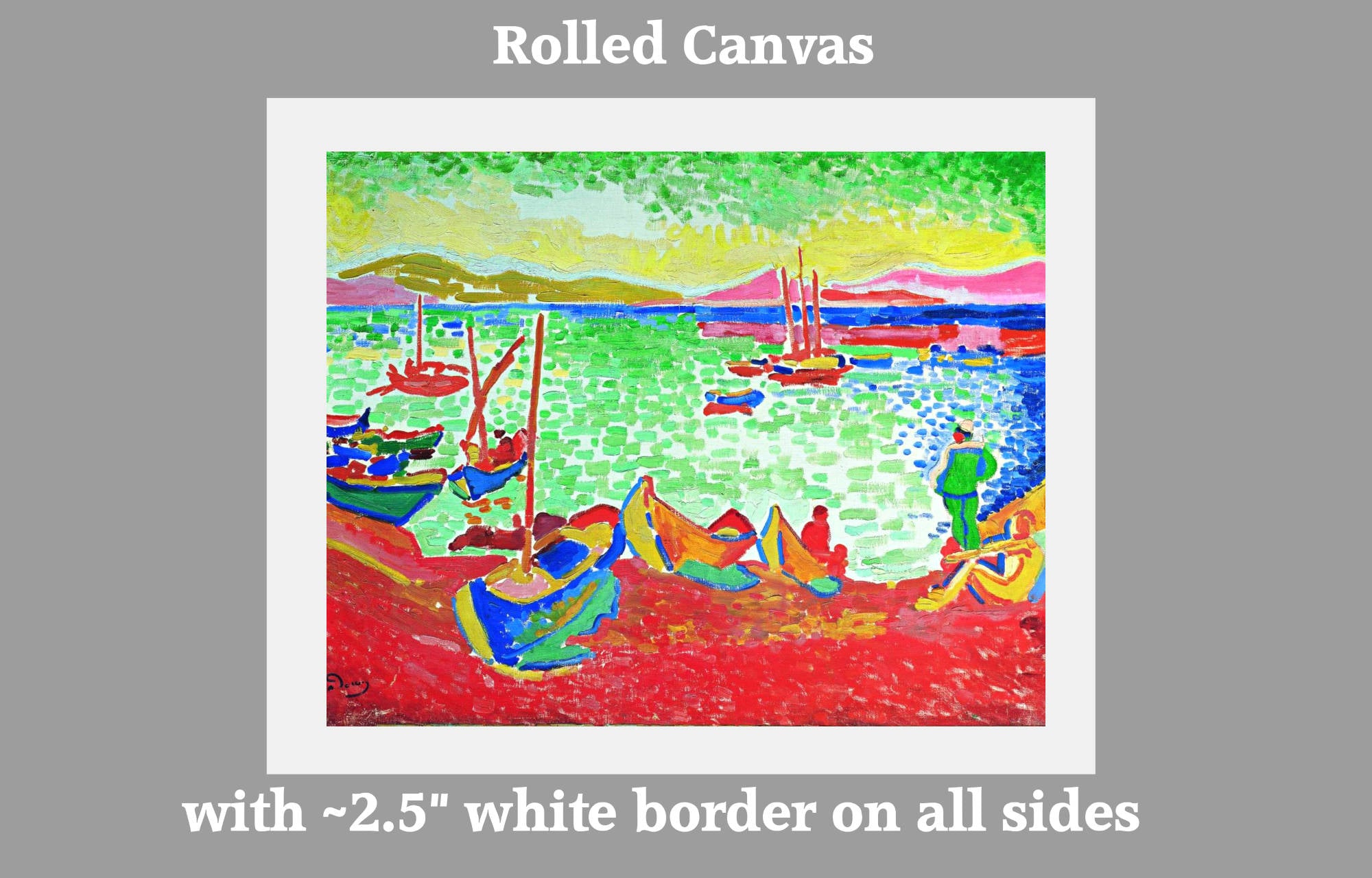
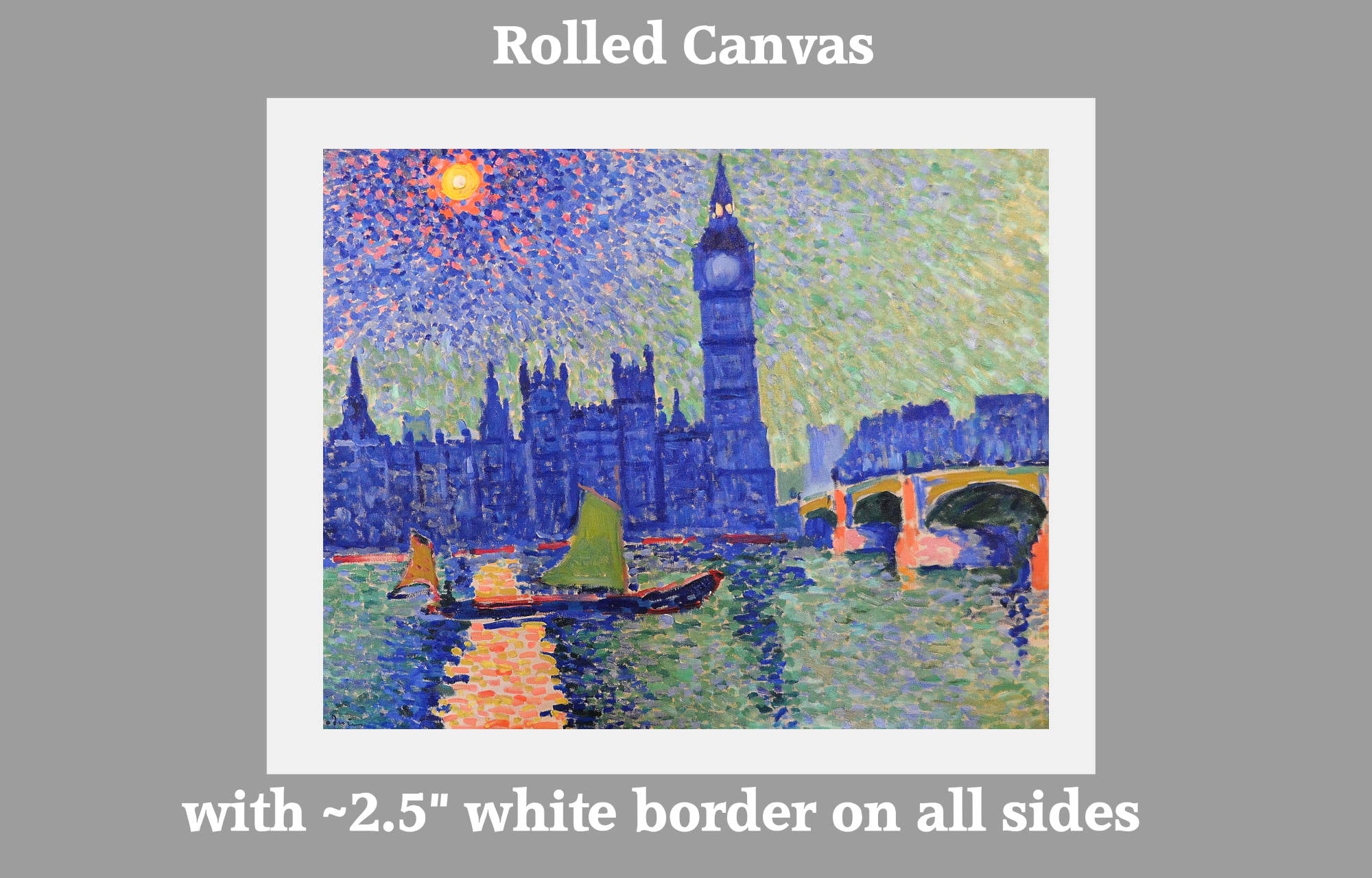
Rolled canvas options have an additional white border of approximately 2.5 inches (7cm) on all 4 sides to aid stretching.
Ready to hang canvas panels are stretched on 1.5 inch deep solid pine frames from sustainable forestry sources. The image is mirrored on all 4 sides to give an aesthetically pleasing finish.
Why not have us gift wrap your order and attach a personalised message to the recipient. Available for all orders. Each order is hand wrapped in high quality gift wrap with meatllic ribbon and bow. Your personalised message is printed on a card which is included with your order.
Have your hand wrapped gift delivered directly to the recipient.
Full tracking and insurance included with every order.
Please note design may vary depending upon availability
Just purchase the gift wrap option HERE
We have a wide range of frames in standard sizes and we also make custom size frames.
To order a framed print:
1. select the print size you would like along with the print materials (matte paper, fine art paper).
2. Add your print choice to the basket.
3. Choose from our range of frames
4. Select the same size as the print you have added to your basket. If the frame size you want is not listed please contact us
5. Choose from the mount or no-mount option
6. Add your frame choice to the basket
7. Proceed to checkout.
Why Choose GalleryThane?
- Printed and framed in-house
- Free UK delivery
- Free EU and USA delivery on orders over £200
- Tracking and insurance included in every order
- Fast 1-3 day dispatch
- Gift wrapping service available
- Gallery quality materials
- Sustainable, eco-friendly packaging
- Great customer support
Explore related collections
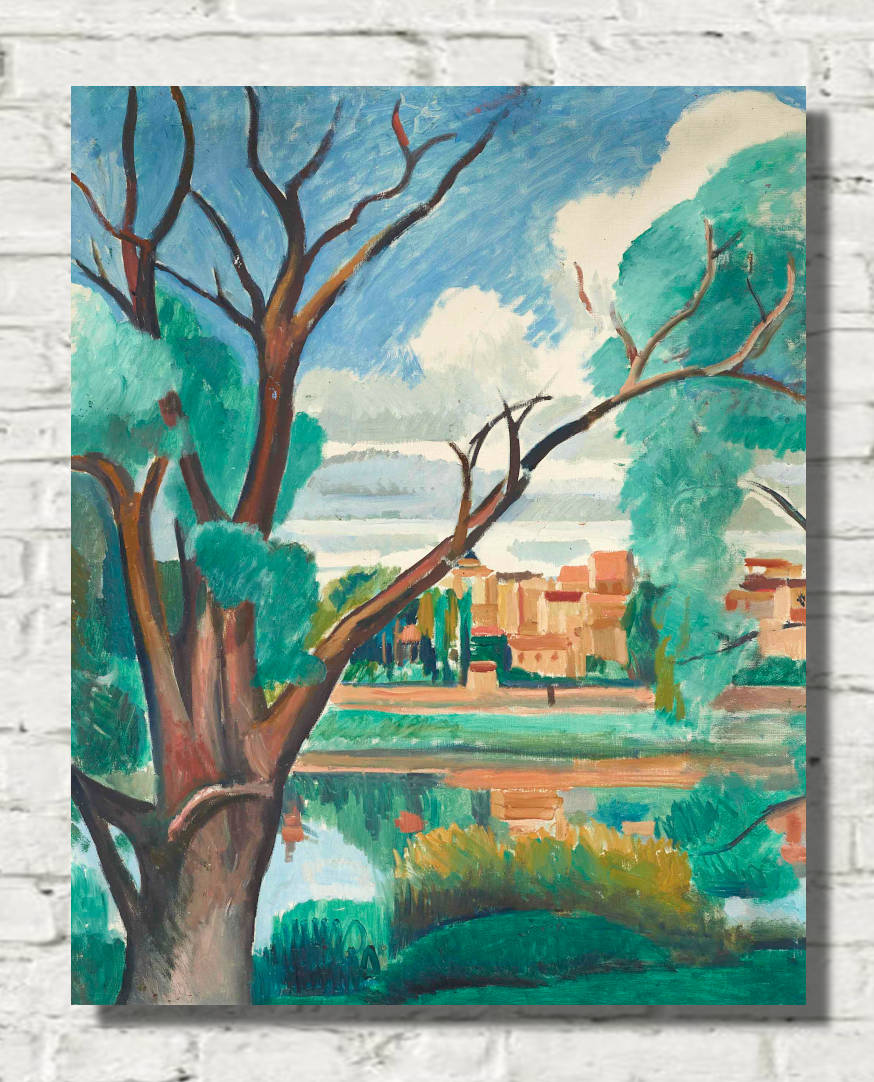
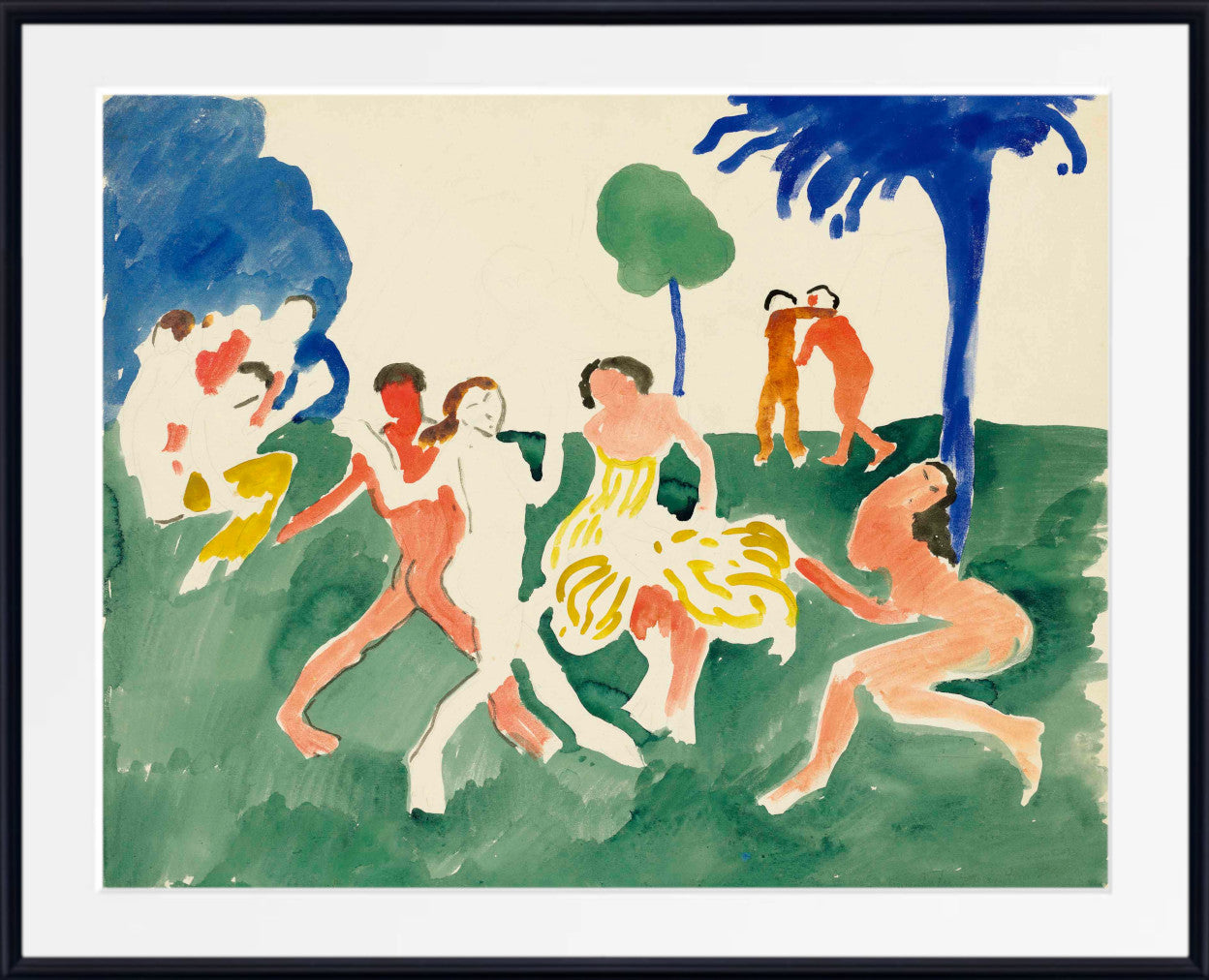
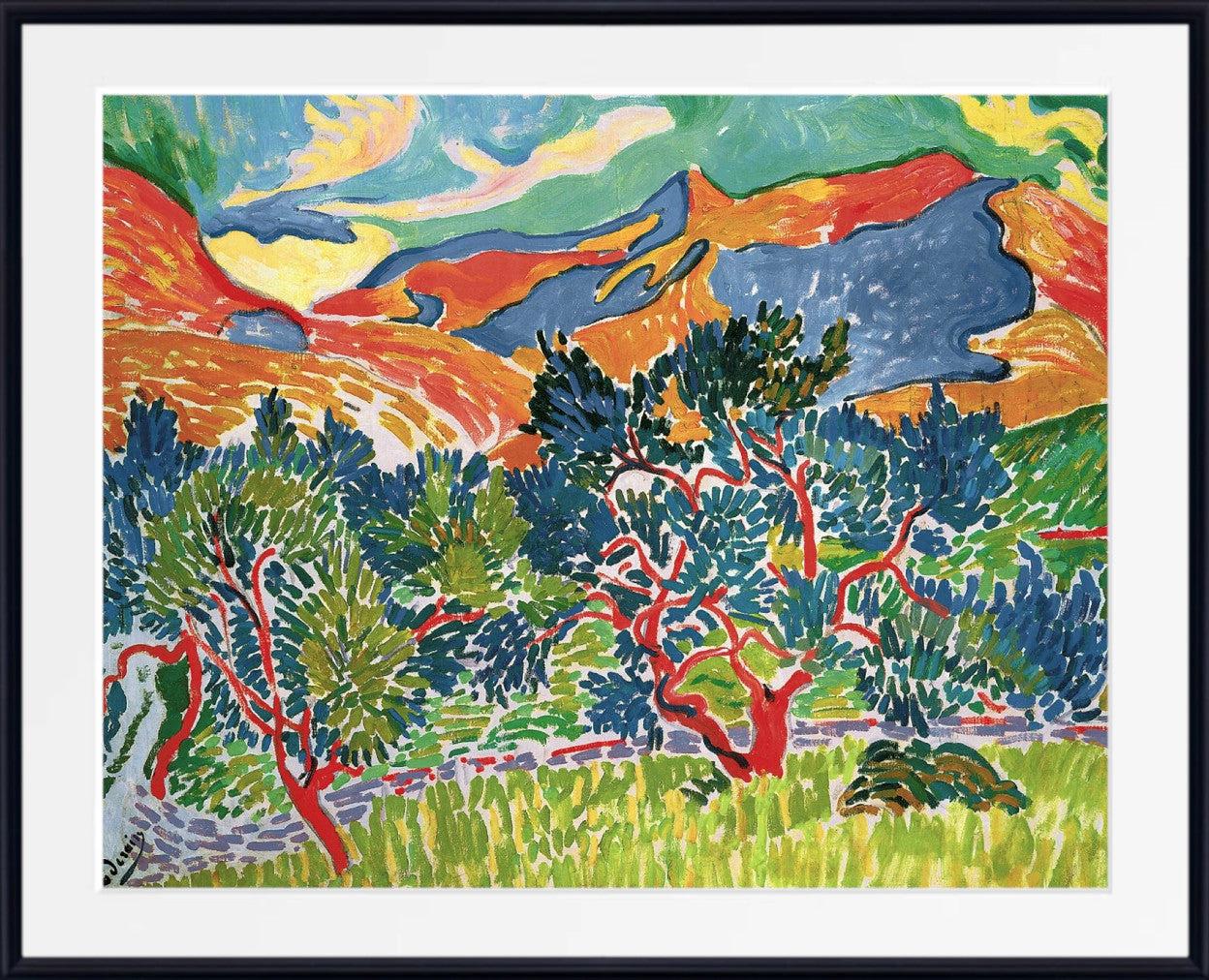
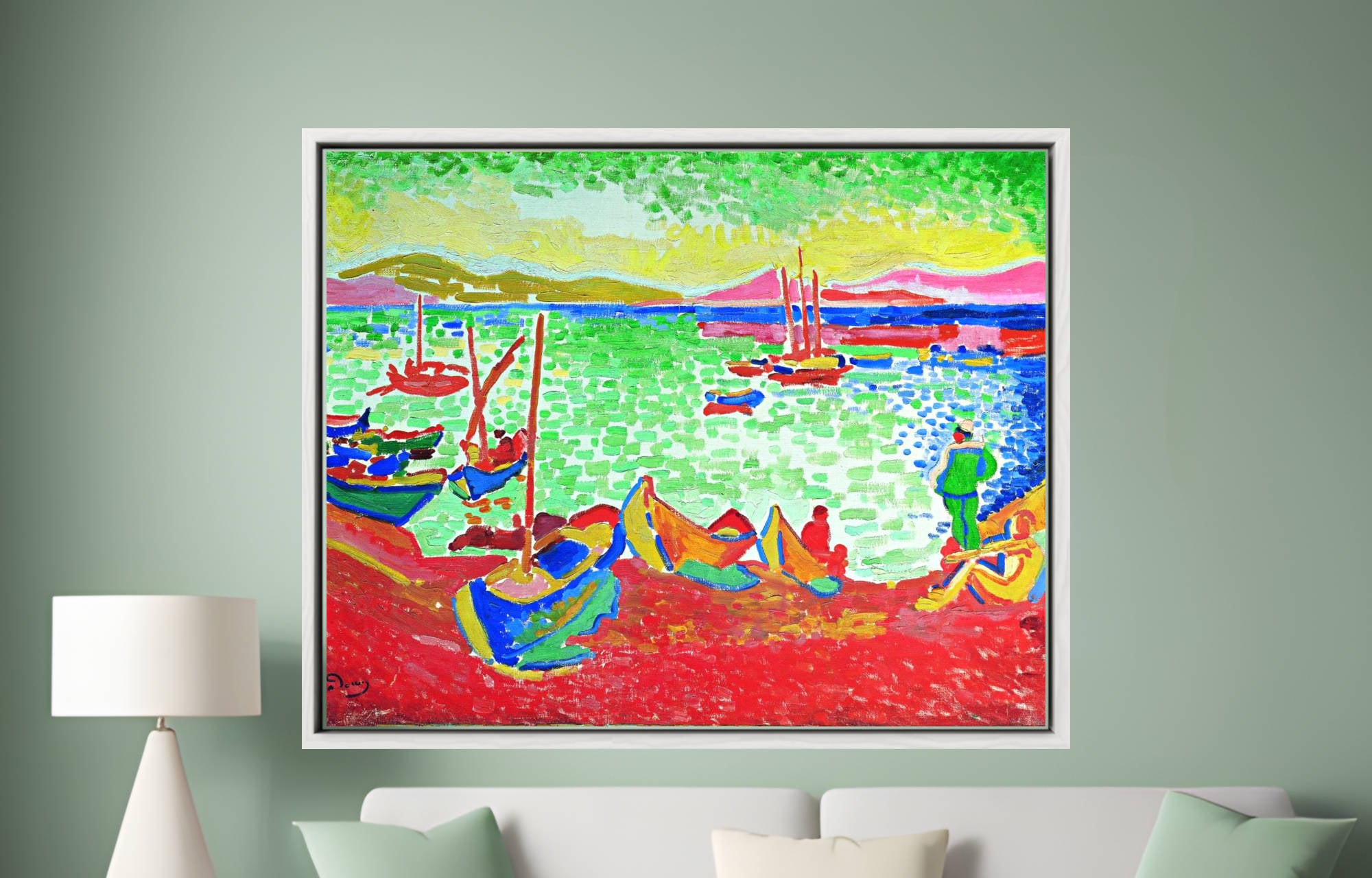
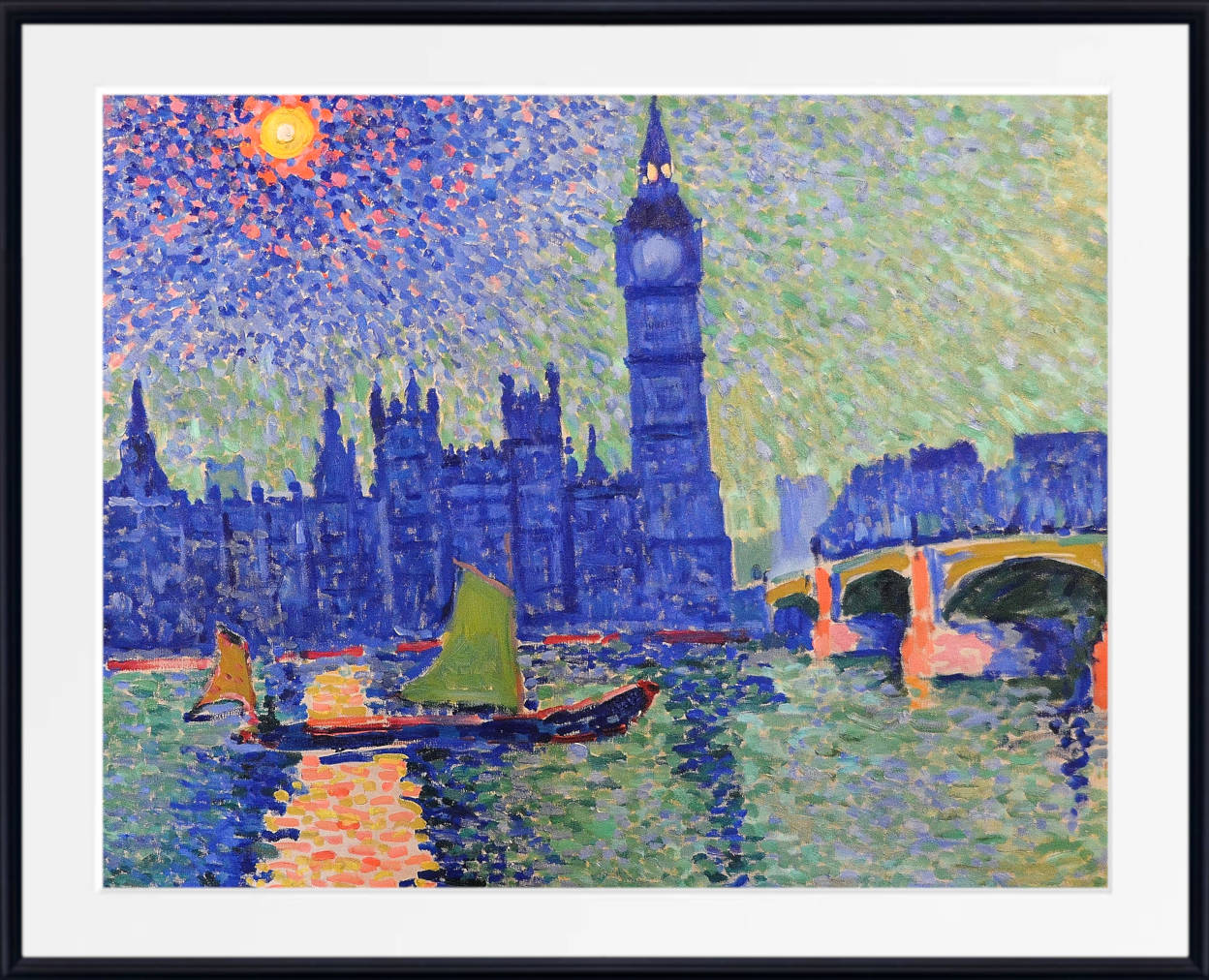
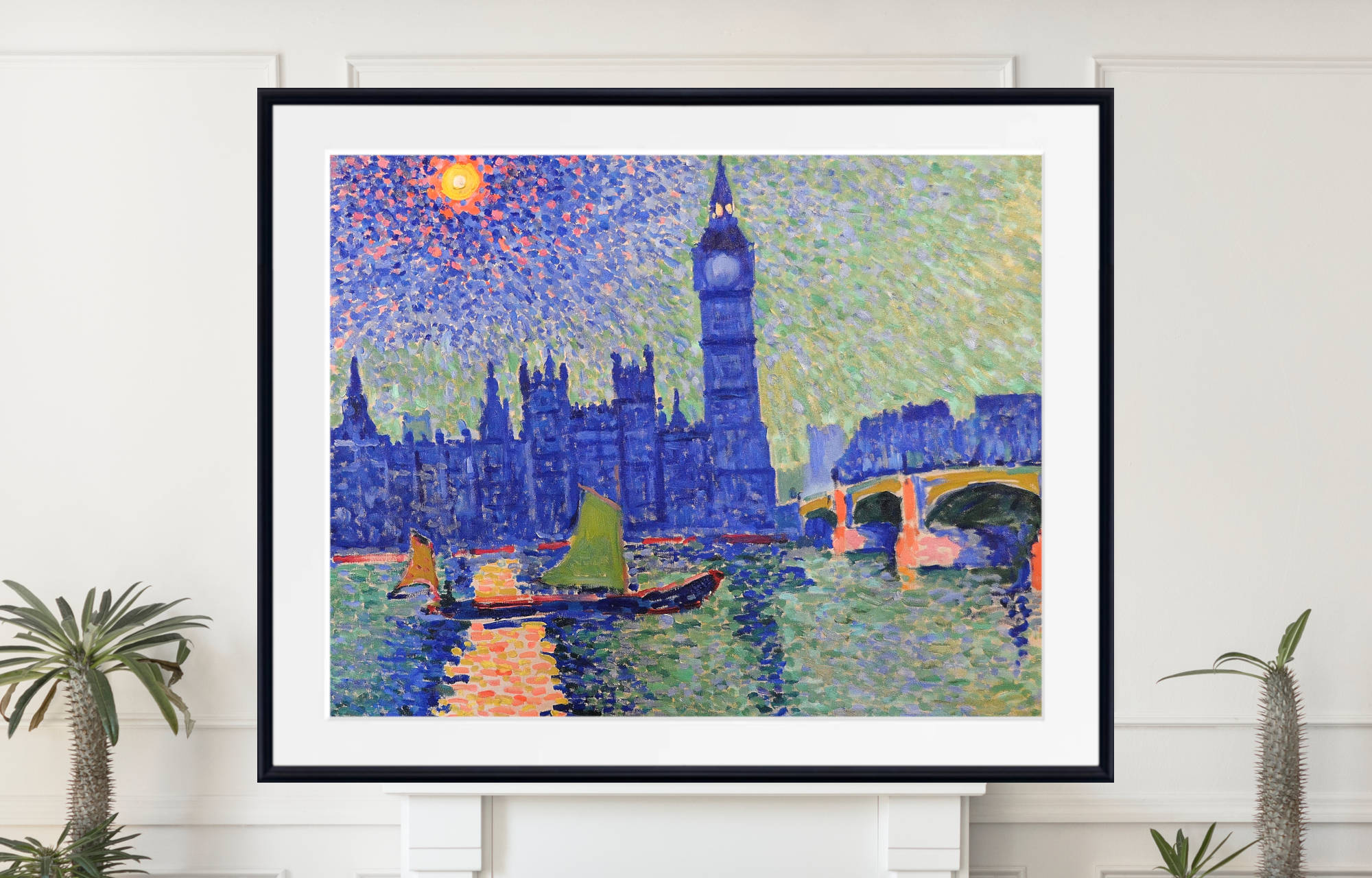

What makes our Prints and Canvas Panels so special

Latest Giclee Printing Technology
We have invested in the latest wide format print technology to produce museum quality giclee prints utilising the highest quality pigment inks to give outstanding colour reproduction.

Museum Quality Archival Fine Art Papers
We print on the finest quality fine art papers with textured, smooth and lustre finishes for prints which last a lifetime.
From aceo miniatures to 40x80 inch large format, every print has our lifetime quality guaranteee.

Solid Wood Frames, Cotton Canvas
All of the wood for our canvas panels and frames is responsibly sourced from manages forests. Our cotton canvas is completely seedless for the highest quality reproduction possible.

Have Your Gift Wrapped


Choose a Custom Frame
Popular Collections


EU Representative
Manufacturer
LucasAbstract t/a GalleryThane
15 Campion Way, Bingham NG13 8TR UK
sales@gallerythane.com
EU Authorised Representative
Westwood Sourcing
Fellenoordstraat 52, Unit 2.38
4811 TJ Breda, Netherlands
info@westwoodsourcing.com