


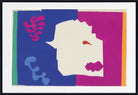
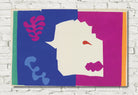
The Wolf (1947) (Jazz Folio) by Henri Matisse
Couldn't load pickup availability
Henri Matisse – The Wolf (1947) (Jazz Folio) Prints
Bring the bold colour and expressive simplicity of Henri Matisse’s celebrated Jazz portfolio into your home with a Henri Matisse The Wolf print. Published in 1947 as Plate VI of Jazz, The Wolf (Le Loup) transforms the suggestion of an animal’s head into a powerful arrangement of flat colour, sharp contours and simplified organic forms.
Available as fine art prints and canvas panels, The Wolf is a striking example of the visual language Matisse developed through his paper cut-outs. A large pale profile dominates the composition, set dramatically against saturated blue and magenta, while smaller red, pink and blue shapes suggest the eye, mouth and surrounding forms. The result is playful, mysterious and unmistakably modern.
Plate VI from Henri Matisse’s Jazz
The Wolf appears as Plate VI in Matisse’s famous Jazz portfolio, immediately following The Horse, The Rider and the Clown. Its original French title is Le Loup.
The work belongs to a sequence in which Matisse drew upon circus performers, animals, mythology, memory and imaginative subjects. Rather than illustrating these themes realistically, he reduced them to simplified shapes capable of communicating character and movement through colour alone.
In The Wolf, the animal is suggested rather than described in detail. The large pale form can be read as a stylised head or profile, with just a few carefully positioned shapes providing the visual clues needed to recognise the subject.
Painting Style
The Wolf Reduced to Essential Form
Matisse spent much of his career searching for ways to simplify a subject without losing its expressive character. The Wolf demonstrates how far he had taken this idea by the 1940s.
Traditional modelling, realistic fur and anatomical detail disappear completely. Instead, the identity of the wolf emerges from silhouette, colour and the relationship between a handful of forms. The pale central shape is immediately dominant, while a small red accent suggests an eye and a more complex magenta form defines the lower part of the face.
This reduction gives the image its visual strength. Rather than describing what a wolf looks like, Matisse communicates something more instinctive: presence, alertness and a slightly theatrical sense of character.
Drawing with Scissors
The designs for Jazz developed from Matisse’s revolutionary experiments with gouache-painted paper cut-outs. Sheets of paper were coated with brilliant colour, after which Matisse cut directly into them with scissors and arranged the resulting pieces into compositions.
He famously described this process as “drawing with scissors”. The technique allowed him to create line and colour simultaneously: every cut established both the contour of a shape and the coloured form itself.
In The Wolf, this method is particularly evident in the sharp, irregular profile of the central figure. The contours feel immediate and spontaneous, yet every shape has been positioned to create a carefully controlled visual balance.
Bold Colour and Graphic Contrast
Colour provides much of the drama in The Wolf. A deep blue field occupies one side of the composition, while brilliant magenta dominates the other. The pale central profile cuts forcefully across both, producing a strong contrast that immediately attracts the eye.
Additional bands of turquoise and warm orange frame the outer edges, while smaller pink, blue and red elements punctuate the larger colour fields. These accents prevent the composition from becoming static and help establish the sense of visual rhythm characteristic of Matisse’s late work.
The resulting design feels remarkably contemporary. Its simplified shapes and flat areas of colour anticipate the graphic clarity associated with later modern design while retaining the irregular, handmade character of Matisse’s cut-paper method.
The Spirit of Jazz
Although Matisse’s portfolio is titled Jazz, its twenty images do not simply depict jazz musicians or musical performances. The title instead reflects qualities of improvisation, variation, rhythm and unexpected contrast.
The Wolf embodies these qualities particularly well. Large shapes are countered by small accents, saturated colour is interrupted by broad pale areas and an apparently simple image becomes increasingly complex the longer it is viewed.
Like a short musical phrase, the composition achieves its effect through economy. Nothing is unnecessary, yet the interaction of a few carefully chosen elements creates a memorable and expressive whole.
From Cut-Paper Design to the 1947 Jazz Portfolio
Matisse developed the compositions that became Jazz during the 1940s, when paper cut-outs were becoming an increasingly important part of his artistic practice. The completed portfolio was published in Paris in 1947 by the influential art publisher Tériade.
The twenty colour plates were accompanied by pages of Matisse’s handwritten text, turning the publication into a complete artist’s book rather than a conventional series of reproductions.
For the published edition, the brilliant colours of Matisse’s original cut-paper designs were reproduced using the pochoir stencil process. This method helped preserve the intense, flat areas of colour that are so important to the visual impact of works such as The Wolf.
The Wolf Wall Art for Modern Interiors
A Henri Matisse The Wolf wall art print makes a particularly strong choice for contemporary interiors. Its combination of deep blue, magenta, turquoise and warm orange introduces vivid colour, while the large pale central form prevents the composition from feeling visually overcrowded.
The work is especially well suited to Scandinavian, contemporary, eclectic and mid-century modern interiors. Against white, cream, putty or other neutral walls, its saturated colours become an immediate focal point.
Displayed above a sofa, console table, sideboard or bed, a Matisse Jazz print adds both graphic impact and art-historical character. It can also be combined with The Horse, The Rider and the Clown, Icarus and the three Lagoon compositions to create a coordinated gallery wall based on Matisse’s Jazz portfolio.
About Henri Matisse
Henri Matisse (1869–1954) was a French painter, draughtsman, sculptor and printmaker and one of the most influential figures in twentieth-century modern art. His long career was characterised by a continual search for greater expressive power through colour, line and simplified form.
Matisse first achieved international recognition as a leading figure of Fauvism. His early paintings rejected conventional naturalistic colour in favour of intense reds, greens, blues and yellows selected for their emotional and compositional effects.
Over subsequent decades, Matisse increasingly simplified his visual language. Interiors, portraits, landscapes and figures were transformed into flowing contours and broad areas of colour, preparing the way for the radical cut-paper compositions of his final years.
During the 1940s, reduced mobility encouraged Matisse to work extensively with painted paper and scissors. What began as a practical method became one of the greatest innovations of his career, allowing him to unite drawing, colour and composition with extraordinary directness.
The Jazz portfolio marks a crucial stage in this development. Works including The Wolf, Icarus and the Lagoon sequence demonstrate how Matisse could communicate movement, personality and emotion through remarkably simple combinations of colour and shape.
Today, Henri Matisse prints remain popular with collectors and interior designers for their combination of major art-historical importance, brilliant colour and enduring modernity.
Frequently Asked Questions
What is The Wolf by Henri Matisse?
The Wolf is one of the colourful compositions included in Henri Matisse’s celebrated Jazz portfolio. The work reduces the suggestion of a wolf’s head to a striking combination of simplified shapes and intense colour.
What is the French title of The Wolf?
The original French title is Le Loup, which translates directly as The Wolf.
What plate number is The Wolf in Jazz?
The Wolf is Plate VI in the twenty-plate Jazz portfolio. It appears immediately after The Horse, The Rider and the Clown, which is Plate V.
When was Matisse’s The Wolf published?
The Wolf was published in 1947 as part of Matisse’s Jazz artist’s book, produced in Paris by Tériade.
How did Henri Matisse create The Wolf?
Matisse developed the composition using sheets of paper painted with gouache and cut into shapes with scissors. The design was then reproduced for the published Jazz portfolio using the pochoir stencil process.
What does The Wolf depict?
The composition suggests a stylised wolf’s head or profile rather than presenting a realistic animal portrait. Matisse uses a large pale silhouette together with small coloured forms to evoke features such as the eye and mouth.
What style of art is The Wolf?
The Wolf belongs to Matisse’s late modernist cut-out period. It combines figurative suggestion with abstraction, flat colour, simplified contours and strong graphic contrast.
Why is colour important in The Wolf?
The strong contrast between blue, magenta and the pale central form creates much of the image’s visual impact. Smaller turquoise, orange, red and pink accents provide rhythm and help balance the larger areas of colour.
What interiors suit a Henri Matisse The Wolf print?
The Wolf works particularly well in contemporary, Scandinavian, mid-century modern and eclectic interiors. Its bold colour and uncluttered composition make it especially effective against neutral walls.
Is The Wolf available as a canvas panel?
GalleryThane offers The Wolf as fine art prints and canvas panels, providing different ways to display this distinctive work from Henri Matisse’s celebrated Jazz portfolio.
All orders for unframed fine art prints and original paintings are dispatched within 2 working days of receipt of payment.
Orders for custom framed prints are dispatched within 4 working days.
All orders are fully tracked from dispatch to delivery at your home or business.
All print and original painting orders are fully insured against loss or damage in transit. We refund or replace any damaged or lost orders.
Buy with confidence - read what our satisfied customers have to say - Reviews
Fine art papers are printed without any additional white border Please let us know at the time of ordering if you would like a small additional white border.
Rolled canvas options have an additional white border of approximately 2.5 inches (7cm) on all 4 sides to aid stretching.
Ready to hang canvas panels are stretched on 1.5 inch deep solid pine frames from sustainable forestry sources. The image is mirrored on all 4 sides to give an aesthetically pleasing finish.
Why not have us gift wrap your order and attach a personalised message to the recipient. Available for all orders. Each order is hand wrapped in high quality gift wrap with meatllic ribbon and bow. Your personalised message is printed on a card which is included with your order.
Have your hand wrapped gift delivered directly to the recipient.
Full tracking and insurance included with every order.
Please note design may vary depending upon availability
Just purchase the gift wrap option HERE
Why Choose GalleryThane?
- Printed and framed in-house
- Free UK delivery
- Free EU an USA delivery on orders over £200
- Tracking and insurance included in every order
- Fast 1-3 day dispatch
- Gift wrapping service available
- Gallery quality materials
- Sustainable, eco-friendly packaging
- Great customer support
What makes our Prints and Canvas Panels so special

Latest Giclee Printing Technology
We have invested in the latest wide format print technology to produce museum quality giclee prints utilising the highest quality pigment inks to give outstanding colour reproduction.

Museum Quality Archival Fine Art Papers
We print on the finest quality fine art papers with textured, smooth and lustre finishes for prints which last a lifetime.
From aceo miniatures to 40x80 inch large format, every print has our lifetime quality guaranteee.

Solid Wood Frames, Cotton Canvas
All of the wood for our canvas panels and frames is responsibly sourced from manages forests. Our cotton canvas is completely seedless for the highest quality reproduction possible.
Multi-column

Have Your Gift Wrapped


