


The Swimmer in the Tank (1947) (Jazz Folio) by Henri Matisse
Couldn't load pickup availability
Henri Matisse – The Swimmer in the Tank (1947) Prints
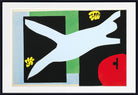
Bring the bold colour and fluid movement of Henri Matisse’s celebrated Jazz portfolio into your home with a Henri Matisse The Swimmer in the Tank print. Published in 1947 as Plate XII of Jazz, The Swimmer in the Tank (La Nageuse dans l’aquarium) transforms the human figure into a sweeping pale-blue silhouette moving across a dramatic arrangement of black, green, red and yellow forms.
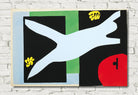
Available as fine art prints and canvas panels, this striking composition is a superb example of Matisse’s late cut-paper technique. The elongated swimmer appears almost weightless, gliding through a highly simplified environment in which colour, shape and negative space create the sensation of movement through water.
Plate XII from Henri Matisse’s Jazz
The Swimmer in the Tank appears as Plate XII in Matisse’s landmark Jazz portfolio. Its French title, La Nageuse dans l’aquarium, translates as The Swimmer in the Tank or The Swimmer in the Aquarium.
The composition belongs to the middle section of the portfolio, following The Codomas and preceding The Sword Swallower. Like many works in Jazz, it transforms a recognisable subject into a remarkably economical arrangement of colour and form.
The swimmer stretches diagonally across the composition, her body reduced to a single flowing silhouette. Matisse requires very little anatomical detail to communicate the action: the direction of the limbs and the elongated curve of the figure immediately create the sensation of a body moving through water.
Painting Style
Movement Reduced to Pure Shape
Matisse had spent decades simplifying the human figure, but his paper cut-outs allowed him to take that process further than ever before. In The Swimmer in the Tank, the figure is no longer modelled with light and shadow. Instead, its presence is created almost entirely by silhouette.
The swimmer’s extended arms and legs create a strong horizontal rhythm, while the irregular curves of the body prevent the composition from feeling static. The pale-blue figure seems to float across the darker background, giving the image an immediate sense of motion.
This ability to communicate physical movement with such limited means is one of the great achievements of Matisse’s late work. The figure is simple, yet the action is unmistakable.
Drawing with Scissors
The compositions for Jazz developed from Matisse’s experiments with gouache-painted paper cut-outs. Sheets of paper were painted in brilliant colours before Matisse cut directly into them with scissors and arranged the resulting shapes into compositions.
He famously described this process as “drawing with scissors”. Rather than separating line from colour, each cut created both at once: the edge formed the contour while the paper itself supplied the colour.
In The Swimmer in the Tank, this approach gives the figure its wonderfully fluid character. The continuous curves of the swimmer feel spontaneous, but the surrounding shapes are carefully placed to balance and contain that movement.
Colour and Contrast
The composition is built from a small number of strong colour relationships. Large black areas provide visual depth and drama, while green and pale blue introduce a cooler, aquatic quality. A brilliant red form in the lower right adds warmth and weight, and smaller yellow motifs act as vivid accents.
The pale-blue swimmer stands out clearly against the black ground, while the green central section breaks the composition into contrasting zones. These colour changes help suggest different areas of space without relying on conventional perspective.
The result is highly graphic yet never rigid. Matisse allows irregular edges and asymmetrical forms to keep the composition lively and organic.
The Aquarium as an Abstract Space
Although the title refers to a swimmer in a tank or aquarium, Matisse does not attempt to describe the setting realistically. There is no conventional pool edge, water surface or architectural space. Instead, the environment is constructed from flat areas of colour.
The swimmer appears to pass through these zones almost as though moving between different currents or depths. The black fields create a strong surrounding space, while green, blue and red shapes interrupt and redirect the eye.
This transformation of a recognisable scene into an abstract visual experience is characteristic of Matisse’s mature art. The subject remains understandable, but colour and form become equally important.
The Spirit of Jazz
Matisse’s Jazz portfolio was published in Paris in 1947 by Tériade and contained twenty colour plates accompanied by the artist’s handwritten text. Although the title suggests music, the images range across circus performers, swimmers, mythology, memory and imaginative subjects.
The connection with jazz lies more deeply in the qualities of rhythm, improvisation and variation that structure the portfolio. Forms repeat and change, colours respond to one another, and apparently spontaneous shapes are held together by careful composition.
The Swimmer in the Tank expresses this idea particularly effectively. The extended figure provides a strong visual phrase, while the surrounding colours create contrasting beats and pauses across the image.
The Swimmer in the Tank Wall Art for Modern Interiors
A Henri Matisse The Swimmer in the Tank wall art print makes a striking addition to contemporary interiors. Its combination of black, pale blue, green, red and yellow provides strong colour while the simplified composition prevents the image from feeling overly complicated.
It works especially well in Scandinavian, contemporary, mid-century modern and eclectic rooms. Against white, cream, putty or other neutral walls, the strong colour contrasts create an immediate focal point.
Displayed above a sofa, console table, sideboard or bed, a Matisse Jazz print introduces movement and modernist character. It can also be grouped with Icarus, The Wolf, The Horse, The Rider and the Clown or the Lagoon series to create a coordinated gallery wall based on Matisse’s Jazz portfolio.
About Henri Matisse
Henri Matisse (1869–1954) was a French painter, draughtsman, sculptor and printmaker whose extraordinary use of colour and simplified form made him one of the most influential figures in twentieth-century modern art.
Matisse first achieved international recognition as the leading figure associated with Fauvism. His early paintings rejected conventional naturalistic colour in favour of intense reds, blues, greens and yellows chosen for their expressive and compositional power.
Throughout his career, he continually simplified his visual language. Portraits, interiors, landscapes and figures became increasingly dependent on flowing contours, broad areas of colour and decorative rhythm.
During the 1940s, reduced mobility encouraged Matisse to work extensively with painted paper and scissors. What began as a practical method became one of the most innovative phases of his career, allowing him to unite colour, drawing and composition with remarkable directness.
The Jazz portfolio represents a crucial stage in this development. Works such as The Swimmer in the Tank, Icarus and the Lagoon series helped establish the visual language that would culminate in the monumental cut-outs of Matisse’s final years.
Today, Henri Matisse prints remain popular with collectors and interior designers for their combination of art-historical importance, brilliant colour and enduring modern appeal.
Frequently Asked Questions
What is The Swimmer in the Tank by Henri Matisse?
The Swimmer in the Tank is one of the colourful works included in Henri Matisse’s celebrated Jazz portfolio. It depicts a simplified swimmer moving across a bold arrangement of flat coloured shapes.
What is the French title of The Swimmer in the Tank?
The French title is La Nageuse dans l’aquarium. It is also sometimes translated as The Swimmer in the Aquarium.
What plate number is The Swimmer in the Tank in Jazz?
The Swimmer in the Tank is Plate XII of the twenty colour plates in Matisse’s Jazz portfolio.
When was The Swimmer in the Tank published?
The work was published in 1947 as part of the Jazz portfolio produced in Paris by Tériade.
How did Henri Matisse create The Swimmer in the Tank?
Matisse developed the design using sheets of paper painted with gouache and cut into shapes with scissors. The composition was then reproduced for the published Jazz portfolio.
What does The Swimmer in the Tank depict?
The composition shows a swimmer reduced to an elongated pale-blue silhouette moving through an abstract environment of black, green, red and yellow forms.
What style of art is The Swimmer in the Tank?
The work belongs to Matisse’s late modernist cut-out period. It combines figurative imagery with abstraction, flat colour, simplified contours and a strong emphasis on movement and visual rhythm.
Why is colour important in The Swimmer in the Tank?
Matisse uses colour to organise the composition rather than to reproduce natural appearances. The pale-blue swimmer contrasts dramatically with the black ground, while green, red and yellow create additional visual energy and balance.
What interiors suit a Henri Matisse Swimmer in the Tank print?
The work is especially well suited to contemporary, Scandinavian, mid-century modern and eclectic interiors. Its bold graphic design can create a strong focal point against neutral walls while complementing colourful modern furnishings.
Is The Swimmer in the Tank available as a canvas panel?
GalleryThane offers The Swimmer in the Tank as fine art prints and canvas panels, providing different ways to display this distinctive work from Henri Matisse’s celebrated Jazz portfolio.
All orders for unframed fine art prints and original paintings are dispatched within 2 working days of receipt of payment.
Orders for custom framed prints are dispatched within 4 working days.
All orders are fully tracked from dispatch to delivery at your home or business.
All print and original painting orders are fully insured against loss or damage in transit. We refund or replace any damaged or lost orders.
Buy with confidence - read what our satisfied customers have to say - Reviews
Fine art papers are printed without any additional white border Please let us know at the time of ordering if you would like a small additional white border.
Rolled canvas options have an additional white border of approximately 2.5 inches (7cm) on all 4 sides to aid stretching.
Ready to hang canvas panels are stretched on 1.5 inch deep solid pine frames from sustainable forestry sources. The image is mirrored on all 4 sides to give an aesthetically pleasing finish.
Why not have us gift wrap your order and attach a personalised message to the recipient. Available for all orders. Each order is hand wrapped in high quality gift wrap with meatllic ribbon and bow. Your personalised message is printed on a card which is included with your order.
Have your hand wrapped gift delivered directly to the recipient.
Full tracking and insurance included with every order.
Please note design may vary depending upon availability
Just purchase the gift wrap option HERE
Why Choose GalleryThane?
- Printed and framed in-house
- Free UK delivery
- Free EU an USA delivery on orders over £200
- Tracking and insurance included in every order
- Fast 1-3 day dispatch
- Gift wrapping service available
- Gallery quality materials
- Sustainable, eco-friendly packaging
- Great customer support
What makes our Prints and Canvas Panels so special

Latest Giclee Printing Technology
We have invested in the latest wide format print technology to produce museum quality giclee prints utilising the highest quality pigment inks to give outstanding colour reproduction.

Museum Quality Archival Fine Art Papers
We print on the finest quality fine art papers with textured, smooth and lustre finishes for prints which last a lifetime.
From aceo miniatures to 40x80 inch large format, every print has our lifetime quality guaranteee.

Solid Wood Frames, Cotton Canvas
All of the wood for our canvas panels and frames is responsibly sourced from manages forests. Our cotton canvas is completely seedless for the highest quality reproduction possible.
Multi-column

Have Your Gift Wrapped


