


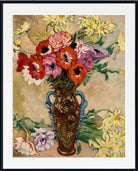
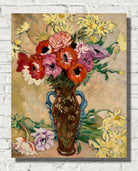
Vase decorated with anemones and yellow savannah daisies (1908) by Louis Valtat
Couldn't load pickup availability
BUY WITH CONFIDENCE
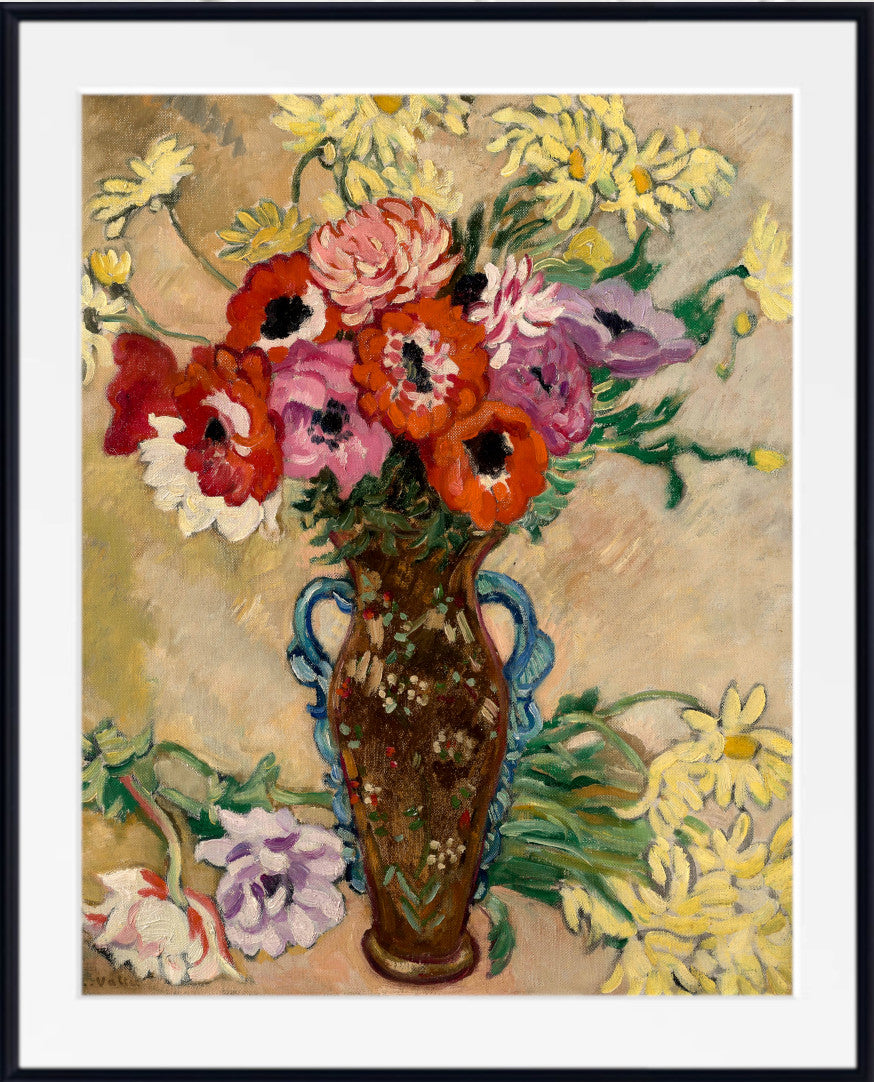
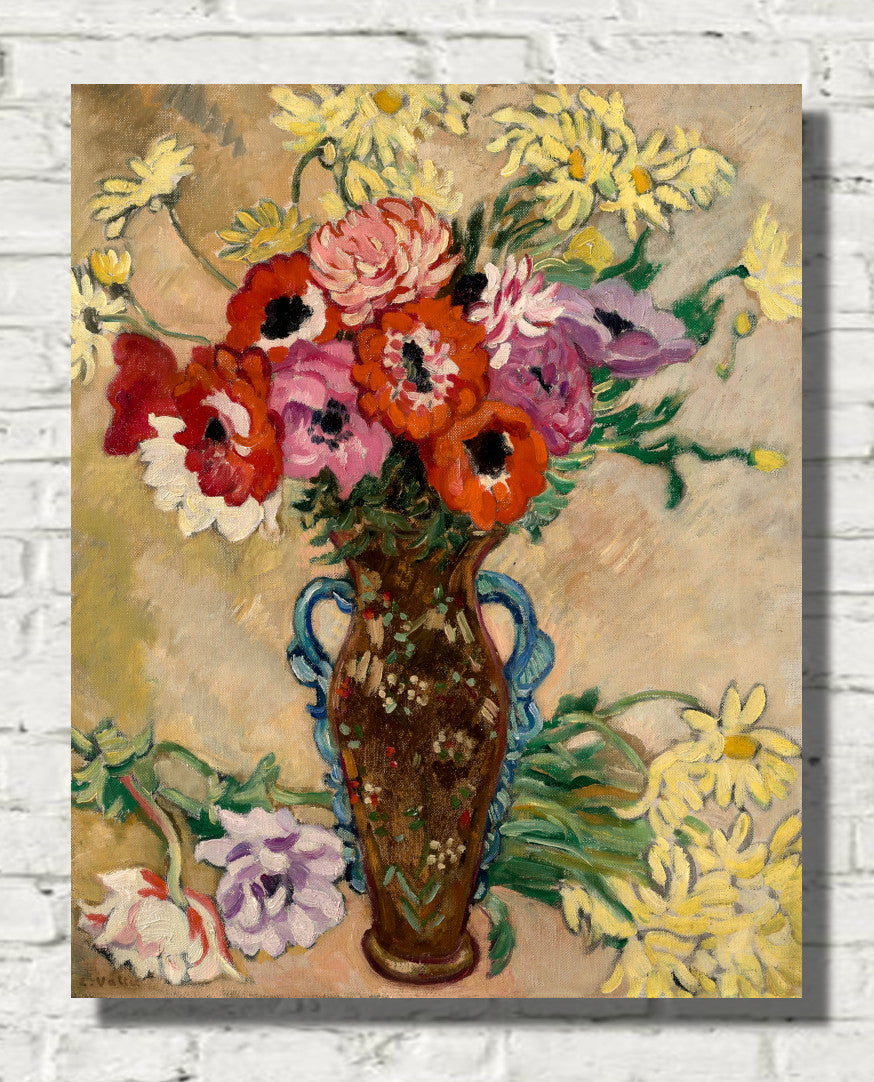
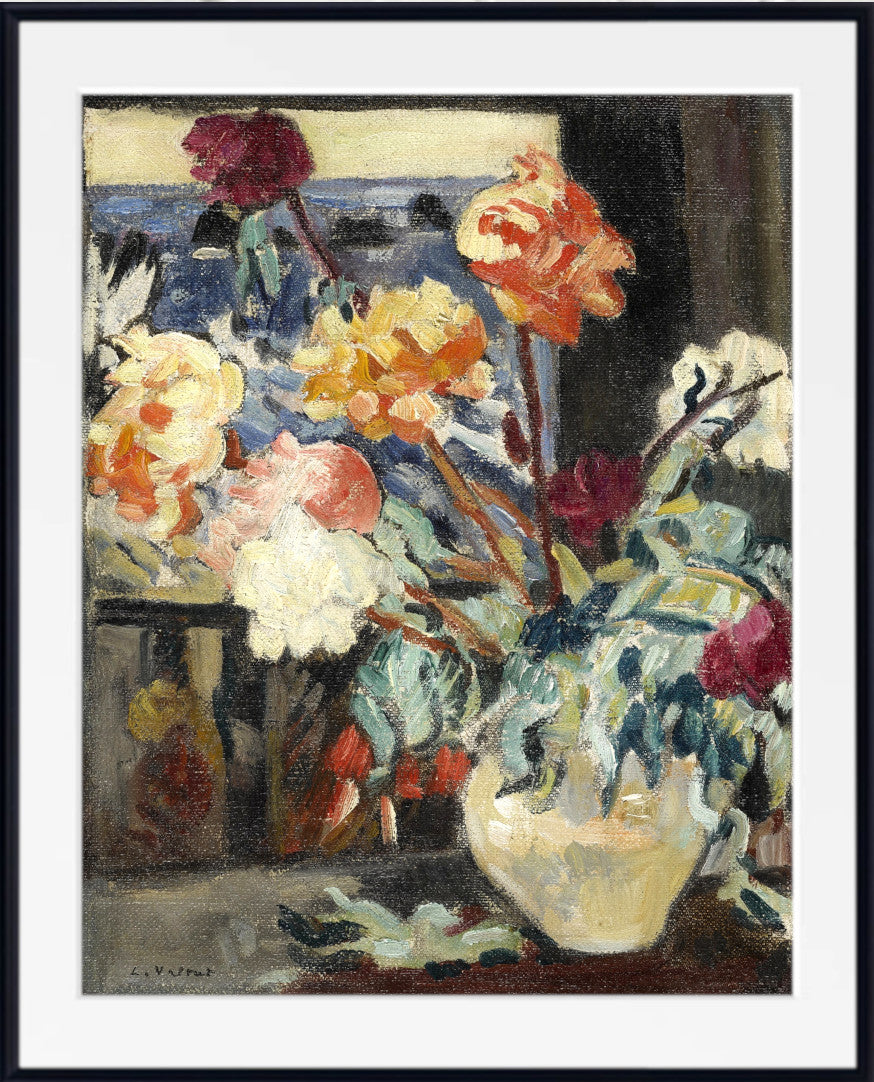
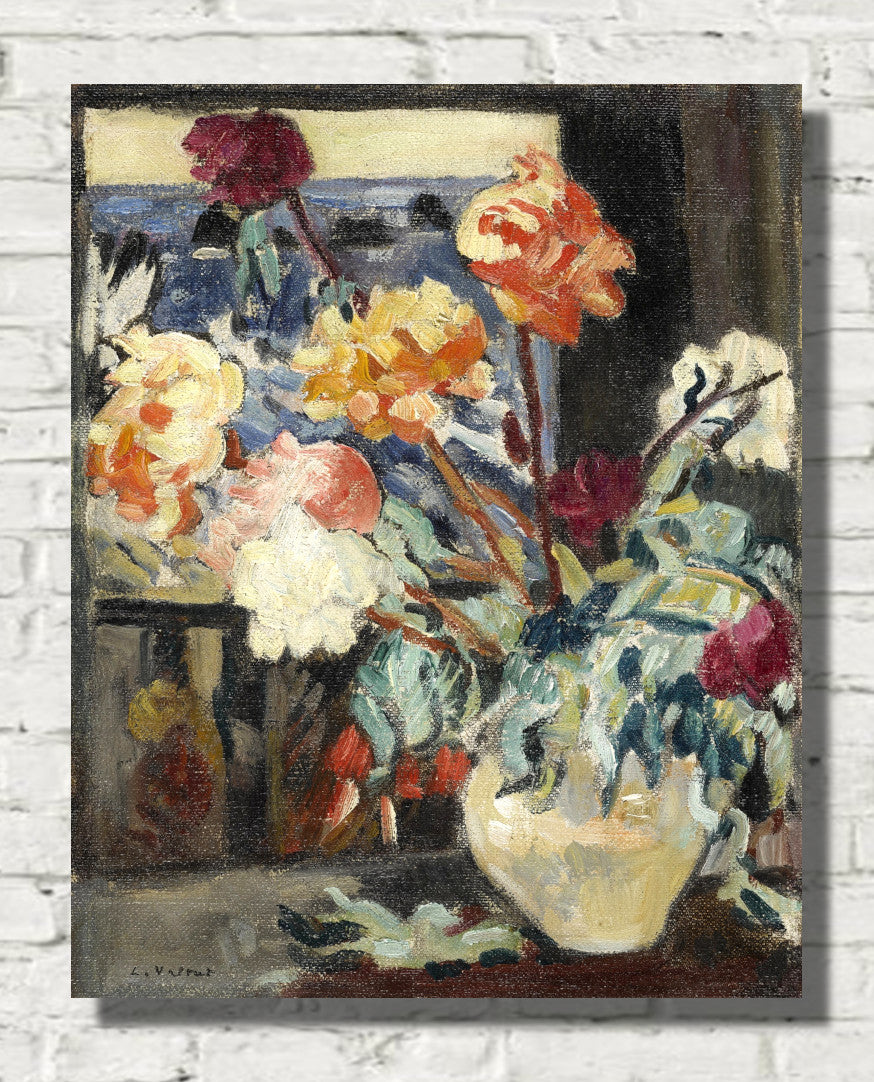
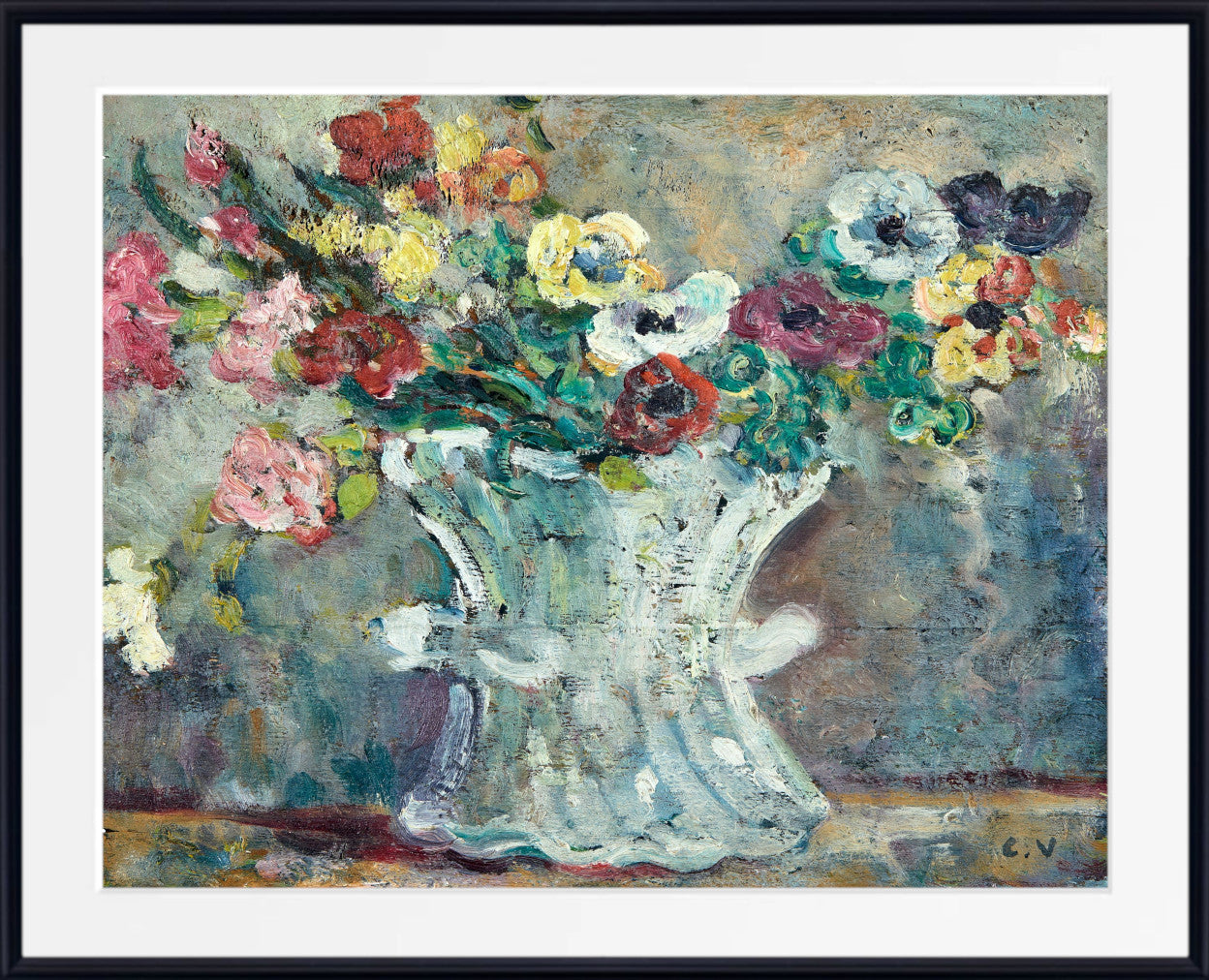
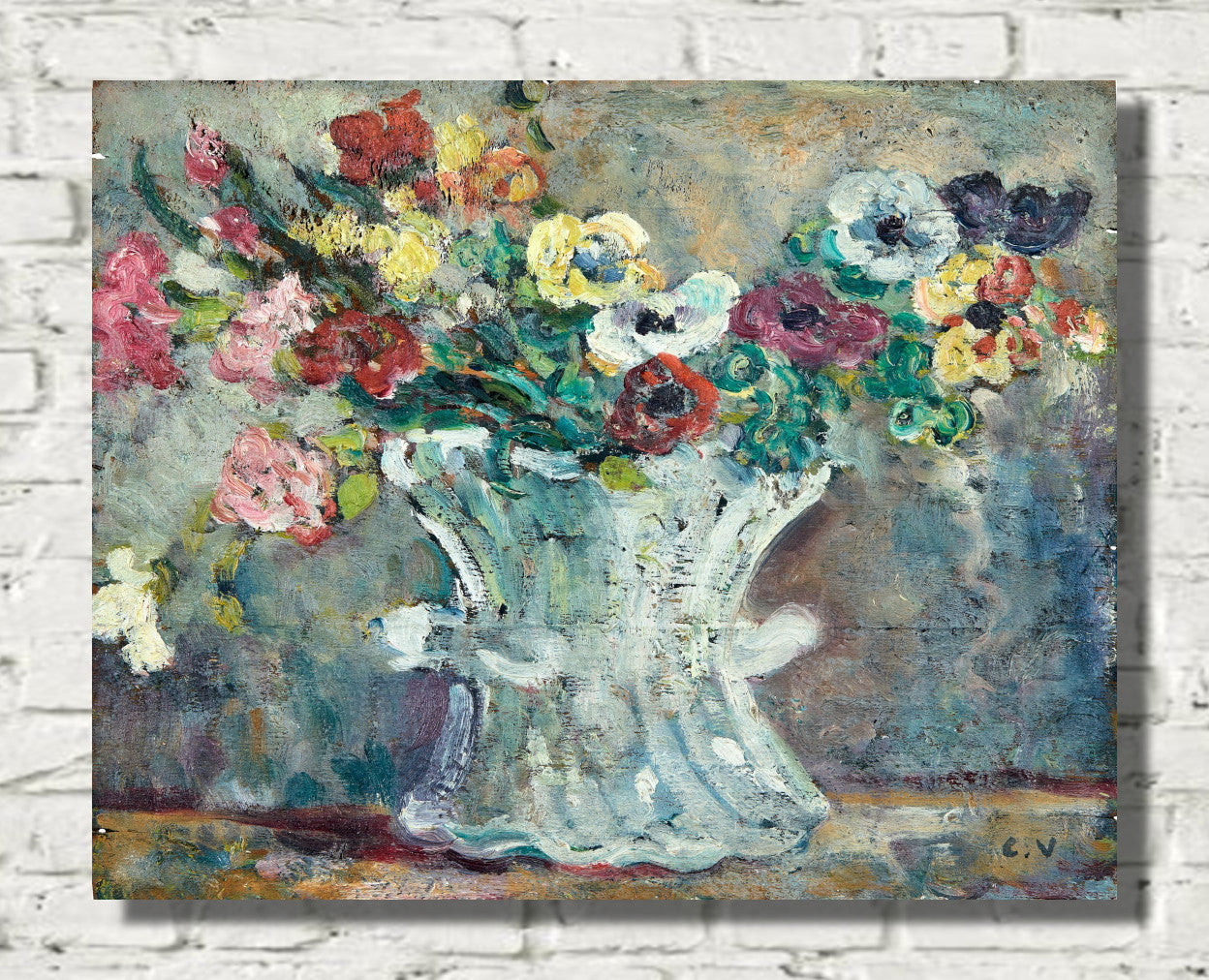
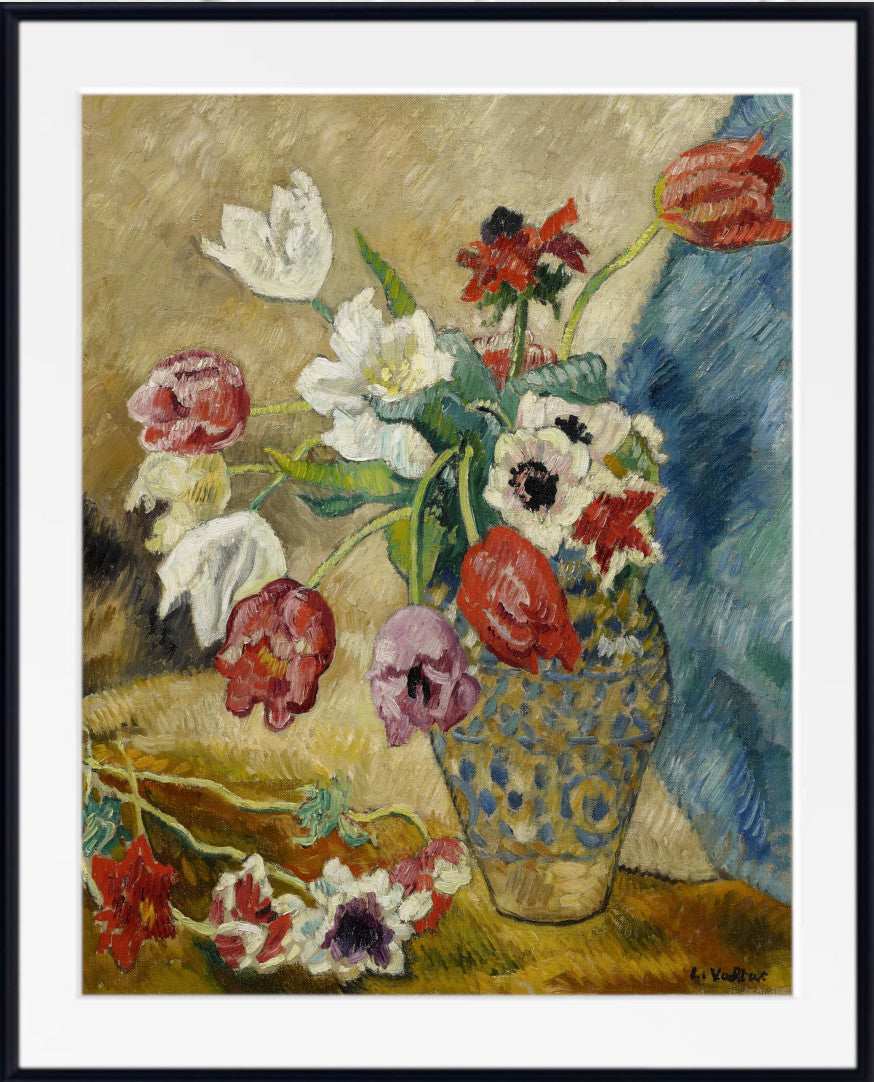
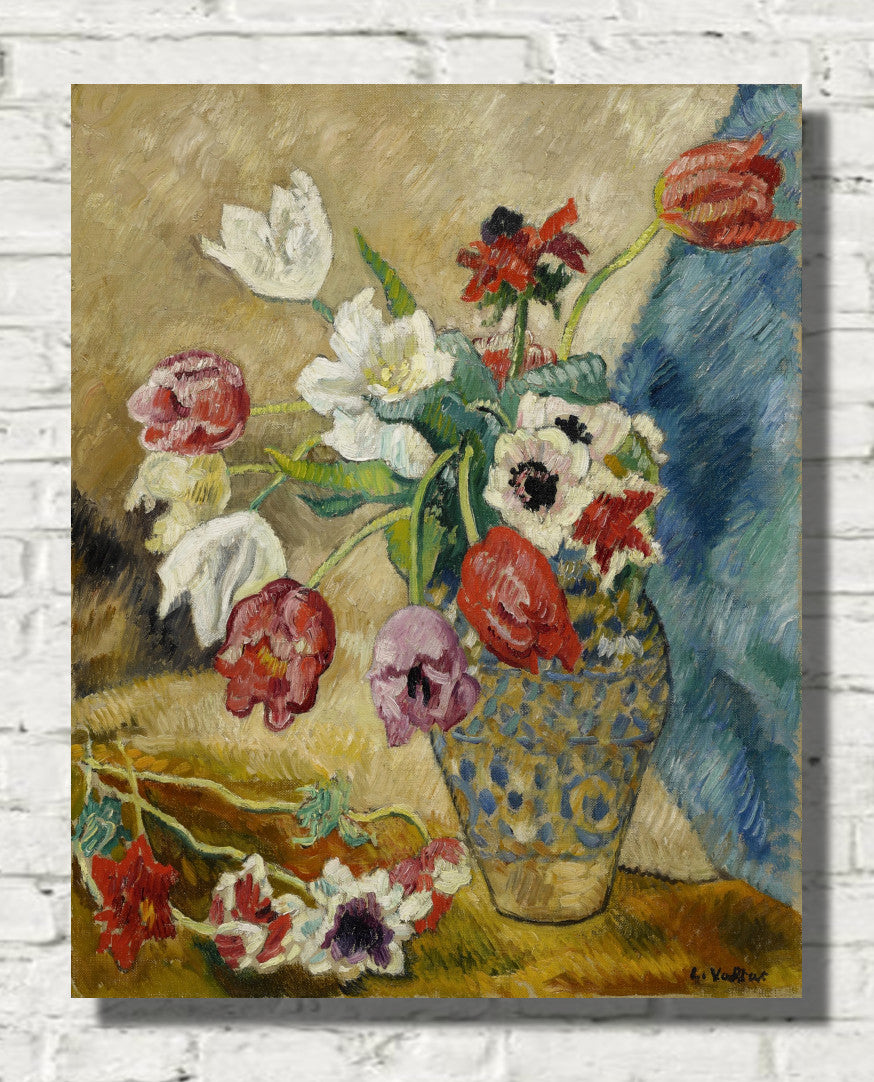
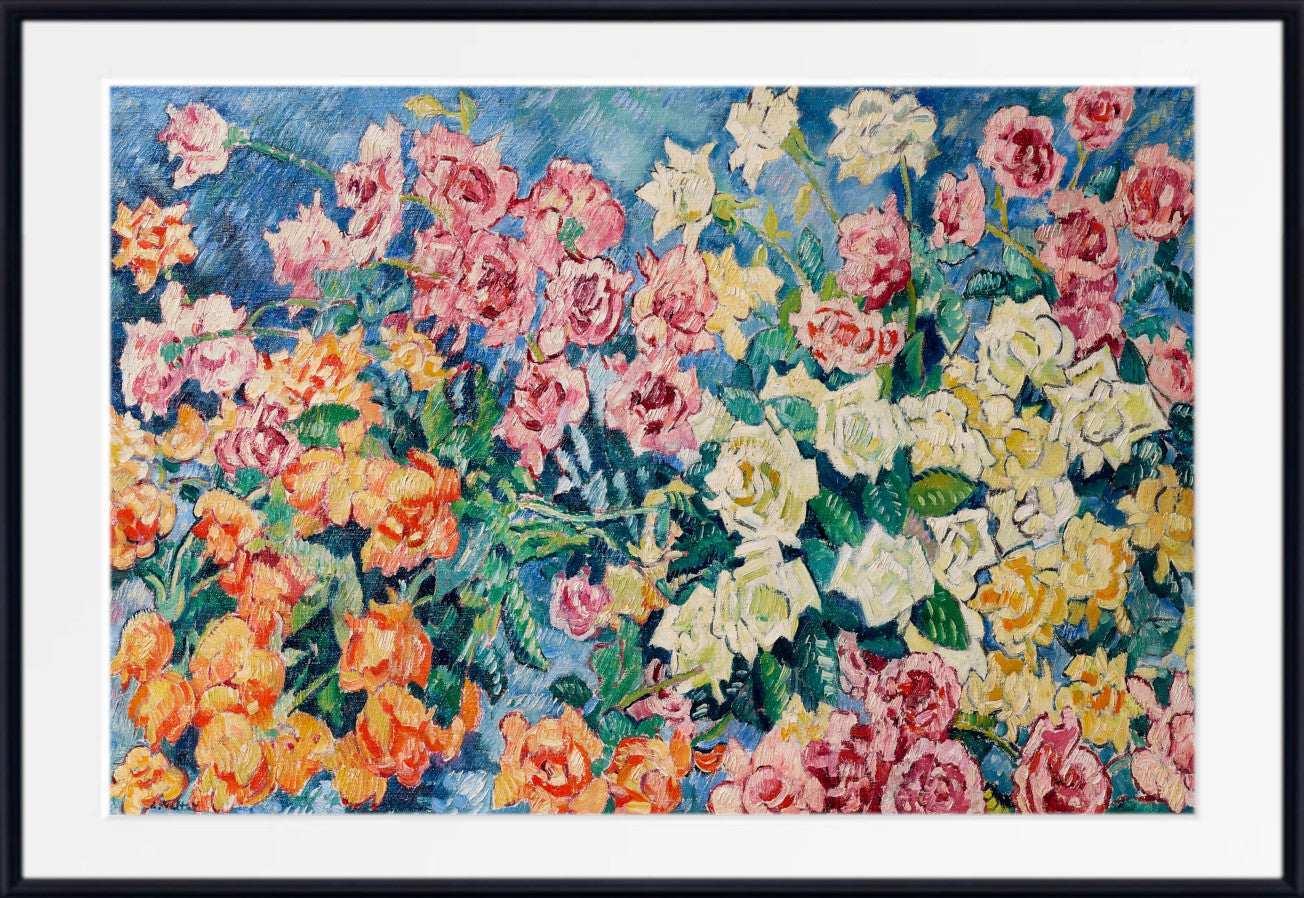
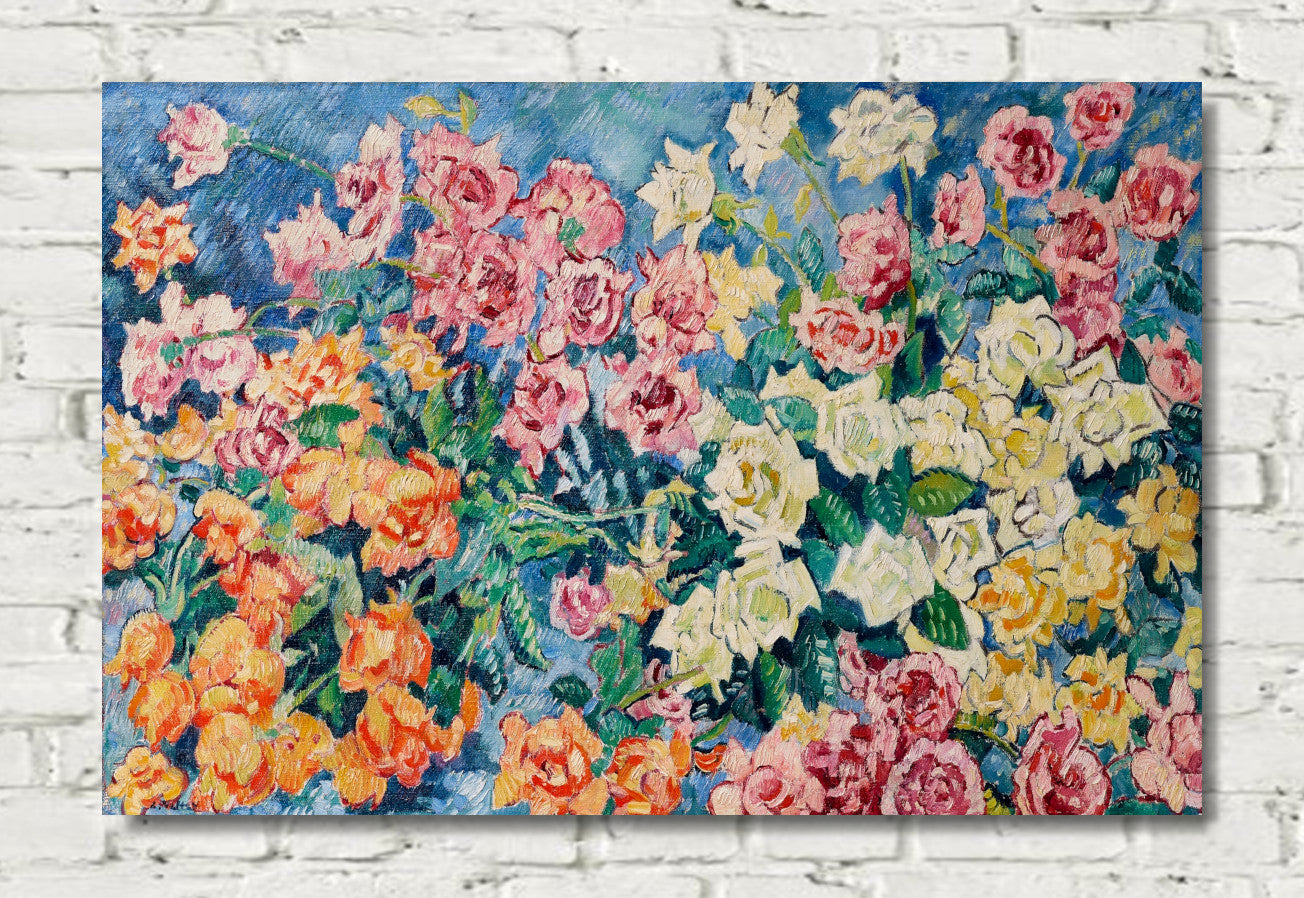
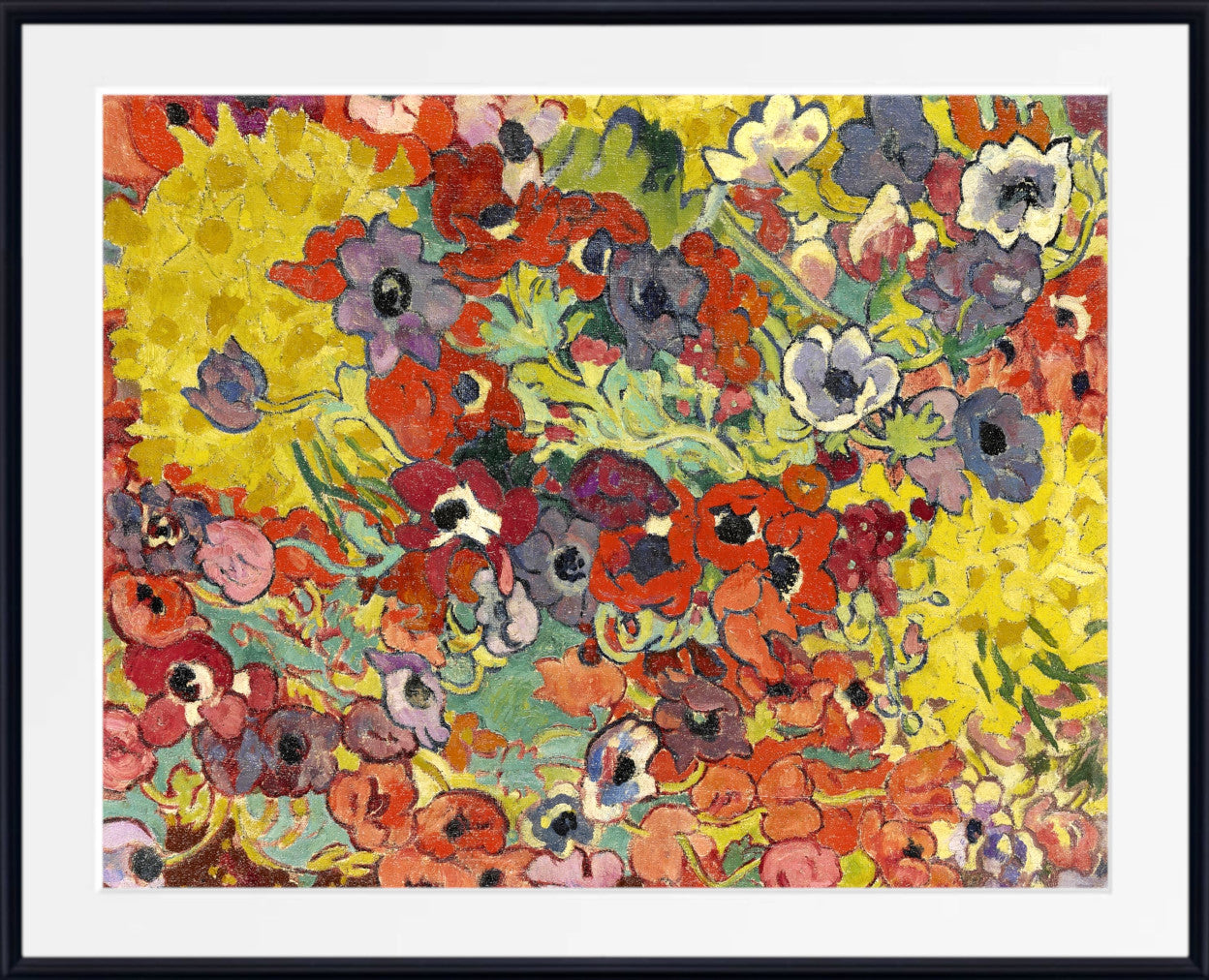
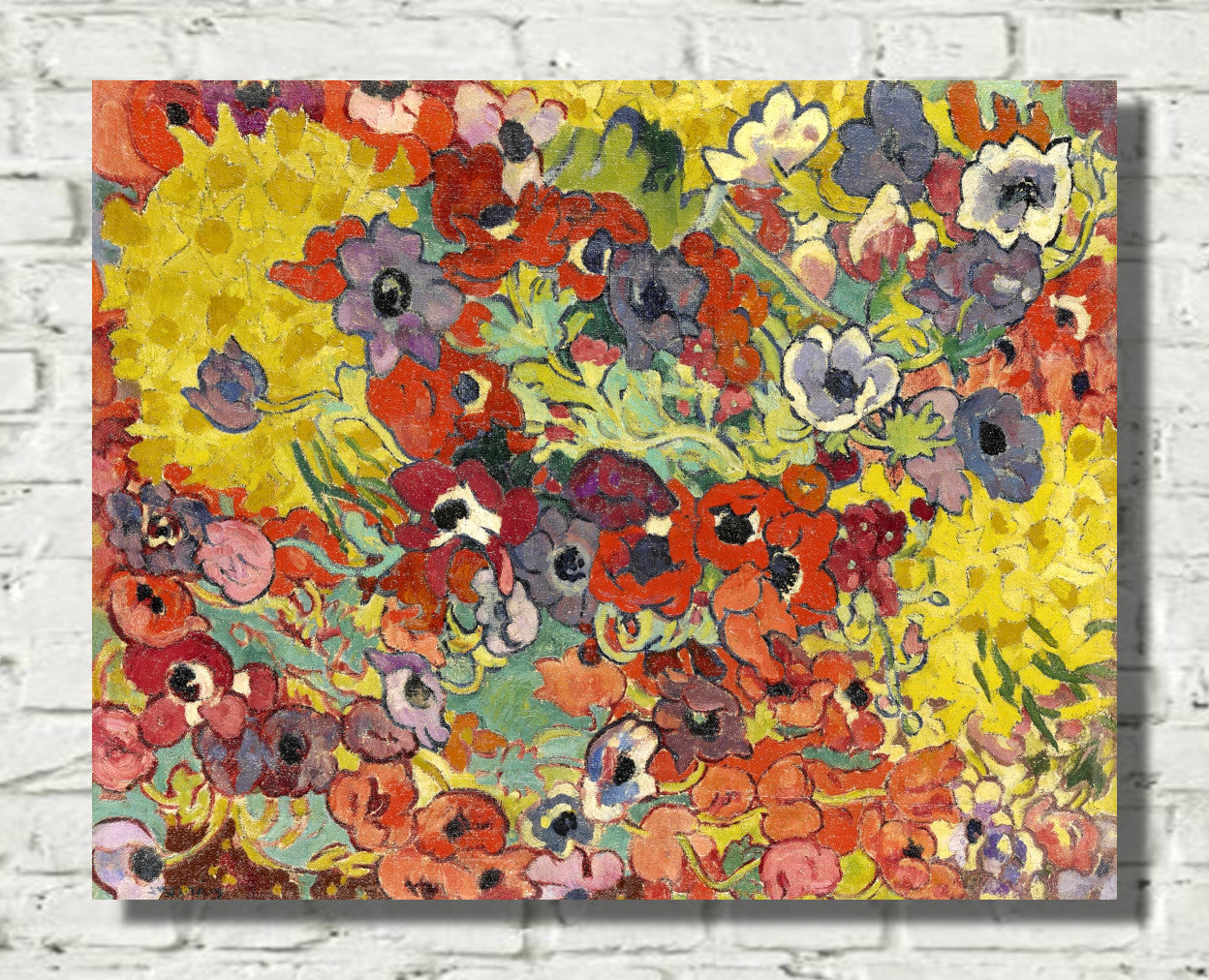
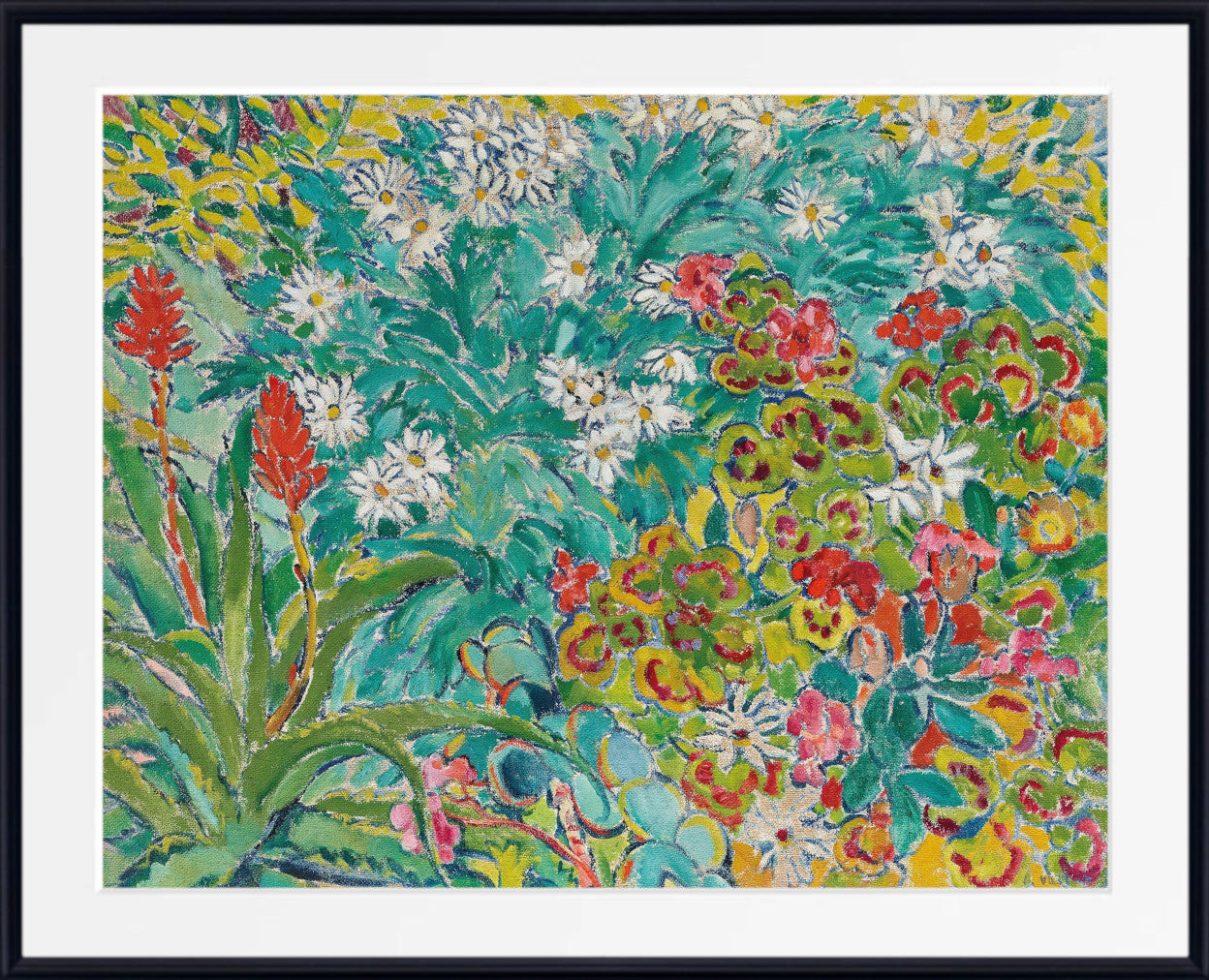
Vase Decorated with Anemones and Yellow Savannah Daisies (c.1908) by Louis Valtat, known in French as Vase décoré aux anémones et marguerites jaunes de savane, is a richly coloured floral still life from one of the most important periods in the artist's career. Anemones and brilliant yellow daisies fill the composition, allowing Valtat to explore the expressive possibilities of flowers through saturated colour, simplified form and vigorous brushwork.
This Louis Valtat floral print demonstrates why flowers became such a natural subject for an artist whose development was closely connected with the liberation of colour in early twentieth-century French painting. Rather than treating the arrangement as a precise botanical study, Valtat concentrates on the relationships between blossoms, foliage, vase and surrounding colour. Available as a fine art print, framed print or canvas panel, this vibrant still life is an excellent choice for admirers of Valtat, Fauvist-era art, colourful botanical prints and modern floral painting.
Vase Decorated with Anemones and Yellow Savannah Daisies
Flowers provided Louis Valtat with an almost ideal subject.
They offered colour in abundance without requiring the artist to invent an elaborate narrative.
Anemones could provide deep, intense floral notes while yellow daisies introduced areas of brightness and contrast.
Stems and foliage created linear movement, while the vase supplied a more stable form beneath the irregular bouquet.
Valtat could therefore build an entire composition from the fundamental elements that interested him most: colour, shape, rhythm and the physical movement of paint.
In this painting, the bouquet is not simply represented.
It is reorganised into a modern pictorial structure.
The French Title of the Painting
The work is catalogued in French as Vase décoré aux anémones et marguerites jaunes de savane.
The GalleryThane title Vase Decorated with Anemones and Yellow Savannah Daisies provides a close English rendering of that title.
The most important elements are immediately clear: a vase containing anemones and distinctive yellow daisy-like flowers.
Unlike a general title such as Bouquet de fleurs, the original title identifies specific components of the arrangement.
This gives the work a particularly individual character within Valtat's extensive body of flower paintings.
Anemones and the Possibilities of Colour
Anemones occur frequently in modern floral painting because of their vivid colours and distinctive forms.
Their petals can be suggested with relatively broad strokes while darker centres provide strong points of contrast.
For Valtat, such flowers offered a natural opportunity to move away from painstaking botanical description.
A blossom did not require dozens of carefully rendered petals.
A concentrated group of coloured marks could communicate its form more directly.
The viewer recognises a flower while simultaneously remaining aware of the brushstrokes used to create it.
This balance between representation and painting itself is one of the defining qualities of early modern art.
The Yellow Savannah Daisies
The yellow daisies named in the title introduce an especially luminous element.
Yellow naturally attracts the eye, particularly when placed among deeper floral and foliage colours.
Valtat repeatedly used strong yellow accents in landscapes, gardens and still lifes because they could suggest sunlight without requiring elaborate tonal modelling.
Within a bouquet, yellow flowers can function almost like points of light.
They interrupt darker areas and create visual movement throughout the arrangement.
The flowers are therefore important not only as botanical subjects but as elements in the chromatic organisation of the canvas.
A Bouquet Built through Colour
Traditional academic still-life painting often depended upon careful drawing and gradual modelling from light to shadow.
Valtat's approach became increasingly different.
Colour itself could establish form.
A blossom might be distinguished from surrounding foliage because of a strong chromatic contrast rather than because every edge had been precisely drawn.
A stem could be indicated by a direct linear stroke.
The vase could function as a comparatively unified area beneath the more fragmented bouquet.
These simplifications give the painting immediacy.
The eye encounters the whole arrangement before analysing individual flowers.
The Vase as an Anchor
Every floral still life depends upon the relationship between the bouquet and its container.
The flowers expand upwards and outwards in irregular directions.
The vase counteracts that movement.
Its more compact silhouette provides weight and stability near the lower part of the composition.
This contrast between organic growth and manufactured form gives the painting structural balance.
Valtat repeatedly explored similar relationships in his flower paintings.
The vase is therefore much more than a practical object holding the flowers.
It forms the visual base from which the entire bouquet develops.
Flowers as Rhythmic Forms
Valtat's flowers can be understood in two ways simultaneously.
They are recognisable natural forms, but they are also repeated shapes distributed across the canvas.
One bloom may echo another.
Stems can lead the eye upwards or diagonally.
Clusters of blossoms create areas of visual density while spaces between them give the composition room to breathe.
This creates rhythm.
The eye moves through the bouquet rather than remaining fixed upon one central flower.
Such rhythmic organisation would become increasingly important throughout twentieth-century decorative painting.
Why Valtat Painted Flowers So Frequently
Flowers remained an important subject for Louis Valtat throughout his long career.
The attraction is easy to understand.
Few natural subjects offer such immediate variety of colour.
Red, violet, pink, white, yellow, orange and green can all coexist naturally within a bouquet.
Flowers also provide enormous variation of shape.
Some blossoms are compact and circular.
Others open into irregular petals.
Stems introduce vertical and diagonal lines while leaves create broader curving masses.
For an artist interested in both colour and decorative structure, the possibilities were almost unlimited.
Still Life as a Modern Experimental Genre
Still life became one of the great laboratories of modern painting.
The genre allowed an artist extraordinary control.
Objects could be selected and moved.
Flowers could be arranged according to colour.
Vessels could be placed to provide structural balance.
The background could be altered according to the needs of the composition.
Paul Cézanne had already demonstrated how radically still life could challenge conventional perspective and pictorial structure.
The generation that followed increasingly explored colour and decorative organisation.
Valtat's floral paintings belong directly to this broader transformation.
Painted Around 1908
Christie's dates Vase décoré aux anémones et marguerites jaunes de savane to circa 1908.
This places it just a few years after the celebrated public emergence of Fauvism at the Salon d'Automne in Paris.
By 1908, the painters associated with Fauvism were already moving in different directions.
Henri Matisse was developing increasingly flattened decorative interiors.
André Derain was reconsidering the structural example of Cézanne.
Georges Braque was moving towards the experiments that would contribute to Cubism.
Valtat followed his own more independent path.
He continued exploring powerful colour without abandoning his attachment to recognisable natural subjects.
Valtat and Fauvism
Louis Valtat has long been associated with Fauvism, but his relationship with the movement is more complex than the label sometimes suggests.
His experiments with intense colour began before the famous Fauvist breakthrough of 1905.
During the 1890s and early years of the twentieth century, his paintings of the Mediterranean coast already displayed colours considerably stronger than conventional Impressionist naturalism.
For this reason, Valtat is frequently described as a precursor of Fauvism or proto-Fauve.
He belonged to the same artistic environment but arrived at intense colour through his own development.
Colour before the Fauvist Revolution
The chronology matters.
The name Fauvism came from the 1905 Salon d'Automne, when critic Louis Vauxcelles reacted to a room containing unusually colourful paintings by Henri Matisse, André Derain and related artists.
Valtat had already been painting with saturated colour for years.
His work therefore demonstrates that the liberation of colour did not emerge from one exhibition or one small group acting in isolation.
Several strands of late nineteenth-century painting were moving in that direction.
Valtat formed an important part of that development.
From Mediterranean Light to Floral Colour
The Mediterranean coast played a crucial role in Valtat's development.
He spent extended periods in southern France, where strong sunlight transformed his understanding of colour.
Vegetation could become intensely green.
Rock and soil could appear red or orange.
The sea offered powerful blues and turquoise.
Sunlight created brilliant yellows and sharp contrasts.
These experiences affected Valtat's entire palette.
When he turned from landscape to flowers, the same chromatic confidence remained.
The subject changed from coastline to bouquet, but colour continued to organise the painting.
Valtat's Mediterranean Years
From the 1890s onwards Valtat worked repeatedly in the south of France.
Places including Agay and Anthéor became particularly important.
The Mediterranean environment encouraged increasingly broad forms and intense pigments.
Valtat's southern landscapes consequently occupy an important position in the transition from Impressionist observation towards the stronger colour associated with early twentieth-century painting.
The confidence visible in later floral still lifes such as this one was developed in large part through those earlier encounters with Mediterranean light.
The Influence of Neo-Impressionism
Valtat also worked within an artistic environment shaped by Neo-Impressionism.
He knew painters including Paul Signac and Henri-Edmond Cross.
Neo-Impressionist theory emphasised the power of placing comparatively pure colours beside one another rather than mixing them excessively into subdued tones.
Valtat never became a rigid Pointillist.
His brushwork remained much freer and responded directly to the forms he was painting.
Nevertheless, the underlying understanding of colour interaction remained important.
A yellow flower becomes more luminous because of neighbouring darker colour.
A green leaf gains intensity beside warmer floral tones.
The whole palette operates relationally.
Valtat and Paul Signac
Paul Signac was one of the major painters of Mediterranean colour around the turn of the twentieth century.
Valtat knew Signac and shared his interest in powerful chromatic relationships.
The two artists did not paint in the same manner.
Signac developed a more systematic Divisionist technique built from separated strokes of colour.
Valtat preferred greater spontaneity.
His brush could change according to the subject: broad for leaves, compact for blossoms and direct for stems.
This flexibility is particularly effective in a flower painting where the natural forms themselves vary constantly.
Valtat and Henri-Edmond Cross
Henri-Edmond Cross also contributed to the artistic environment in which Valtat's colour developed.
Cross's later Mediterranean landscapes increasingly replaced small Pointillist marks with broader, mosaic-like areas of brilliant pigment.
These works became particularly influential on the generation approaching Fauvism.
Valtat absorbed similar lessons about complementary colour while maintaining his own direct and physical brushwork.
The result was an approach that could be highly chromatic without becoming dependent upon a fixed technical system.
Valtat and Pierre-Auguste Renoir
Valtat maintained an important friendship with Pierre-Auguste Renoir.
He visited the older Impressionist painter in southern France and moved within his artistic circle.
The relationship demonstrates Valtat's unusual position between generations.
Renoir belonged to the great Impressionist breakthrough of the nineteenth century.
Matisse and Derain represented the younger generation associated with Fauvism.
Valtat's work forms a link between the two.
His art retained an Impressionist pleasure in natural subjects while pushing colour towards much stronger twentieth-century expression.
Ambroise Vollard and Valtat's Career
The influential dealer Ambroise Vollard began representing Valtat in 1904.
Vollard was one of the most important figures in the development of the modern Parisian art market and worked with artists including Cézanne, Gauguin and Picasso.
For several years he acquired Valtat's production and helped circulate his work among collectors and exhibitions.
This relationship confirms that Valtat's innovative colour had attracted serious attention before Fauvism became firmly established as an art-historical category.
From Landscape to Still Life
Valtat did not separate genres as rigidly as a traditional academic hierarchy might suggest.
The same artistic problems could be explored in a landscape, a portrait or a bouquet.
A Mediterranean hillside offered contrasts between red rock and green vegetation.
A flower arrangement offered contrasts between blossoms and leaves.
A landscape could be organised through broad coloured masses.
A still life could be organised in exactly the same way.
This continuity is important when looking at Valtat's work.
His floral paintings are not secondary diversions from his landscapes.
They are another arena in which he investigated colour.
Direct Brushwork
Valtat generally allowed the physical movement of the brush to remain apparent.
This gives his paintings a freshness that would be lost through excessive polishing.
A flower may require only a few confident marks.
A group of leaves can emerge from broader strokes.
Edges do not always need to be precisely finished.
The technique reflects a modern belief that the viewer should be able to sense the act of painting.
The image remains recognisable while the material qualities of paint are allowed to contribute to its expressive effect.
Flowers, Pattern and Decoration
Floral subjects naturally approach decorative pattern.
Petals repeat around centres.
Leaves echo one another.
Stems create linear networks.
Colours recur throughout the bouquet.
Valtat uses these natural repetitions to structure the surface of the painting.
The result can be appreciated both as an arrangement of real flowers and as an interconnected sequence of shapes and colours.
This increasing interest in the decorative organisation of the entire canvas was one of the broader developments transforming European painting during these years.
Valtat and Henri Matisse
Comparing Valtat with Henri Matisse helps clarify what makes his art distinctive.
Both painters developed exceptionally strong palettes.
Matisse, however, increasingly flattened space and allowed colour and pattern to become almost independent of conventional representation.
Valtat generally remained closer to observable nature.
His flowers continue to possess physical form.
The vase retains weight.
The surrounding space remains understandable.
The colours may be intensified, but the subject is not dissolved.
This balance between modern colour and recognisable form is central to Valtat's appeal.
Valtat and André Derain
André Derain also pushed colour to extraordinary extremes during the Fauvist years.
In his Collioure and L'Estaque landscapes, natural colours could be replaced by brilliant orange, red, violet and turquoise.
Valtat's palette can be equally rich, but he generally maintains a closer relationship with observed colour.
His approach therefore represents a somewhat different route into modernism.
Rather than completely detaching colour from nature, he heightens nature until it becomes dramatically expressive.
Why the Painting Matters
Vase Decorated with Anemones and Yellow Savannah Daisies brings together several qualities central to Valtat's mature early style:
- a floral subject ideally suited to strong colour
- anemones contrasted with brilliant yellow flowers
- recognisable natural forms simplified through direct brushwork
- the vase providing stability beneath an irregular bouquet
- colour functioning structurally rather than merely descriptively
- an interest in repeated floral rhythms and decorative organisation
- the chromatic freedom associated with Valtat's relationship to Fauvism
- a continuing balance between observation and artistic invention
The painting therefore offers much more than an attractive bouquet.
It demonstrates how Valtat could transform one of painting's oldest subjects into a vehicle for distinctly modern colour.
Louis Valtat's Painting Style
Louis Valtat developed an individual style from several important currents in late nineteenth-century French art.
Impressionism encouraged direct observation and visible brushwork.
Neo-Impressionism strengthened his understanding of colour relationships.
His Mediterranean experiences encouraged increasingly saturated pigments.
Contact with artists from different generations prevented him from becoming confined to one movement.
By the early twentieth century, his paintings combined powerful colour with simplified but recognisable form.
This places him in a particularly interesting position between Post-Impressionism and Fauvism.
Flower paintings such as this one reveal that development in an especially accessible form.
About Louis Valtat
Louis Valtat (1869–1952) was a French painter and printmaker recognised as an important precursor to Fauvism and a significant figure in the transition towards modern colour painting.
Born in Dieppe, Valtat studied art in Paris and began exhibiting during the late nineteenth century.
His early work developed within an artistic environment shaped by Impressionism, Neo-Impressionism and Post-Impressionism.
Repeated stays along the Mediterranean coast had a profound effect on his palette, encouraging increasingly intense greens, blues, reds, oranges and yellows.
Valtat knew important painters including Paul Signac, Henri-Edmond Cross and Pierre-Auguste Renoir and was represented for several years by Ambroise Vollard.
His colour experiments were already well advanced before the public emergence of Fauvism in 1905.
Although closely associated with the movement, Valtat retained an independent style distinguished by a stronger attachment to recognisable natural structure than some of the core Fauvist painters.
Throughout his long career he painted landscapes, seascapes, portraits, domestic scenes, gardens and numerous floral still lifes.
The Original Vase Decorated with Anemones and Yellow Savannah Daisies
The original painting is catalogued as Vase décoré aux anémones et marguerites jaunes de savane.
Christie's dates the work to circa 1908.
It was painted in oil on canvas and measures approximately 54.7 × 45.9 cm, equivalent to 21⅝ × 18⅛ inches.
The painting bears a stamped signature, L. Valtat, at the lower left.
Christie's specifically identifies the stamp as Lugt 2479bis.
The documented provenance records that the work was acquired by its owner around 1985.
Christie's further states that the painting will be included in the forthcoming Louis Valtat catalogue raisonné currently being prepared by Les Amis de Louis Valtat.
The auction house issued a sale-room notice confirming both the precise French title and the circa-1908 date.
No permanent public museum collection is identified in the available Christie's documentation, so the work should not be attributed to a museum without additional evidence.
A Louis Valtat Floral Print for Your Interior
A Louis Valtat Vase Decorated with Anemones and Yellow Savannah Daisies print combines colourful botanical subject matter with the expressive handling of early twentieth-century modern art.
The varied floral palette makes the painting particularly effective when an interior needs a concentrated source of colour without the scale or visual weight of a large landscape.
Against white, cream, putty or pale grey walls, the flowers can provide an immediate focal point.
Natural timber complements the botanical subject, while furnishings in sage, olive, ochre, mustard, plum or muted blue can echo individual tones within the composition.
Its vertical proportions make the work especially suitable for narrower wall spaces, above console tables, beside fireplaces or as part of a curated gallery wall.
It works particularly well in living rooms, dining rooms, bedrooms, kitchens, hallways and home offices.
The combination of recognisable flowers and expressive colour makes it suitable for contemporary, Scandinavian-inspired, mid-century and eclectic interiors.
For admirers of Valtat and Fauvist-era painting, however, its appeal extends beyond decoration. The painting shows how the artist transformed the familiar floral still life into a sophisticated exploration of colour at a pivotal moment in the development of modern art.
Frequently Asked Questions
When did Louis Valtat paint Vase Decorated with Anemones and Yellow Savannah Daisies?
Christie's dates the painting to circa 1908.
What is the original French title?
The painting is catalogued as Vase décoré aux anémones et marguerites jaunes de savane.
What flowers are shown in the painting?
The title identifies anemones and yellow savannah daisies as the principal flowers in the arrangement.
Is this a Fauvist painting?
The painting dates from the years immediately following the height of historical Fauvism and displays the saturated colour associated with Valtat's relationship to the movement. Valtat is often described more precisely as a precursor or proto-Fauve because his experiments with powerful colour began before Fauvism received its name in 1905.
Why did Valtat paint so many flowers?
Flowers provided exceptional possibilities for experimenting with saturated colour, varied brushwork and decorative rhythm while remaining grounded in recognisable natural forms.
Why is Louis Valtat associated with Fauvism?
Valtat used intense colour before and during the period in which Fauvism emerged. He exhibited within the same avant-garde environment as artists associated with the movement, although his artistic development was independent and began earlier.
How does Valtat differ from Henri Matisse?
Valtat generally retained a stronger connection with recognisable natural form and pictorial depth. Matisse increasingly pushed colour and pattern towards more radical flatness and independence from observed reality.
What medium did Louis Valtat use?
The original painting was created in oil on canvas.
What size is the original painting?
Christie's records the original as measuring approximately 54.7 × 45.9 cm.
Is the original signed?
Yes. It bears Valtat's stamped signature L. Valtat at the lower left.
Why is the signature stamped rather than painted?
Christie's specifically records the work as bearing Valtat's stamped signature, identified as Lugt 2479bis. The catalogue does not state that the signature was individually painted onto the canvas, so it is more accurate to describe it as a stamped signature.
Where is the original painting?
The available Christie's documentation does not identify the work as belonging to a permanent public museum collection. Its provenance records acquisition by a private owner around 1985.
Is the painting included in the Valtat catalogue raisonné?
Christie's states that it will be included in the forthcoming catalogue raisonné being prepared by Les Amis de Louis Valtat.
Why should the painting be dated c.1908 rather than simply 1908?
Christie's specifically catalogues the work as painted circa 1908 and issued a sale-room notice confirming that dating. Using c.1908 therefore reflects the strongest available documentation.
How does this painting relate to Valtat's landscapes?
The subject is very different, but Valtat applies similar principles. Strong colours interact across the composition, simplified forms replace excessive detail and visible brushwork gives the image energy.
Did Mediterranean painting influence Valtat's flower pictures?
Yes. Valtat's extended periods in southern France played an important role in developing his saturated palette. The confidence with which he used strong colour subsequently carried into his still lifes, portraits and flower paintings.
Was Valtat represented by Ambroise Vollard?
Yes. The influential Paris dealer Ambroise Vollard began representing Valtat in 1904 and handled much of his production for several years.
Is Vase Decorated with Anemones and Yellow Savannah Daisies available as a framed Louis Valtat print?
Yes. GalleryThane offers the work in a choice of sizes and formats, including fine art paper prints, framed prints and canvas options.
Where would this Louis Valtat floral print work well?
Its vertical format and colourful floral subject make it particularly suitable for living rooms, dining rooms, bedrooms, kitchens, hallways and home offices. It works especially well in contemporary, Scandinavian-inspired, mid-century and eclectic interiors.
All orders for unframed fine art prints and original paintings are dispatched within 2 working days of receipt of payment.
Orders for custom framed prints are dispatched within 4 working days.
All orders are fully tracked from dispatch to delivery at your home or business.
All print and original painting orders are fully insured against loss or damage in transit. We refund or replace any damaged or lost orders.
Buy with confidence - read what our satisfied customers have to say - Reviews
Fine art papers are printed without any additional white border Please let us know at the time of ordering if you would like a small additional white border.
Rolled canvas options have an additional white border of approximately 2.5 inches (7cm) on all 4 sides to aid stretching.
Ready to hang canvas panels are stretched on 1.5 inch deep solid pine frames from sustainable forestry sources. The image is mirrored on all 4 sides to give an aesthetically pleasing finish.
Why not have us gift wrap your order and attach a personalised message to the recipient. Available for all orders. Each order is hand wrapped in high quality gift wrap with meatllic ribbon and bow. Your personalised message is printed on a card which is included with your order.
Have your hand wrapped gift delivered directly to the recipient.
Full tracking and insurance included with every order.
Please note design may vary depending upon availability
Just purchase the gift wrap option HERE
We have a wide range of frames in standard sizes and we also make custom size frames.
To order a framed print:
1. select the print size you would like along with the print materials (matte paper, fine art paper).
2. Add your print choice to the basket.
3. Choose from our range of frames
4. Select the same size as the print you have added to your basket. If the frame size you want is not listed please contact us
5. Choose from the mount or no-mount option
6. Add your frame choice to the basket
7. Proceed to checkout.
Why Choose GalleryThane?
- Printed and framed in-house
- Free UK delivery
- Free EU and USA delivery on orders over £200
- Tracking and insurance included in every order
- Fast 1-3 day dispatch
- Gift wrapping service available
- Gallery quality materials
- Sustainable, eco-friendly packaging
- Great customer support
Explore related collections
What makes our Prints and Canvas Panels so special

Latest Giclee Printing Technology
We have invested in the latest wide format print technology to produce museum quality giclee prints utilising the highest quality pigment inks to give outstanding colour reproduction.

Museum Quality Archival Fine Art Papers
We print on the finest quality fine art papers with textured, smooth and lustre finishes for prints which last a lifetime.
From aceo miniatures to 40x80 inch large format, every print has our lifetime quality guaranteee.

Solid Wood Frames, Cotton Canvas
All of the wood for our canvas panels and frames is responsibly sourced from manages forests. Our cotton canvas is completely seedless for the highest quality reproduction possible.

Have Your Gift Wrapped


Choose a Custom Frame
Popular Collections


EU Representative
Manufacturer
LucasAbstract t/a GalleryThane
15 Campion Way, Bingham NG13 8TR UK
sales@gallerythane.com
EU Authorised Representative
Westwood Sourcing
Fellenoordstraat 52, Unit 2.38
4811 TJ Breda, Netherlands
info@westwoodsourcing.com