

Table of Contents:[hide]
- What Is Fauvism?
- Origins and Influences
- Collioure 1905: Matisse and Derain
- The 1905 Salon d'Automne and the “Wild Beasts”
- What Makes a Painting Fauvist?
- The Fauvist Artists
- The Three Fauvist Circles
- Famous Fauvist Paintings
- Why Did Fauvism End?
- Fauvism, Cubism and Expressionism
- Fauvism Prints and Wall Art
- Frequently Asked Questions
- Related Artists and Articles
Fauvism was one of the first great artistic revolutions of the twentieth century. Emerging in France during the opening years of the 1900s, the movement replaced conventional naturalistic colour with intense reds, blues, greens, yellows and oranges, while simplifying landscapes, figures and architecture into bold areas of colour and expressive line.
Led principally by Henri Matisse and André Derain, the Fauves were never a formal organisation with a manifesto or fixed membership. They were a loose network of painters who shared an interest in liberating colour from the task of simply describing the visible world. Their experiments lasted only a few years, but helped redefine what colour could do in modern painting.
GalleryThane's carefully curated Fauvism Prints collection brings together works from this crucial period by artists including Matisse, Derain, Raoul Dufy, Henri Manguin, Louis Valtat and Othon Friesz.
What Is Fauvism?
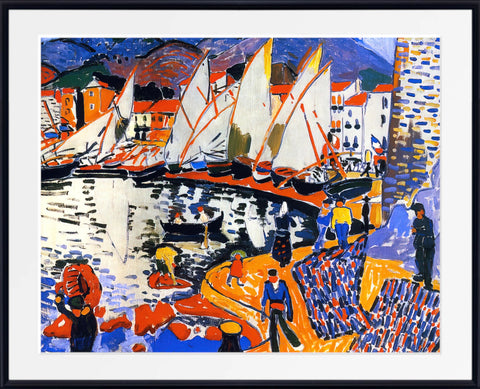
Fauvism was a short-lived French modern-art movement associated with brilliant non-naturalistic colour, simplified forms, energetic brushwork and a deliberate rejection of conventional modelling and perspective.
Instead of asking whether a tree was really green, a shadow really grey or a face realistically flesh-coloured, the Fauves asked what colours would make the painting itself more powerful. Trees could become red, faces could contain green or blue, and water might be constructed from vivid patches of orange, violet and turquoise.
This transformation was fundamental. Colour ceased to be merely descriptive and became an independent element of composition and expression.
The core Fauvist period is generally associated with the years from approximately 1905 to 1908, although its development began earlier and several painters carried aspects of Fauvist colour into later phases of their careers.
Origins and Influences
Fauvism did not appear suddenly or in isolation. It developed from experiments already taking place within Impressionism, Post-Impressionism and Neo-Impressionism.
Vincent van Gogh demonstrated how intensified colour and vigorous brushwork could communicate emotion. Paul Gauguin showed how flattened forms and large decorative areas of colour could replace conventional modelling. Paul Cézanne encouraged artists to reconsider pictorial structure, while Georges Seurat, Paul Signac and Henri-Edmond Cross explored ways in which separate touches of pure colour could interact optically.
Matisse and Derain experimented with Neo-Impressionist techniques before moving towards increasingly broad, arbitrary and expressive areas of colour. Other painters arrived at related solutions through different routes, which helps explain why Fauvism never had a completely uniform appearance.
What united the Fauves was not one technique but a willingness to let colour become more powerful than conventional representation.
Collioure 1905: Matisse and Derain
The summer of 1905 at Collioure, a Mediterranean fishing town close to the Spanish border, became one of the decisive moments in the development of Fauvism.
Henri Matisse invited the younger André Derain to work alongside him there. The intense southern light, harbour, fishing boats, mountains and colourful architecture provided ideal material for experimentation.
Instead of reproducing the landscape through subtle natural tones, the two artists increasingly constructed their paintings from pure and contrasting colour. Shadows became blues, violets and greens; buildings were transformed into reds, yellows and pinks; water and sky became fields of colour rather than atmospheric descriptions.
Derain's Collioure paintings, including Boats in the Harbor of Collioure, Drying the Sails and Bateaux sur la plage à Collioure, demonstrate how radically ordinary coastal scenes could be transformed by colour.
Matisse was exploring the same freedom. His Collioure landscapes increasingly reduced natural forms to energetic brushstrokes and flat coloured zones, establishing a visual language that would become central to Fauvism.
The 1905 Salon d'Automne and the “Wild Beasts”
The breakthrough came publicly at the Salon d'Automne in Paris in 1905.
Paintings by Matisse, Derain, Henri Manguin, Albert Marquet and other like-minded artists were displayed together. Their intense colour and apparently uncontrolled brushwork looked startling beside more conventional works.
French critic Louis Vauxcelles famously used the word fauves — “wild beasts” — when describing the brightly coloured paintings. The initially mocking term quickly became the name by which the movement was known.
One of the exhibition's most controversial paintings was Henri Matisse's Woman with a Hat. Instead of modelling the sitter with conventional skin tones, Matisse used vivid greens, blues, reds and yellows across her face, clothing and surroundings.
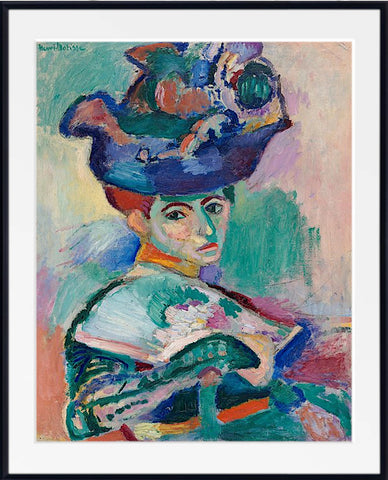
To modern eyes, such colour may appear familiar, but in 1905 it challenged deeply rooted expectations about how a portrait should look. The controversy surrounding the Salon d'Automne helped bring the Fauves international attention.
What Makes a Painting Fauvist?
Expressive Colour
The most recognisable characteristic of Fauvism is colour that does not need to correspond to visible reality. A Fauvist painter might choose a colour because of how it interacts with neighbouring colours or because it intensifies the emotional character of the composition.
Simplified Forms
Fauvist painters frequently reduced landscapes, buildings and figures to broad shapes. Fine modelling and precise anatomical or architectural description became less important than the overall impact of the composition.
Visible and Energetic Brushwork
Many Fauvist paintings retain highly visible brushstrokes. Instead of disguising the act of painting beneath a polished surface, the brushstroke becomes part of the visual energy of the work.
Flattened Pictorial Space
Traditional Western painting frequently creates the illusion of deep three-dimensional space. Fauvist painters often flattened that depth, allowing foreground and background to operate more like areas within a decorative design.
Strong Outlines and Colour Contrasts
Forms are often separated by pronounced contours or contrasting areas of pure colour. Complementary colours — such as red and green or blue and orange — could be placed close together to increase visual intensity.
The Fauvist Artists
Henri Matisse
Henri Matisse was the central figure of Fauvism and the artist who most consistently pushed colour towards independence from naturalistic representation.
Works including Woman with a Hat, Landscape at Collioure, Blue Still Life, The Joy of Life and Blue Nude demonstrate different stages in this transformation. Matisse combined intense colour with careful organisation, ensuring that even his most apparently spontaneous compositions retained a strong underlying structure.
Fauvism was only one part of his long career, but the discoveries he made during these years remained fundamental to his later paintings, interiors, decorative compositions and cut-outs.
Explore Henri Matisse prints or read the GalleryThane guide to Henri Matisse's life and paintings.
André Derain
André Derain was, alongside Matisse, one of the principal creators of the Fauvist visual language.
His work at Collioure in 1905 helped establish the movement, while his later paintings of London demonstrated how Fauvist colour could completely transform an urban landscape. The Thames, bridges and surrounding architecture became extraordinary arrangements of vivid blue, orange, green, red and yellow.
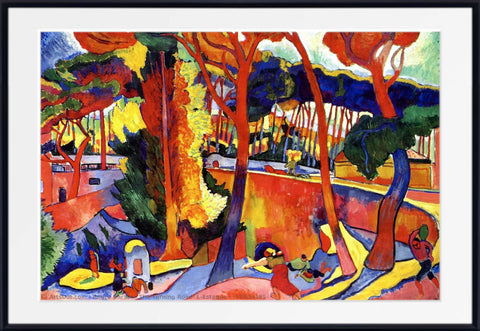
Works such as The Turning Road, L'Estaque reveal how Derain combined brilliant colour with increasingly simplified and structured forms.
Read more in André Derain: A Pioneer of Fauvism.
Maurice de Vlaminck
Maurice de Vlaminck formed the celebrated Chatou partnership with Derain and became one of the most forceful exponents of Fauvist colour. His paintings frequently combine thick brushwork with intense reds, blues and yellows, particularly in landscapes around the Seine.
Vlaminck was strongly impressed by Van Gogh and shared the Fauvist belief that colour could express sensation more powerfully than conventional realism. His work often appears more turbulent and emotionally direct than Matisse's carefully balanced compositions.
Although GalleryThane's present curated Fauvism collection does not contain a Vlaminck work, his position within the movement is too important to omit from any serious account of Fauvism.
Henri Manguin
Henri Manguin studied alongside Matisse in Gustave Moreau's circle and exhibited with the Fauves during the movement's crucial early years.
His interpretation of Fauvism was often warmer and more lyrical than that of Derain or Vlaminck. Mediterranean landscapes, bathers and portraits allowed him to explore saturated pinks, reds, oranges, greens and blues without losing a sense of intimacy.
Works such as La Baigneuse, La Sieste and Jeanne à l'ombrelle, Cavalière demonstrate the importance of colour within his Fauvist-period work.
Read more in Henri Manguin: A Fauvist Master.
Albert Marquet
Albert Marquet studied with Matisse under Gustave Moreau and participated in the Fauvist circle, including the celebrated 1905 Salon d'Automne.
Marquet generally used a more restrained palette than the most extreme Fauves. His importance lies partly in demonstrating the breadth of the movement: Fauvism was not a single formula of maximum colour intensity but a shared willingness to simplify form and rethink the relationship between colour and observed reality.
Marquet later moved towards a quieter, more naturalistic landscape style, becoming especially celebrated for harbour and river views.
Explore Albert Marquet prints or read Albert Marquet: From Fauvism to Naturalism.
Raoul Dufy
Raoul Dufy joined the Fauvist experiment slightly later than Matisse and Derain. The impact of Matisse's work encouraged him to abandon his more conventional early manner and embrace stronger colour.
His Fauvist-period paintings concentrated particularly on Normandy harbours, beaches, sailing boats and scenes of modern life. Works including The Parasols, 14 Juillet au Havre and Sailboats and Boats in the Harbor belong to this important stage of his development.
Dufy subsequently moved away from Fauvism and developed the lighter calligraphic style for which he is now best known.
Explore the Raoul Dufy collection or read the GalleryThane article Raoul Dufy: Fauvist Luminary.
Othon Friesz
Émile-Othon Friesz, usually known as Othon Friesz, was another artist from Le Havre who joined the Fauvist circle during the movement's mature phase.
His work around 1906–08 combines powerful outlines, broad areas of colour and simplified landscapes and figures. The Regatta at Antwerp demonstrates how harbour and maritime subjects could be transformed by the new Fauvist language.
Friesz later moved towards a more structured approach influenced by Cézanne, illustrating the rapid changes that brought the Fauvist moment to an end.
Louis Valtat
Louis Valtat occupies a particularly interesting place in Fauvism because his experiments with strong colour began before the movement received its name in 1905.
His landscapes, floral still lifes and figure paintings helped bridge the transition from late Impressionist and Post-Impressionist colour towards the more saturated palette associated with the Fauves.
GalleryThane's curated Fauvist selection includes early Valtat works such as Landscape of the South, Flowerbed and Bouquet of Iris in a Green Pitcher.
Kees van Dongen
Dutch-born Kees van Dongen became closely associated with the Fauvist circle in Paris and brought a distinctive emphasis on portraiture and urban nightlife.
His use of highly saturated colour, exaggerated features and strong contours extended Fauvist principles into glamorous and sometimes provocative figure painting. Van Dongen's work demonstrates that Fauvism was not confined to Mediterranean landscapes and harbour scenes.
Georges Braque
Georges Braque is remembered primarily as one of the founders of Cubism, but immediately before that development he passed through an important Fauvist phase.
After encountering the work of Matisse and Derain, Braque adopted a brighter palette and painted landscapes in places including L'Estaque and La Ciotat. His Fauvist works increasingly combined strong colour with an interest in underlying structure.
That growing structural concern, strengthened by the influence of Cézanne, helped lead Braque away from Fauvism and towards the revolutionary experiments with Pablo Picasso that produced Cubism.
Explore Georges Braque prints or read Georges Braque: The Genius Behind Cubism.
The Three Fauvist Circles
Fauvism is easier to understand when viewed not as a single organised group but as several overlapping circles of artists.
The Matisse and Gustave Moreau Circle
Henri Matisse studied under Gustave Moreau alongside artists including Albert Marquet and Henri Manguin. Moreau encouraged individuality rather than imposing a rigid academic style, creating an environment in which experimentation could develop.
The Chatou Circle
André Derain and Maurice de Vlaminck worked together around Chatou on the Seine. Their friendship produced some of the movement's most forceful early experiments with direct brushwork and intense colour.
The Le Havre Circle
Raoul Dufy and Othon Friesz had trained in Le Havre, while Georges Braque also had close connections with the Normandy port. These younger artists encountered the developing Fauvist language slightly later and adapted it to their own work during approximately 1906–07.
Matisse acted as an important link between these different groups, which helps explain why Fauvism could display substantial stylistic variety while remaining recognisably connected by its approach to colour.
Famous Fauvist Paintings
The Fauvist period produced some of the defining images of early modern art.
Woman with a Hat — Henri Matisse
Exhibited at the 1905 Salon d'Automne, Woman with a Hat became one of the works most closely associated with the shock of early Fauvism. Matisse's use of green, blue and other unexpected colours across the sitter's face demonstrated that portrait colour no longer needed to imitate nature.
The Joy of Life — Henri Matisse
Matisse's large composition of figures within an intensely coloured landscape brought together several strands of his early experimentation and demonstrated how Fauvist colour could be extended beyond landscape into complex figure painting.
The Turning Road, L'Estaque — André Derain
The Turning Road, L'Estaque transforms the landscape into a sweeping pattern of vivid colour, simplified trees and strongly rhythmic forms. It is one of the clearest examples of the decorative power of mature Fauvism.
London Bridge — André Derain
Derain's London paintings reimagined the Thames through brilliant non-naturalistic colour. Familiar architecture became raw material for modern painting rather than something that needed to be reproduced literally.
14 Juillet au Havre — Raoul Dufy
Dufy's 14 Juillet au Havre demonstrates how Fauvist colour could transform urban life. Flags, buildings and crowds become part of a vibrant decorative pattern celebrating movement and public spectacle.
The Regatta at Antwerp — Othon Friesz
Friesz's maritime scene shows the movement spreading beyond the central Matisse-Derain partnership. Boats, water and harbour structures are simplified and intensified through strong colour.
Why Did Fauvism End?
Fauvism had extraordinary impact but a remarkably short life.
By 1907–08, many of its principal artists were already moving in different directions. Derain became increasingly interested in greater structural order. Braque responded strongly to the work of Cézanne and soon began the experiments that led towards Cubism. Friesz also returned to more structured forms, while Dufy gradually developed a lighter and more personal approach to colour and line.
Matisse did not abandon the freedom of colour discovered through Fauvism, but he continued developing it independently rather than preserving a fixed Fauvist style.
This rapid dispersal was possible because the Fauves had never formed a formal organisation. There was no manifesto to defend and no official membership to maintain. Fauvism was better understood as a brief period of shared discovery.
Fauvism, Cubism and Expressionism
Fauvism's historical importance greatly exceeds its short duration.
Its most profound achievement was the liberation of colour. Once colour no longer had to reproduce the natural world faithfully, artists gained a powerful new means of constructing pictures and communicating sensation.
The relationship between Fauvism and Cubism is particularly visible in the career of Georges Braque. His movement from Fauvist landscapes towards increasingly structured forms demonstrates one path through which early twentieth-century painting changed rapidly between 1906 and 1908.
Fauvism also developed alongside the beginnings of German Expressionism. Both used distortion and non-naturalistic colour, although Expressionist artists often placed greater emphasis on psychological intensity, anxiety and emotional confrontation.
More broadly, the Fauves demonstrated that a painting could function through the relationships between colour, line and shape rather than through faithful imitation. That principle became increasingly important across modern and eventually abstract art.
Fauvism Prints and Wall Art
Fauvist paintings translate particularly well into wall art because colour is central to their visual impact. Landscapes, figures, harbours and still lifes can introduce substantial colour into an interior without requiring complicated subject matter.
GalleryThane's Fauvism Prints collection has been curated around works that genuinely belong to the Fauvist period or its immediate development rather than simply including later paintings by artists who once participated in the movement.
The collection includes works by Henri Matisse, André Derain, Raoul Dufy, Henri Manguin, Louis Valtat and Othon Friesz, available across a range of print sizes and formats including fine art paper prints, framed prints and canvas wall art.
For contemporary interiors, a strong Fauvist landscape can provide an immediate focal point against neutral walls. Matisse and Manguin figure paintings work particularly well where colourful figurative art is wanted, while Derain, Dufy and Friesz offer vivid landscapes, harbours and scenes of modern life.
Explore the Fauvism Prints collection →
Frequently Asked Questions
What is Fauvism?
Fauvism was an early twentieth-century French art movement characterised by intense expressive colour, simplified forms and energetic brushwork. It emerged around 1905 and had largely dispersed by approximately 1908.
What does Fauvism mean?
The name derives from the French word fauves, meaning “wild beasts”. Critic Louis Vauxcelles applied the term to the brightly coloured paintings exhibited by Matisse, Derain and their associates at the 1905 Salon d'Automne in Paris.
Who were the main Fauvist artists?
Henri Matisse and André Derain were the central figures. Maurice de Vlaminck was also a major early Fauve. Other artists associated with the movement include Henri Manguin, Albert Marquet, Raoul Dufy, Othon Friesz, Louis Valtat, Kees van Dongen and Georges Braque.
When did Fauvism begin?
Experiments that contributed to Fauvism began before 1905, but the movement became publicly identifiable during 1905, particularly through Matisse and Derain's work at Collioure and the Salon d'Automne exhibition later that year.
How long did Fauvism last?
The core movement was remarkably brief. Its most concentrated period lasted from approximately 1905 to 1907, and by around 1908 many of the participating artists had moved towards different styles.
What are the main characteristics of Fauvist painting?
Typical features include vivid non-naturalistic colour, simplified forms, visible brushwork, bold outlines, flattened pictorial space and strong contrasts between areas of colour.
Why did Fauvist artists use unrealistic colours?
The Fauves believed colour could perform an expressive and structural role rather than merely reproduce what the eye observed. A face could therefore contain green or blue, while a tree might be red if those colours strengthened the composition.
Was Henri Matisse a Fauvist?
Yes. Matisse was the central figure of Fauvism and produced many of the movement's defining paintings. His experiments with expressive colour during the early 1900s had an enormous influence on other members of the group.
Was Raoul Dufy a Fauvist?
Yes. Dufy adopted Fauvist colour during an important early period around the middle of the 1900s. He later moved away from Fauvism and developed the light, calligraphic style associated with his mature paintings.
Was Georges Braque a Fauvist before Cubism?
Yes. Braque passed through a significant Fauvist phase before developing Cubism with Pablo Picasso. His Fauvist landscapes already show an increasing concern with underlying structure that became more pronounced after his encounter with Cézanne's work.
What is the difference between Fauvism and Impressionism?
Impressionist painters generally used colour to investigate observed light and atmosphere. Fauvist painters moved further away from observation, using colour freely and often deliberately choosing hues that did not correspond to the natural appearance of the subject.
What is the difference between Fauvism and Expressionism?
Both movements used colour and distortion expressively, but Fauvism emerged first in France and often retained a sense of decorative harmony and visual pleasure. Expressionism became especially important in Germany and central Europe and frequently placed greater emphasis on psychological or emotional intensity.
How did Fauvism influence Cubism?
The relationship was not a simple progression from one movement to another, but several artists moved rapidly between the two developments. Georges Braque is the clearest example: after his Fauvist period he became increasingly concerned with structure and, together with Picasso, helped develop Cubism.
Are Fauvism prints suitable for modern interiors?
Yes. Fauvist prints work particularly well in contemporary, Scandinavian-inspired, mid-century and eclectic interiors because their simplified forms and strong colours can create a clear focal point without depending on elaborate detail.
Where can I buy Fauvism prints?
GalleryThane offers a curated collection of Fauvism prints and wall art featuring works by Matisse, Derain, Dufy, Manguin, Valtat, Friesz and other artists associated with the movement.
Related Artists and Articles
Continue exploring Fauvism and the artists connected with the movement: