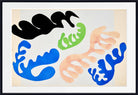
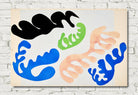
Henri Matisse Print, The lagoon (1947) I (Jazz Folio)

£14.70
Size
printed on
Frame


Dispatches within 48 hrs, Tracked, insured worldwide delivery

Buy With Confidence

BUY WITH CONFIDENCE

Details

Henri Matisse – The Lagoon I (Jazz Folio, 1947) Prints

Bring the brilliant colour and flowing organic forms of Henri Matisse’s celebrated Jazz portfolio into your home with a Henri Matisse The Lagoon I print. Published in 1947 as Plate XVII of Jazz, The Lagoon (Le Lagon) is the first of three closely related Lagoon compositions in the portfolio, combining sweeping abstract shapes with vivid red, magenta, green, black and white.

Available as fine art prints and canvas panels, The Lagoon I captures the extraordinary freedom of Matisse’s late cut-paper technique. Organic shapes suggest aquatic plants, coral, seaweed and movement through water without becoming literal representations, creating a composition that feels simultaneously natural, abstract and intensely rhythmic.

The First of Matisse’s Three Lagoon Compositions

The Lagoon I corresponds to Plate XVII of Matisse’s Jazz portfolio. It begins a sequence of three works entitled Le LagonThe Lagoon – which appear consecutively as Plates XVII, XVIII and XIX.

Rather than creating three unrelated images, Matisse developed variations on a shared vocabulary of curving, branching and repeated forms. Shapes reappear in altered colours and configurations, making the sequence feel almost like variations on a musical theme.

In The Lagoon I, bands of red, magenta and black sweep around the composition while a smaller green organic form provides a vivid focal point. Areas of white negative space are equally important, allowing the coloured shapes to appear as though they are floating or drifting across the surface.

Inspired by the Natural World

The forms within The Lagoon are highly abstracted, yet they retain a strong connection with nature. Matisse repeatedly drew inspiration from leaves, flowers, algae, coral and marine life, reducing these subjects to their most expressive contours.

The branching and undulating shapes in The Lagoon I evoke an underwater environment without attempting to describe one realistically. They can suggest seaweed moving in a current, fragments of coral or aquatic organisms suspended in water.

This balance between recognition and abstraction is one of the great strengths of Matisse’s late work. A shape can remind us of something from the natural world while simultaneously functioning as an independent element of colour, movement and design.

Painting Style

Drawing with Scissors

The original design for The Lagoon was developed using Matisse’s revolutionary paper cut-out technique. Sheets of paper were painted with gouache before Matisse cut directly into them with scissors and arranged the resulting shapes into a composition.

Matisse described this method as “drawing with scissors”. Instead of drawing a line around a form and then filling it with colour, cutting into coloured paper allowed contour and colour to be created simultaneously.

The original cut-paper maquette for Plate XVII was made in 1944. When Jazz was published in 1947, the design was reproduced using the pochoir stencil process, a demanding printing method chosen to preserve the intense flat colour of Matisse’s painted-paper originals.

Colour, Repetition and Visual Rhythm

Rhythm is fundamental to The Lagoon I. Repeated curved shapes move around the picture almost like phrases within a piece of music, while changes in colour and orientation prevent the pattern from becoming predictable.

Black forms provide visual weight, while red and magenta introduce warmth and intensity. The smaller green element contrasts sharply with the surrounding colours, helping the eye move towards the centre before travelling back through the larger repeating shapes.

The pale areas between these coloured elements are not simply empty background. Matisse uses negative space as an active part of the design, allowing the cut forms to breathe and creating the sensation of objects suspended within an open environment.

The Lagoon and the Spirit of Jazz

Matisse’s title Jazz was not intended to mean that every image represented jazz musicians. Instead, the portfolio brings together subjects associated with the circus, theatre, mythology, travel and personal memory, unified by ideas of rhythm and improvisation.

The three Lagoon compositions express this musical quality particularly clearly. Related shapes return in changing arrangements, just as a musical phrase can be repeated, altered and reinterpreted.

This combination of repetition and variation gives The Lagoon I a sense of controlled spontaneity. The composition appears wonderfully free, yet the position, scale and colour of each form have been carefully balanced.

From Cut-Paper Design to the 1947 Jazz Portfolio

Matisse developed the works that became Jazz during the 1940s, when his increasing use of painted paper and scissors was transforming his artistic practice. The project was ultimately published in Paris in 1947 by Tériade as an artist’s book containing twenty colour plates accompanied by Matisse’s handwritten text.

The Lagoon sequence appears towards the end of the portfolio, with The Lagoon I as Plate XVII followed by two further variations as Plates XVIII and XIX. The final plate, Toboggan, concludes the sequence of twenty images.

The resulting publication became one of the defining achievements of Matisse’s late career and an important precursor to the monumental paper cut-outs he produced during his final years.

The Lagoon I Wall Art for Modern Interiors

A Henri Matisse The Lagoon I wall art print is particularly effective in contemporary interiors where strong colour and clean graphic forms are desired. Despite its rich palette, the generous areas of pale negative space prevent the composition from feeling overly busy.

The combination of red, magenta, green and black makes this Matisse print particularly striking against white, cream, beige and putty-coloured walls. Its organic forms also complement natural woods and the simple furniture associated with Scandinavian and mid-century modern interiors.

Displayed above a sofa, console table, sideboard or bed, The Lagoon I can provide a vibrant focal point. It also works especially well alongside other Jazz prints, Matisse cut-outs and colourful abstract art as part of a modern gallery wall.

About Henri Matisse

Henri Matisse (1869–1954) was a French painter, draughtsman, sculptor and printmaker whose radical exploration of colour and form made him one of the most influential artists of twentieth-century modernism.

Matisse first became internationally prominent as a leading figure of Fauvism during the opening years of the twentieth century. His Fauvist paintings rejected conventional naturalistic colour in favour of vivid hues chosen for their emotional and compositional power.

Throughout his career, Matisse progressively simplified his visual language. Figures, landscapes, interiors and natural forms were increasingly reduced to flowing contours and broad areas of colour.

During the 1940s, Matisse began working extensively with sheets of paper painted with gouache and cut with scissors. What initially offered him a practical new way of composing developed into an entirely independent artistic medium.

The Jazz portfolio represents one of the crucial stages in this transformation. Its brilliant colours, simplified shapes and rhythmic arrangements anticipated masterpieces of Matisse’s final years including the Blue Nudes and The Snail.

Today, Henri Matisse prints continue to appeal to collectors and interior designers because his work combines exceptional importance within modern art with a clarity, colour and decorative vitality that remain remarkably contemporary.

Frequently Asked Questions

When did Henri Matisse create The Lagoon I?

Matisse created the original cut-paper design for the first Lagoon composition in 1944. It was subsequently reproduced as Plate XVII when his Jazz portfolio was published in 1947.

Is The Lagoon I part of Henri Matisse’s Jazz portfolio?

Yes. The Lagoon I is the first of three consecutive Lagoon (Le Lagon) compositions in Jazz. They appear as Plates XVII, XVIII and XIX of the twenty-plate portfolio.

What is the French title of The Lagoon?

The French title is Le Lagon. Major museum catalogues identify each of the three related compositions by this same title and distinguish them by their plate numbers within Jazz.

How was Matisse’s The Lagoon created?

Matisse developed the original design from sheets of paper painted with gouache, which he cut and arranged into the composition. For the published 1947 Jazz portfolio, the image was reproduced using the pochoir stencil-printing process.

What does The Lagoon I represent?

The composition is highly abstract but draws on organic and aquatic forms. Its curving shapes can suggest algae, seaweed, coral and marine organisms, while their arrangement creates the impression of movement through an underwater environment.

Why did Matisse make three Lagoon compositions?

The three Lagoon plates allowed Matisse to explore repetition and variation. Related organic forms recur in changing colours and arrangements, creating a visual rhythm that reflects the broader improvisational character of Jazz.

What plate number is The Lagoon I in Jazz?

The first Lagoon composition is Plate XVII of Jazz. The other two Lagoon compositions are Plates XVIII and XIX.

What style of art is The Lagoon I?

The Lagoon I belongs to Matisse’s late modernist cut-out period. Its simplified organic forms, flat areas of colour and emphasis on rhythm place it between abstraction and imagery inspired by the natural world.

What interiors suit a Matisse Lagoon print?

A Lagoon I print works particularly well in contemporary, Scandinavian, mid-century modern and eclectic interiors. Its vivid colour introduces energy, while the pale negative space helps maintain a clean and balanced appearance.

Is The Lagoon I available as a canvas panel?

GalleryThane offers The Lagoon I as fine art prints and canvas panels, providing different ways to display this colourful work from Henri Matisse’s celebrated Jazz portfolio.

Shipping

All orders for unframed fine art prints and original paintings are dispatched within 2 working days of receipt of payment.

Orders for custom framed prints are dispatched within 4 working days.

All orders are fully tracked from dispatch to delivery at your home or business.

All print and original painting orders are fully insured against loss or damage in transit. We refund or replace any damaged or lost orders.

Buy with confidence - read what our satisfied customers have to say - Reviews

Size and Printed Materials

Fine art papers are printed without any additional white border Please let us know at the time of ordering if you would like a small additional white border.

Rolled canvas options have an additional white border of approximately 2.5 inches (7cm) on all 4 sides to aid stretching.

Ready to hang canvas panels are stretched on 1.5 inch deep solid pine frames from sustainable forestry sources. The image is mirrored on all 4 sides to give an aesthetically pleasing finish.

Gift Wrap Option

Why not have us gift wrap your order and attach a personalised message to the recipient. Available for all orders. Each order is hand wrapped in high quality gift wrap with meatllic ribbon and bow. Your personalised message is printed on a card which is included with your order.

Have your hand wrapped gift delivered directly to the recipient.

Full tracking and insurance included with every order.

Please note design may vary depending upon availability

Just purchase the gift wrap option HERE

Framing Options - Instructions

We have a wide range of frames in standard sizes and we also make custom size frames.

To order a framed print:

1. select the print size you would like along with the print materials (matte paper, fine art paper).

2. Add your print choice to the basket.

3. Choose from our range of frames

4. Select the same size as the print you have added to your basket. If the frame size you want is not listed please contact us

5. Choose from the mount or no-mount option

6. Add your frame choice to the basket

7. Proceed to checkout.

Why Choose GalleryThane?

  • Printed and framed in-house
  • Free UK delivery
  • Free EU and USA delivery on orders over £200
  • Tracking and insurance included in every order
  • Fast 1-3 day dispatch
  • Gift wrapping service available
  • Gallery quality materials
  • Sustainable, eco-friendly packaging
  • Great customer support

What makes our Prints and Canvas Panels so special

latest wide format pigment ink printers

Latest Giclee Printing Technology

We have invested in the latest wide format print technology to produce museum quality giclee prints utilising the highest quality pigment inks to give outstanding colour reproduction.

museum quality fine art papers

Museum Quality Archival Fine Art Papers

We print on the finest quality fine art papers with textured, smooth and lustre finishes for prints which last a lifetime.

From aceo miniatures to 40x80 inch large format, every print has our lifetime quality guaranteee.

cotton canvas stretched over solid wood frame

Solid Wood Frames, Cotton Canvas

All of the wood for our canvas panels and frames is responsibly sourced from manages forests. Our cotton canvas is completely seedless for the highest quality reproduction possible.

Have Your Gift Wrapped

gift wrapping service from GaleryThane

Choose a Custom Frame