


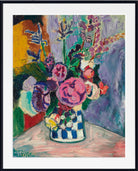
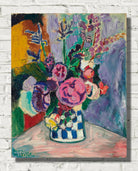


Peonies by Henri Matisse
Couldn't load pickup availability
BUY WITH CONFIDENCE
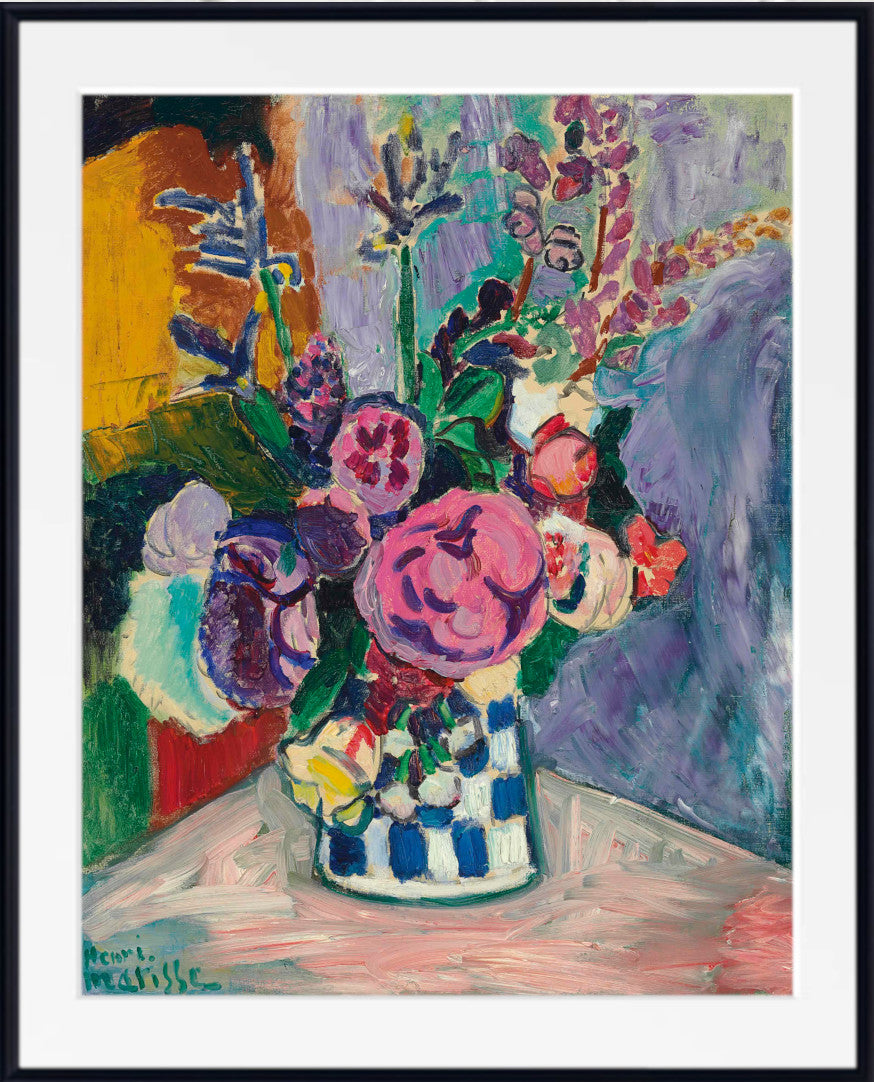
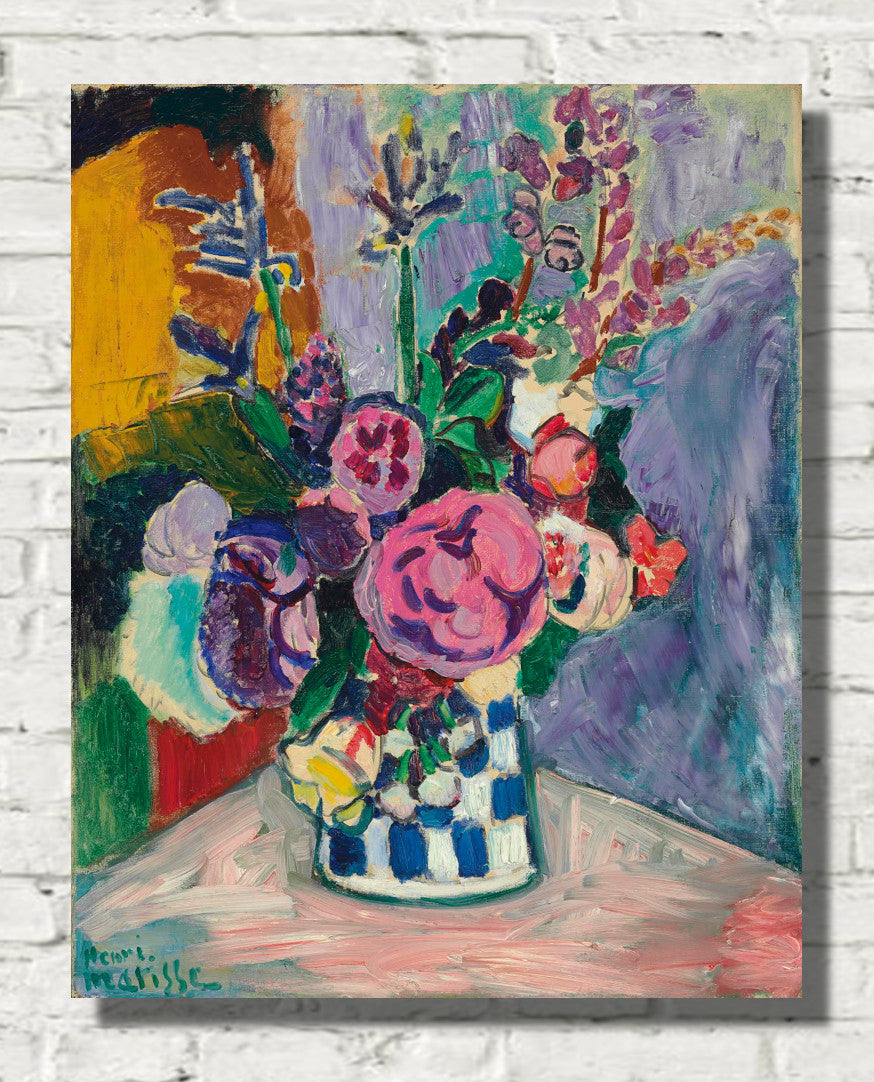
Peonies (Les Pivoines) (1907) by Henri Matisse is a spectacular Fauvist floral still life painted at Collioure during one of the most experimental periods of the artist's career. A dense bouquet of magenta peonies and slender purple irises rises from a low blue-and-white vase, while the surrounding wall seems to dissolve into an extraordinary cascade of vermilion, gold, green, blue, turquoise and lavender.
This Henri Matisse Peonies print captures the moment when the brilliant colour of Fauvism was developing into the flatter, increasingly decorative visual language that would define many of Matisse's greatest paintings. The flowers retain a remarkable sense of physical abundance, yet the space around them becomes progressively less conventional, allowing colour and brushwork to take on an almost independent life. Available as a fine art print, framed print or canvas panel, Les Pivoines is an outstanding choice for admirers of Matisse, Fauvist art, floral wall art and colourful modern still life.
Peonies – A Fauvist Bouquet at Collioure
Matisse painted Les Pivoines at Collioure in 1907, returning once again to the Mediterranean town that had played such an important role in the birth of Fauvism two years earlier.
The composition centres on a lush arrangement of late-spring flowers.
Large magenta peonies create the principal mass of the bouquet, while taller, more delicate purple irises introduce slender vertical forms above and between them.
The flowers are gathered in a comparatively low vase decorated with blue and white squares.
At first glance this appears to be a conventional floral still life.
Yet almost everything about Matisse's handling pushes the painting beyond convention.
The flowers combine substantial volume with energetic brushwork. The table has a convincing physical presence, but the wall behind it begins to lose its solidity altogether.
Instead of functioning as a quiet background, it becomes a field of independent colour.
A Bouquet Bursting with Colour
The peonies have an almost explosive presence.
Matisse does not describe every petal individually. Instead, he builds each flower from clusters of energetic coloured strokes.
Magenta, red, pink and deeper tones combine to create the dense rounded forms of the blossoms.
Between them rise thinner purple irises whose stems and flowers provide a contrasting rhythm.
The difference between the two types of flower is important.
The peonies appear heavy, rounded and abundant. The irises are more linear, open and vertical.
By placing these different forms together, Matisse creates a bouquet that is varied without becoming visually fragmented.
The flowers seem to expand beyond the confines of the vase, filling much of the upper canvas with colour and movement.
The Blue-and-White Vase
The low vase provides an important geometric counterpoint to the organic shapes above it.
Its decoration is simplified into contrasting blue and white squares.
These regular geometric forms differ sharply from the irregular curves and brushstrokes used to construct the flowers.
Matisse had become increasingly interested in this type of opposition between natural and manufactured forms.
Flowers offered unpredictable curves, overlapping petals and branching stems.
Vases, tables and other domestic objects provided clearer boundaries and more stable shapes.
Bringing the two together allowed him to explore how different visual rhythms could coexist within the same composition.
The vase therefore performs much more than a practical role as a container for the flowers. Its compact blue-and-white structure anchors the extraordinary movement above it.
Painting Flowers as Modern Art
Matisse had begun incorporating cut flowers more frequently into his still lifes during the previous year.
They offered enormous possibilities for a painter increasingly interested in colour, rhythm and pattern.
A flower could remain immediately recognisable while being simplified dramatically.
Its colour could be intensified without destroying its identity.
Petals, stems and leaves could also become part of a larger decorative structure stretching across the painting.
This made flowers ideal subjects for Matisse.
They allowed him to retain direct contact with visible reality while moving steadily towards a more autonomous form of painting in which colour and shape mattered as much as description.
Les Pivoines is one of the finest examples of that transformation.
The Wall Dissolves into Colour
One of the most remarkable features of Peonies is the treatment of the background.
In traditional still-life painting, a wall behind a table normally provides a stable spatial boundary.
Matisse effectively dematerialises it.
On the left, the background contains broad patches of vermilion, gold and dark green.
Towards the right, the handling becomes looser and more animated, with blue, sea green and lavender applied in increasingly free strokes.
The effect is extraordinary.
We understand that the flowers stand in front of a wall, but the wall no longer behaves like a solid architectural surface.
It becomes an independent cascade of coloured gestures.
The distinction between object and surrounding space begins to break down.
From Three-Dimensional Flowers to Flat Pattern
Matisse deliberately creates a tension between volume and flatness.
The large peonies retain considerable three-dimensional presence.
They appear to project forward from the vase, overlapping one another and occupying tangible space.
The taller stems near the upper part of the composition behave differently.
As they approach the background, they become flatter and increasingly integrated into its decorative pattern.
Flowers and wall start to merge.
This is one of the central innovations of the painting.
Matisse allows part of the composition to remain convincingly three-dimensional while another part approaches a flat decorative surface.
Rather than choosing between realism and abstraction, he holds both possibilities in tension.
The Table and the Solid World
The table provides another important contrast.
Unlike the increasingly intangible background, it possesses strong physical weight.
Matisse applies paint in thick, vigorous passages that reinforce the tabletop's solidity.
Its surface clearly recedes away from the viewer, establishing a recognisable sense of depth.
The vase sits firmly upon it.
Then, immediately behind this relatively conventional spatial structure, the wall begins to dissolve.
The painting therefore contains two apparently contradictory types of space.
The lower part remains tangible and structured.
The upper background becomes increasingly abstract.
This duality was fundamental to Matisse's development during 1906 and 1907.
Varied Brushwork Across a Single Canvas
Les Pivoines is notable for the remarkable variety of brushwork Matisse uses within one painting.
He does not employ a single consistent technique from top to bottom.
The table is constructed through comparatively thick, substantial strokes.
The peonies are built from dense clusters of energetic marks.
The irises require thinner, more linear gestures.
Parts of the background are constructed from flatter blocks of colour, while other areas contain freer, rapidly moving strokes.
This variety prevents the surface from becoming predictable.
Each section of the painting receives the kind of handling required by its role within the composition.
Yet repeated colours and rhythms prevent these different techniques from fragmenting the image.
Light and Shadow Without Conventional Atmosphere
There remains some sense of illumination across the painting.
The right side appears brighter while the left carries heavier, darker colour.
This may preserve something of Matisse's earlier practice of placing flower arrangements near a window.
Yet the light does not behave conventionally.
There is no carefully constructed atmospheric space stretching behind the bouquet.
Instead, light is translated into colour relationships.
Bright blues, greens and lavender suggest luminosity on one side, while deeper vermilion, gold and dark green establish greater visual weight on the other.
Matisse consequently transforms observed illumination into the structure of the painting itself.
Collioure in 1907
By 1907, Collioure had become one of the most important places in Matisse's artistic development.
His first decisive summer there in 1905, working alongside André Derain, had produced the radical colour experiments associated with the birth of Fauvism.
Matisse returned repeatedly.
The Mediterranean town provided intense light and a degree of separation from the competitive Parisian art world.
It allowed him to work through artistic problems with unusual concentration.
During 1906 and 1907 his attention shifted increasingly from landscape towards figure painting and still life.
The brilliant Fauvist colour remained, but new questions became more important.
How flat could pictorial space become while remaining recognisable?
How could decorative pattern replace conventional perspective?
How could colour unify an entire canvas?
Peonies records Matisse exploring precisely these questions.
Matisse Between Fauvism and a New Decorative Style
The painting was produced during a period of transition.
The radical colour of Fauvism remained central to Matisse's art, but he was increasingly moving towards a flatter and more decorative approach.
This should not be understood as decoration in the sense of superficial ornament.
For Matisse, decorative organisation meant treating the entire surface of a painting as an interconnected whole.
No section should exist merely as empty background.
Colour in one corner should relate to colour elsewhere.
A curved stem should participate in a rhythm established by other curves and shapes.
Objects, empty space and background should all contribute equally to the final harmony.
Les Pivoines is a major step towards that goal.
The Influence of Paul Cézanne
Paul Cézanne remained enormously important to Matisse during these years.
Cézanne had demonstrated that still life could become a laboratory for fundamental questions about structure and perception.
Tables could tilt unexpectedly. Objects could appear to be viewed from slightly different positions. Conventional perspective could be altered in order to strengthen the composition.
Matisse admired Cézanne deeply.
Yet by 1907 he was developing a solution very different from the greater solidity associated with Cézanne.
In Peonies, certain forms remain sculptural and substantial, but other areas flatten dramatically.
The work therefore explores the tension between Cézannesque volume and Matisse's emerging decorative flatness.
This tension was central to avant-garde painting around 1907.
Matisse and Picasso in 1907
The year 1907 also marked an important moment in the emerging artistic rivalry between Henri Matisse and Pablo Picasso.
Matisse had become recognised as one of the leading figures of the Parisian avant-garde through the notoriety and innovation of Fauvism.
Picasso, meanwhile, was undertaking increasingly radical experiments of his own and produced Les Demoiselles d'Avignon during the same year.
Both artists were reconsidering the lessons of Cézanne and questioning the inherited conventions of Western representation.
Their solutions were very different.
Picasso increasingly investigated fractured structure and multiple viewpoints.
Matisse developed colour, flatness and decorative unity.
Les Pivoines belongs directly to this period when several competing possibilities for the future of modern painting were emerging simultaneously.
From Peonies to Harmony in Red
The innovations in Peonies point directly towards Matisse's celebrated Harmony in Red of 1908.
In Les Pivoines, the table still recedes clearly into space while the rear wall becomes increasingly abstract.
In Harmony in Red, Matisse goes significantly further.
The same red field and blue decorative pattern spread across both wall and table, almost eliminating the boundary between horizontal and vertical surfaces.
The conventional room becomes a decorative field.
Peonies can therefore be understood as an important step towards that breakthrough.
The collapsing background and increasingly autonomous colour demonstrate Matisse discovering how far he could flatten pictorial space without abandoning recognisable objects altogether.
Peonies and the Development of Modern Floral Painting
Floral still lifes were traditionally regarded as a relatively conservative genre.
Matisse demonstrated that they could become vehicles for some of the most radical experiments in modern painting.
Flowers offered a built-in excuse for extraordinary colour.
The irregular forms of petals and stems also allowed brushwork to become more spontaneous.
Most importantly, a bouquet naturally occupies the boundary between volume and pattern.
Flowers possess physical depth, yet seen collectively they can create a flattened decorative arrangement.
Matisse exploited this ambiguity brilliantly.
His influence can subsequently be traced through numerous twentieth-century artists who treated flowers as structures of colour rather than merely botanical subjects.
Fauvist Colour in Peonies
Les Pivoines retains several characteristics central to Fauvism:
- intense, liberated colour
- magenta peonies and purple irises treated expressively
- strong contrasts between warm and cool hues
- visible, vigorous brushwork
- colour increasingly independent of literal natural appearance
- limited reliance on conventional atmospheric modelling
- a background transformed into expressive colour
- the whole canvas treated as an active pictorial surface
Yet the painting also demonstrates Matisse moving beyond the most straightforward definition of Fauvism.
The principal question is no longer simply how boldly colour can be used.
It is how colour can reorganise space itself.
Why Peonies Is Important
Peonies is particularly significant within Matisse's career because it brings together several competing artistic concerns at a moment when his style was developing rapidly.
The flowers possess real volume while the background approaches abstraction.
The table remains structurally convincing while the wall becomes intangible.
Colour refers to observed objects while simultaneously operating independently.
The painting therefore sits between several worlds:
- Fauvism and Matisse's mature decorative style
- three-dimensional modelling and flat pattern
- traditional still life and modern abstraction
- Cézannesque solidity and increasingly autonomous colour
- observed nature and pictorial invention
That complexity explains why the work has remained one of Matisse's most highly regarded Fauvist still lifes.
Henri Matisse's Painting Style in 1907
By 1907 Matisse had already moved through a remarkable series of artistic experiments.
His early painting reflected academic practice and naturalism before he encountered Impressionism and Post-Impressionism.
He explored Divisionist colour through his relationship with Paul Signac.
Working with André Derain at Collioure during the summer of 1905 helped liberate his palette still further and contributed to the emergence of Fauvism.
By 1907, however, Matisse was refusing to settle into a fixed formula.
He experimented simultaneously with sculptural solidity and radical flatness.
Increasingly, the flatter decorative solution proved more important.
Les Pivoines captures that shift while the energy of Fauvist colour remains unmistakably present.
About Henri Matisse
Henri Matisse (1869–1954) was a French painter, draughtsman, sculptor and printmaker and one of the defining artists of twentieth-century modernism.
Born in Le Cateau-Cambrésis in northern France, Matisse initially trained in law before discovering painting during a period of illness.
His artistic development was exceptionally broad, incorporating lessons from Impressionism, Post-Impressionism, Cézanne and Neo-Impressionist colour theory.
During the summer of 1905 at Collioure, his experiments alongside André Derain helped establish Fauvism.
Matisse became the movement's leading figure, but his career extended far beyond its brief historical life.
Over the following decades he developed an increasingly personal visual language based upon expressive colour, rhythmic line, simplified form and decorative harmony.
Still lifes, interiors, figures, patterned textiles and Mediterranean light remained central themes.
During his later years he transformed his art once again through the celebrated paper cut-outs, reducing colour and shape to some of their most direct and powerful forms.
The Original Peonies
The original Les Pivoines, or Peonies, was painted by Henri Matisse at Collioure in late spring 1907.
The work was created in oil on canvas and measures approximately 65 × 54.6 cm.
It is signed Henri. Matisse at the lower left.
The painting depicts a bouquet containing large magenta peonies and slender purple irises arranged in a low vase decorated with blue and white squares.
Its early provenance is particularly well documented.
Galerie Bernheim-Jeune in Paris acquired the painting directly from Matisse on 18 June 1907.
The influential critic and collector Félix Fénéon acquired it from Bernheim-Jeune later that year, on 28 November 1907.
Fénéon was one of the most perceptive supporters of modern art in Paris and had recently become artistic director of Bernheim-Jeune.
The painting was included in a still-life exhibition at Bernheim-Jeune in November 1907.
Matisse also selected it for his important solo retrospective at the gallery in 1910, demonstrating that he continued to regard the work as a significant stage in his artistic development.
Its later documented provenance includes Georges Aubry and Mme Bourdon before the work entered the private collection from which it was eventually offered at auction.
The painting was sold at Christie's in New York on 1 May 2012 for approximately $19.1 million, substantially exceeding its pre-sale estimate.
The work remains in a private collection.
A Henri Matisse Peonies Print for Your Interior
A Henri Matisse Peonies print combines the enduring appeal of floral art with the energy and sophistication of early twentieth-century modernism.
The magenta flowers immediately provide a strong focal point, while purple, blue, green, vermilion, gold and lavender create a much broader surrounding palette.
This makes the work especially effective against white, cream, putty, pale grey and other neutral wall colours.
The floral subject can soften minimalist interiors, while the vigorous brushwork prevents the image from feeling traditional or overly decorative.
Natural timber furniture works particularly well with Matisse's palette, as do restrained Scandinavian-inspired interiors where the painting can provide the principal source of colour.
The vertical composition makes Peonies particularly useful for narrower wall spaces, above console tables, beside fireplaces or within a carefully arranged gallery wall.
It can work especially well in living rooms, dining rooms, bedrooms, kitchens, hallways and home offices.
For admirers of Matisse and Fauvism, however, the painting offers far more than an attractive bouquet. It captures one of the crucial moments when Matisse was transforming Fauvist colour into the increasingly decorative and abstract visual language that would shape the rest of his career.
Frequently Asked Questions
When did Henri Matisse paint Peonies?
Matisse painted Les Pivoines at Collioure in late spring 1907.
What is the French title of Peonies?
The original French title is Les Pivoines.
What flowers appear in Matisse's Peonies?
The bouquet contains large magenta peonies together with slender purple irises and other late-spring flowers.
What does the vase look like?
The flowers are arranged in a relatively low vase decorated with a distinctive pattern of blue and white squares.
Is Peonies a Fauvist painting?
Yes. Les Pivoines belongs to Matisse's Fauvist period and uses the vivid, liberated colour associated with Fauvism. It also demonstrates his movement towards the flatter and more decorative style that developed after the height of the movement.
Why does the background look almost abstract?
Matisse deliberately reduces the solidity of the rear wall. Instead of modelling it as conventional architectural space, he transforms it into vigorous patches and strokes of vermilion, gold, green, blue and lavender.
Why are the peonies more three-dimensional than the background?
This contrast is fundamental to the painting. Matisse allows the flowers and table to retain substantial physical volume while the background becomes increasingly flat and intangible, creating tension between realism and decorative abstraction.
How does Peonies relate to Harmony in Red?
Peonies anticipates the increasingly flattened decorative space of Harmony in Red of 1908. In the earlier painting the table remains clearly three-dimensional while the wall begins to dissolve; in Harmony in Red, Matisse pushes the flattening of interior space much further.
Was Peonies painted at Collioure?
Yes. Matisse painted the work at Collioure in southern France, the Mediterranean town that had played a central role in his development of Fauvism.
What medium did Henri Matisse use?
The original Les Pivoines was painted in oil on canvas.
What size is the original Peonies?
The original measures approximately 65 × 54.6 cm.
Is the original Peonies signed?
Yes. Matisse signed the painting Henri. Matisse at the lower left.
Where is the original Peonies by Henri Matisse?
The original is currently held in a private collection.
Who first owned Peonies?
Galerie Bernheim-Jeune acquired the painting directly from Matisse in June 1907. The critic and collector Félix Fénéon acquired it from the gallery in November of the same year.
Was Peonies exhibited during Matisse's lifetime?
Yes. The painting appeared in a still-life exhibition at Galerie Bernheim-Jeune in 1907 and was included in Matisse's important solo retrospective at the same gallery in 1910. It was subsequently shown in numerous major exhibitions devoted to Matisse and Fauvism.
How much did Matisse's Peonies sell for?
The original Les Pivoines sold at Christie's in New York in May 2012 for approximately $19.1 million.
Why is Peonies important in Matisse's career?
The painting captures Matisse at a crucial transition between the vivid colour of Fauvism and the increasingly flattened, decorative organisation that would become fundamental to his mature art.
Is Peonies available as a framed Henri Matisse print?
Yes. GalleryThane offers Peonies (Les Pivoines) (1907) in a choice of sizes and formats, including fine art paper prints, framed prints and canvas options.
Where would a Henri Matisse Peonies print work well?
Its vertical format and rich floral palette make it particularly suitable for living rooms, dining rooms, bedrooms, kitchens, hallways and home offices. It works especially well in contemporary, Scandinavian-inspired, mid-century and eclectic interiors.
All orders for unframed fine art prints and original paintings are dispatched within 2 working days of receipt of payment.
Orders for custom framed prints are dispatched within 4 working days.
All orders are fully tracked from dispatch to delivery at your home or business.
All print and original painting orders are fully insured against loss or damage in transit. We refund or replace any damaged or lost orders.
Buy with confidence - read what our satisfied customers have to say - Reviews
Fine art papers are printed without any additional white border Please let us know at the time of ordering if you would like a small additional white border.
Rolled canvas options have an additional white border of approximately 2.5 inches (7cm) on all 4 sides to aid stretching.
Ready to hang canvas panels are stretched on 1.5 inch deep solid pine frames from sustainable forestry sources. The image is mirrored on all 4 sides to give an aesthetically pleasing finish.
Why not have us gift wrap your order and attach a personalised message to the recipient. Available for all orders. Each order is hand wrapped in high quality gift wrap with meatllic ribbon and bow. Your personalised message is printed on a card which is included with your order.
Have your hand wrapped gift delivered directly to the recipient.
Full tracking and insurance included with every order.
Please note design may vary depending upon availability
Just purchase the gift wrap option HERE
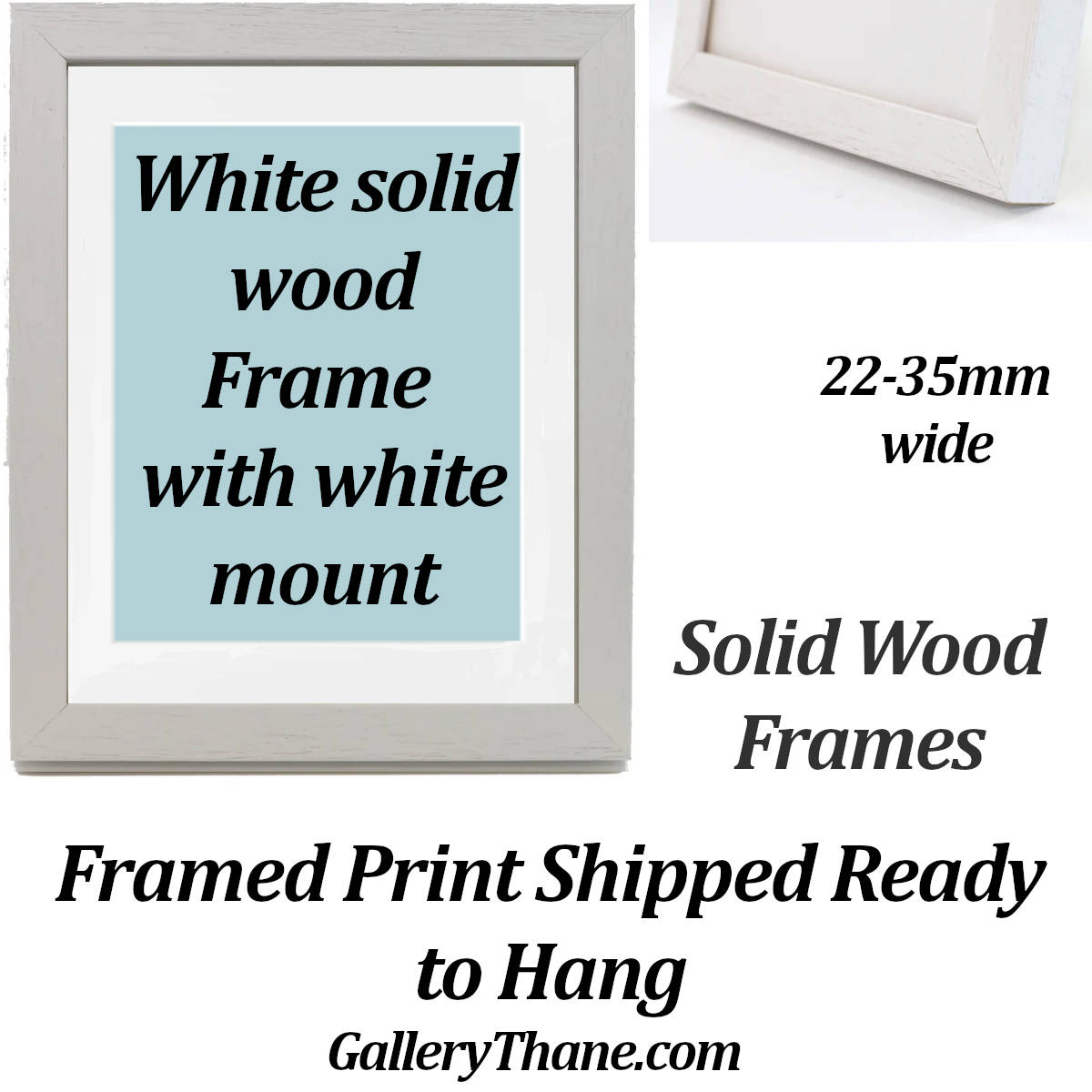
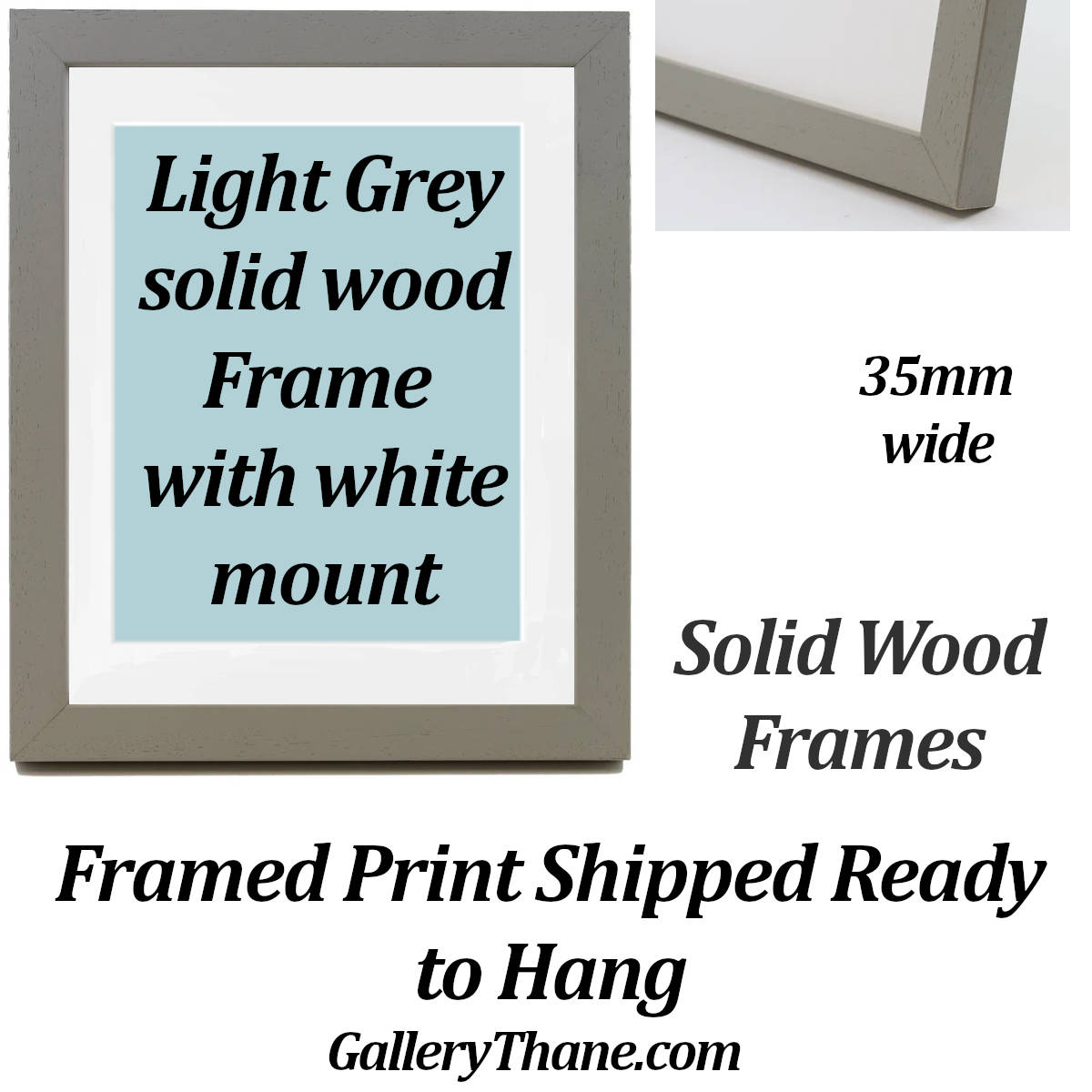
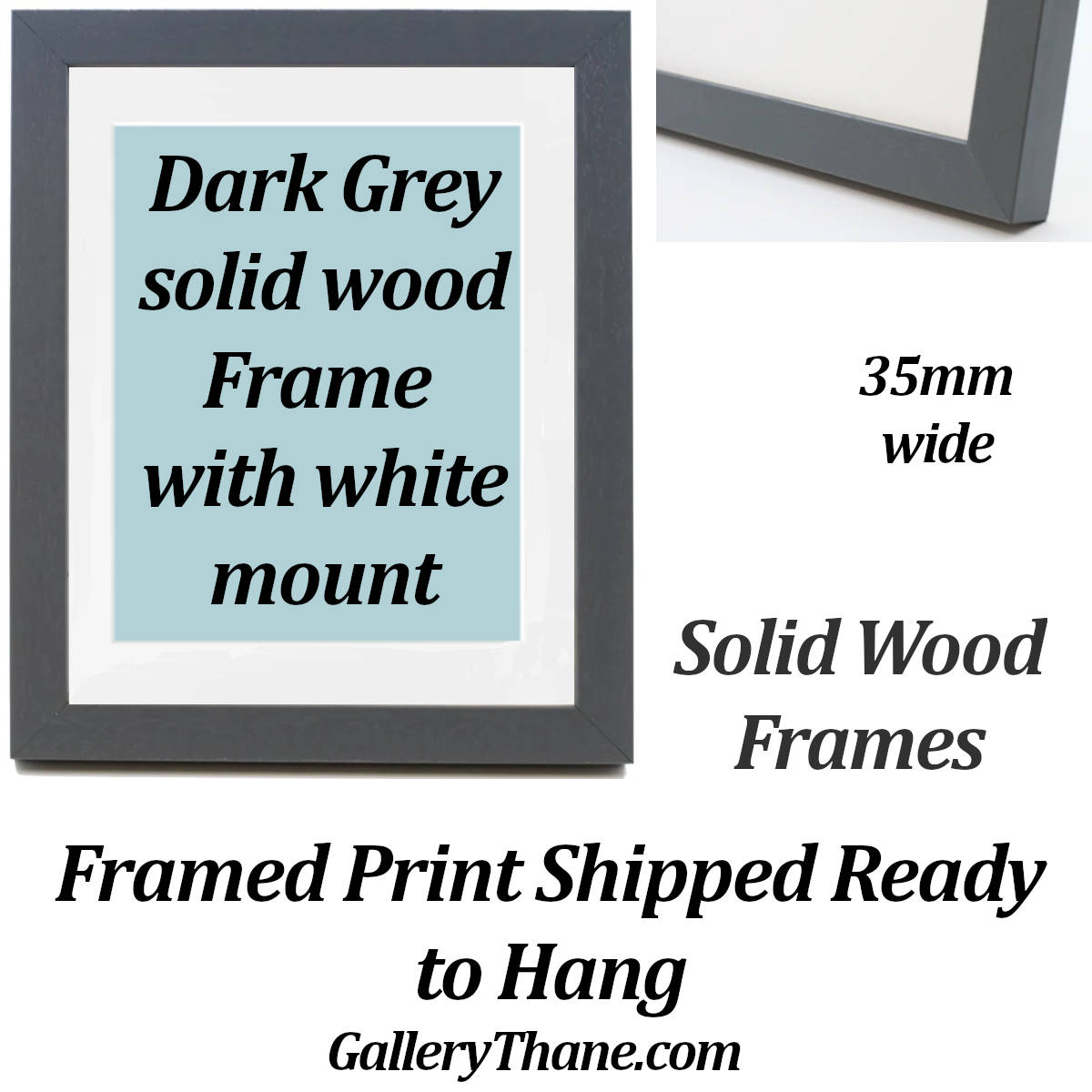
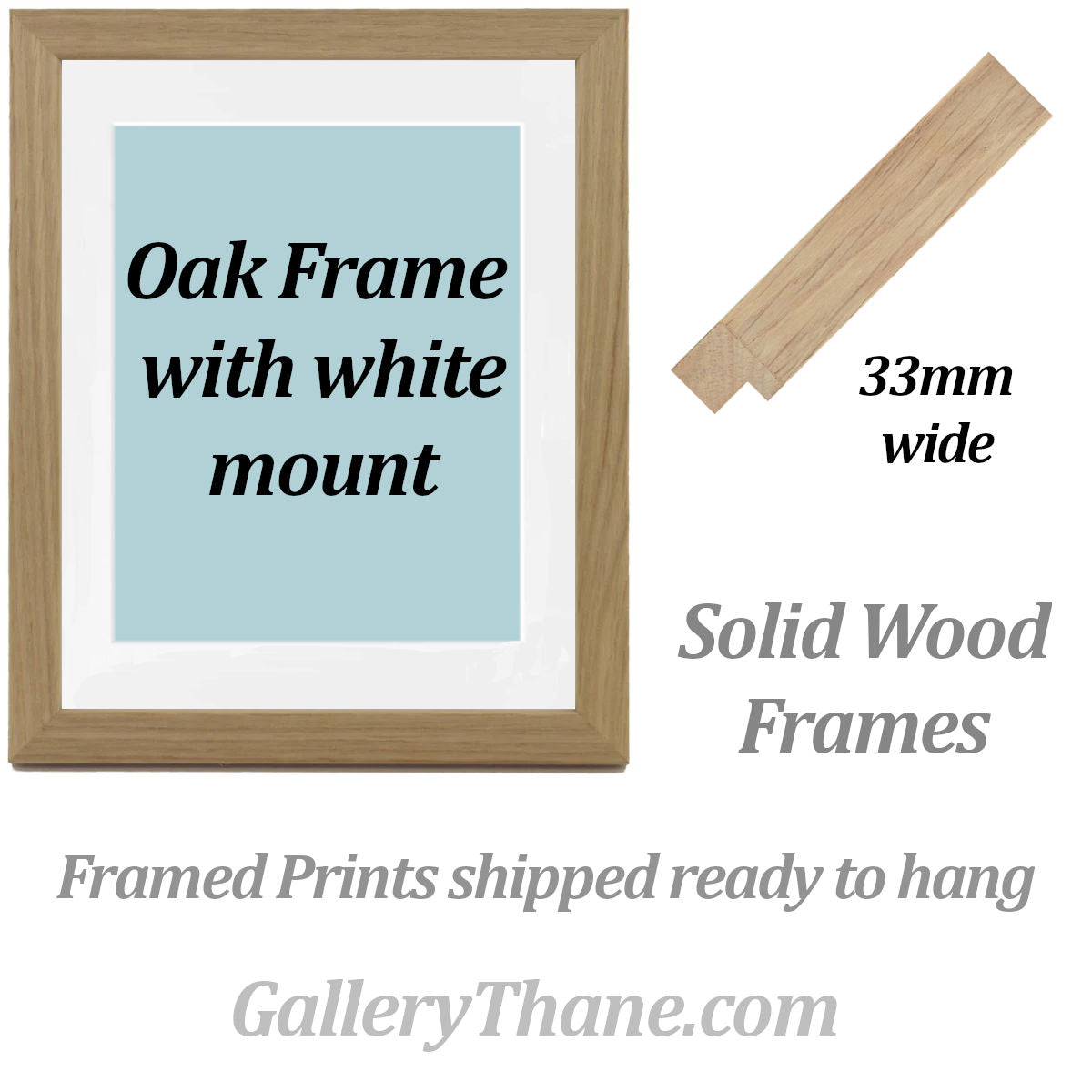
We have a wide range of frames in standard sizes and we also make custom size frames.
To order a framed print:
1. select the print size you would like along with the print materials (matte paper, fine art paper).
2. Add your print choice to the basket.
3. Choose from our range of frames
4. Select the same size as the print you have added to your basket. If the frame size you want is not listed please contact us
5. Choose from the mount or no-mount option
6. Add your frame choice to the basket
7. Proceed to checkout.
Why Choose GalleryThane?
- Printed and framed in-house
- Free UK delivery
- Free EU and USA delivery on orders over £200
- Tracking and insurance included in every order
- Fast 1-3 day dispatch
- Gift wrapping service available
- Gallery quality materials
- Sustainable, eco-friendly packaging
- Great customer support
Explore related collections

What makes our Prints and Canvas Panels so special

Latest Giclee Printing Technology
We have invested in the latest wide format print technology to produce museum quality giclee prints utilising the highest quality pigment inks to give outstanding colour reproduction.

Museum Quality Archival Fine Art Papers
We print on the finest quality fine art papers with textured, smooth and lustre finishes for prints which last a lifetime.
From aceo miniatures to 40x80 inch large format, every print has our lifetime quality guaranteee.

Solid Wood Frames, Cotton Canvas
All of the wood for our canvas panels and frames is responsibly sourced from manages forests. Our cotton canvas is completely seedless for the highest quality reproduction possible.

Have Your Gift Wrapped


Choose a Custom Frame
Popular Collections


EU Representative
Manufacturer
LucasAbstract t/a GalleryThane
15 Campion Way, Bingham NG13 8TR UK
sales@gallerythane.com
EU Authorised Representative
Westwood Sourcing
Fellenoordstraat 52, Unit 2.38
4811 TJ Breda, Netherlands
info@westwoodsourcing.com