


Henri Matisse Print – Goldfish (1912)
Couldn't load pickup availability
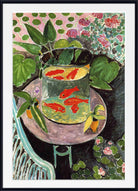
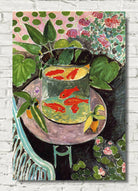
Goldfish (1912) by Henri Matisse
Henri Matisse's Goldfish (1912) is one of the most recognisable still lifes of his early modernist period. Four brilliant red-orange fish swim within a cylindrical glass bowl surrounded by lush green leaves, flowering plants, a tilted circular table and glimpses of turquoise garden furniture.
The painting appears joyful and immediately accessible, yet beneath its brilliant colour lies an extraordinarily sophisticated experiment with perspective. Matisse allows us to see the fish bowl simultaneously from the front and from above, deliberately disrupting conventional pictorial space and transforming an intimate garden subject into a landmark of modern painting.
Available as a Henri Matisse fine art print, framed print or canvas wall art, Goldfish combines intense complementary colour with plants, flowers and decorative pattern, making it one of Matisse's most appealing works for colourful contemporary interiors.
A Goldfish Bowl in Matisse's Garden
Matisse painted Goldfish in 1912 at his studio in Issy-les-Moulineaux, outside Paris.
The setting is intimate rather than imaginary. A glass fish bowl stands on a small round table surrounded by dense vegetation and garden furniture. Broad leaves overlap one another while pink and red flowers rise behind the bowl.
The brilliant fish occupy the visual centre of the composition.
Their vivid red-orange bodies immediately attract the eye before the viewer begins to discover the remarkably complex arrangement of plants, furniture, water, glass and reflected forms around them.
Rather than presenting a traditional still life against a neutral background, Matisse almost completely fills the canvas with living colour.
Why Goldfish Became Important to Matisse
Goldfish became a recurring motif in Matisse's paintings during the years around 1912.
He explored the subject in several different compositions, including paintings in which fish bowls appear alongside sculpture, studio interiors, windows and plants.
This GalleryThane work should therefore not be confused with other Matisse paintings such as Goldfish and Sculpture or Studio with Goldfish.
The 1912 Goldfish in the Pushkin State Museum is a distinct vertical composition in which the fish themselves become the central subject.
Matisse painted it during the period between his first and second visits to Morocco, when he was simultaneously exploring Mediterranean and North African light, decorative pattern and increasingly unconventional approaches to pictorial space.
Red Fish Against Green
The most immediate feature of Goldfish is its colour.
The fish are painted in brilliant red-orange, surrounded almost completely by greens.
This relationship is fundamental to the painting.
Red and green are complementary colours. Placed beside one another, each appears visually more intense.
Matisse had explored this principle dramatically during his earlier Fauvist period, when colour was deliberately liberated from strict naturalistic description.
By 1912 his style had become more structured, but those discoveries remained fundamental.
The fish do not need elaborate modelling or minute detail to command attention. Their saturated colour separates them instantly from the surrounding vegetation and water.
Pink, Green, Turquoise and Orange
The red-orange fish are only one part of a carefully balanced palette.
Green dominates much of the composition through large tropical leaves and smaller rounded plant forms.
Behind them, the upper background shifts towards pink, punctuated by red flowers and areas of turquoise, white and darker foliage.
At the lower left, part of a pale turquoise garden chair enters the composition at an angle.
These colours are repeated and redistributed across the canvas.
Orange appears in flowerpots as well as the fish. Pink appears in both flowers and background. Turquoise enters the chair, water and surrounding forms.
The painting therefore works as an interconnected colour structure rather than a collection of separately painted objects.
A Radical View of the Fish Bowl
One of the most remarkable aspects of Goldfish is the way Matisse constructs space.
The glass bowl is presented largely from the front.
We can clearly see the fish swimming through the water, including their eyes, mouths and fins.
Yet the upper surface of the water is simultaneously visible from above.
Several more fish appear as red shapes across this upper plane.
A single fixed viewpoint cannot explain both views convincingly.
Matisse deliberately combines them.
The result challenges the traditional Renaissance idea that a painting should behave like a window through which everything is observed from one stable position.
The Tilted Table
The round table adds another layer of spatial ambiguity.
Its surface appears tilted sharply upwards towards the viewer.
If interpreted literally, the bowl and surrounding flowerpots would seem in danger of sliding forwards.
But Matisse is not attempting to construct mathematically consistent three-dimensional space.
He alters perspective so that the objects can be seen clearly and so that the round tabletop contributes strongly to the design.
The large oval of the table echoes the circular opening of the fish bowl, while the curved table legs continue the rhythmic movement of the fish and plants.
Matisse, Cézanne and Multiple Viewpoints
Matisse's willingness to tilt surfaces and combine viewpoints has important connections with the work of Paul Cézanne.
Matisse admired Cézanne profoundly.
In Cézanne's still lifes, tables frequently tilt, objects seem to be viewed from subtly different angles and strict perspective gives way to a pictorial structure designed around the needs of the painting itself.
Matisse develops a related idea in Goldfish.
We understand that the bowl, table and plants occupy real space, yet their relationships have been reorganised to produce a stronger composition.
The painting consequently exists in two ways at once: as a recognisable garden scene and as an arrangement of shapes, colours and rhythms across a flat canvas.
The Fish Seen Through Glass and Water
The transparent aquarium gave Matisse another intriguing visual problem.
Plants behind the bowl appear altered by the curved glass and water.
Leaves and stems shift, distort or become difficult to distinguish from reflections.
The fish themselves occupy an equally ambiguous environment.
Some are described sufficiently clearly to appear almost tangible, while others become simple streaks or patches of colour.
Matisse therefore uses the glass vessel to complicate the relationship between what is actually present and what the viewer perceives.
Still Life Becomes a Living Subject
Although Goldfish belongs broadly to the tradition of still life painting, it is unusually animated.
The fish swim continuously around the bowl.
Curving leaves appear to grow in every direction.
Flowers bend on thin stems.
The circular table and rounded foliage establish repeated arcs across the canvas.
Even the garden chair enters from the lower-left corner at a strong diagonal.
The result is a still life filled with movement.
Rather than freezing isolated objects on a tabletop, Matisse creates an environment in which almost every form appears alive.
Pattern Across the Canvas
The upper half of Goldfish is especially decorative.
Round leaves appear against a pink field, while flowers and smaller foliage form dense areas of repeated shape.
At times the background begins to resemble patterned textile or wallpaper rather than conventional three-dimensional garden space.
This flattening is characteristic of Matisse.
Throughout his career he was fascinated by fabrics, carpets, wallpapers, screens, flowers and other patterned surfaces.
Instead of relegating decoration to the background, he allowed it to compete with the principal subject.
In Goldfish, the distinction between object, vegetation and decorative pattern becomes deliberately unstable.
Beyond Fauvism
Goldfish was painted around seven years after the famous 1905 Salon d'Automne that gave Fauvism its name.
It is therefore misleading to describe this simply as another early Fauvist painting.
By 1912 Matisse's art had changed considerably.
His colour remained intense, but his attention was increasingly directed towards structure, spatial ambiguity and the relationship between decorative surface and recognisable objects.
At the same time, Cubism had transformed the Parisian avant-garde through the work of Pablo Picasso and Georges Braque.
Matisse did not become a Cubist, but his paintings of the early 1910s show his own increasingly radical investigations of pictorial space.
Goldfish is an excellent example: its subject is peaceful and domestic, while its construction is surprisingly experimental.
Goldfish and Matisse's 1912 Paintings
The year 1912 was exceptionally productive for Matisse.
After returning from his first stay in Tangier, he worked again at Issy-les-Moulineaux before later returning to Morocco.
During this interval he painted several important works involving goldfish and studio imagery.
These included the Pushkin Museum's Goldfish, other fish-bowl compositions and versions of Nasturtiums and “Dance”.
Seen together, these paintings reveal an artist experimenting repeatedly with similar objects while altering scale, viewpoint and composition.
The fish bowl became a flexible visual device through which Matisse could explore colour, transparency and space.
Sergei Shchukin and Goldfish
The original painting has an important connection with the great Russian collector Sergei Ivanovich Shchukin.
Shchukin was one of the most adventurous collectors of modern French art before the First World War and became an exceptionally important patron of Matisse.
His Moscow collection contained numerous works by the artist, including the monumental Dance and Music decorations.
In July 1912, Shchukin acquired Goldfish directly from Matisse at Issy-les-Moulineaux for 6,000 francs.
The painting subsequently formed part of the celebrated Pink Drawing Room ensemble in Shchukin's Moscow house.
This early acquisition places Goldfish directly within one of the most important private collections responsible for promoting French modernism internationally.
From the Shchukin Collection to the Pushkin Museum
After the Russian Revolution, Shchukin's collection was nationalised.
Goldfish subsequently passed through the reorganised state collections devoted to modern Western art.
The Pushkin Museum's provenance record traces it from Shchukin's collection to the First Museum of New Western Painting and subsequently the State Museum of New Western Art.
In 1948 the painting entered the Pushkin State Museum of Fine Arts in Moscow, where it remains today.
Original Artwork Details
- Artist: Henri Matisse (1869–1954)
- Title: Goldfish
- Alternative museum title: Red Fish (Goldfish)
- Date: 1912
- Place painted: Matisse's studio at Issy-les-Moulineaux, France
- Medium: Oil on canvas
- Dimensions: 140 × 98 cm
- Original collector: Sergei Ivanovich Shchukin
- Acquired by Shchukin: July 1912, directly from Matisse
- Present collection: Pushkin State Museum of Fine Arts, Moscow
- Museum number: Ж-3299
About Henri Matisse
Henri Matisse was born in Le Cateau-Cambrésis, France, in 1869 and became one of the defining artists of twentieth-century modernism.
After initially training in law, Matisse turned to art and studied in Paris, including under Gustave Moreau at the École des Beaux-Arts.
His breakthrough came during the early years of the twentieth century.
Working with artists including André Derain, Matisse increasingly rejected conventional naturalistic colour. Their brilliantly coloured paintings exhibited at the 1905 Salon d'Automne became associated with Fauvism.
Matisse subsequently developed far beyond that brief movement.
His work encompassed landscapes, portraits, monumental figure compositions, still lifes, richly patterned interiors, Moroccan paintings, experimental works of the 1910s, Nice-period figures and interiors, and finally the revolutionary paper cut-outs of his last years.
Despite these changes, colour, line, rhythm and simplification remained central throughout his career.
Explore more works in GalleryThane's Henri Matisse prints collection.
Henri Matisse's Painting Style in Goldfish
Complementary Colour
Brilliant red-orange fish stand against extensive green foliage, allowing complementary colours to intensify one another.
Multiple Viewpoints
The bowl can be seen both from the front and from above, while the tabletop is tilted towards the viewer. Conventional single-point perspective is deliberately abandoned.
Flattened Decorative Space
Plants and flowers increasingly behave as patterns across the canvas rather than objects receding naturally into the background.
Simplified Form
Fish, leaves, flowers and furniture are reduced to clear shapes while retaining enough detail to remain immediately recognisable.
Visual Rhythm
Repeated circular and curving shapes — the bowl, tabletop, fish, leaves and table legs — carry the eye continuously through the composition.
Displaying a Goldfish Print in Your Home
A Goldfish print by Henri Matisse is particularly effective where you want a strong vertical artwork with substantial colour.
The combination of green foliage, pink background, turquoise accents and vivid orange-red fish works naturally against white, cream, putty, pale grey and other neutral wall colours.
Natural oak and other pale timbers complement the painting particularly well and can give the work a distinctly Scandinavian-inspired setting.
Dark timber, walnut and mid-century furniture can create a richer contrast with the foliage and pink background.
The tall portrait format makes Goldfish well suited to a wall above a console table, beside a fireplace, between windows or doors, or as the focal artwork within a colourful gallery wall.
The abundance of plants and flowers also makes the work especially effective in interiors containing natural materials and indoor greenery.
A Matisse Print for Botanical and Colour-Led Interiors
Although the goldfish provide the principal focus, much of the canvas is occupied by foliage and flowers.
This gives the painting an unusual versatility.
It can function as modernist wall art, a colourful still life or an almost botanical composition.
The pink and green palette can bring warmth to restrained interiors, while the intense fish provide small but powerful areas of orange-red.
Rather than trying to match every colour within a room, picking up one or two accents — perhaps green, turquoise or muted pink — is usually enough to connect the print naturally with surrounding furnishings.
Goldfish Prints, Framed Prints and Canvas Wall Art
GalleryThane offers Goldfish by Henri Matisse in a wide range of sizes and presentation options.
Choose a fine art paper print for a traditional presentation, add a professionally made frame and white mount for ready-to-display wall art, or select a canvas format for a more contemporary appearance.
The portrait proportions of the original are preserved, allowing the distinctive vertical composition of Matisse's painting to remain intact.
GalleryThane prints and frames its artwork in-house using archival art stocks, pigment inks and carefully selected framing materials.
Frequently Asked Questions
When did Henri Matisse paint Goldfish?
Matisse painted this version of Goldfish in 1912.
Where was Matisse's Goldfish painted?
The Pushkin Museum records that the painting was made in Matisse's studio at Issy-les-Moulineaux, outside Paris.
Is this the same painting as Goldfish and Sculpture?
No. Matisse produced several paintings featuring goldfish during this period. The GalleryThane image corresponds to the tall portrait-format Goldfish of 1912 now in the Pushkin State Museum of Fine Arts. Goldfish and Sculpture is a separate composition.
Why did Matisse paint goldfish so often?
Goldfish became a recurring motif in Matisse's work during the early 1910s. Their brilliant colour, curved glass bowls and reflective water gave him opportunities to explore complementary colour, transparency and unconventional pictorial space.
How many goldfish are shown in the bowl?
Four distinct red-orange fish are clearly visible through the front of the bowl. Additional red forms seen across the upper surface demonstrate how Matisse combines frontal and overhead viewpoints within the same image.
Why are the fish so bright?
Matisse places intense red-orange against extensive green foliage. Red and green are complementary colours, so their proximity increases the apparent intensity of both.
Why does the table look tilted?
Matisse deliberately alters conventional perspective. Tilting the tabletop allows more of its surface to be seen while also strengthening its circular shape within the overall composition.
Is Goldfish a Fauvist painting?
The painting dates from 1912, several years after Matisse's concentrated Fauvist period of approximately 1905–07. Its brilliant complementary colour reflects lessons learned through Fauvism, but its complex treatment of perspective belongs to Matisse's later artistic development.
What medium did Matisse use for Goldfish?
The original is painted in oil on canvas.
How large is the original Goldfish?
The Pushkin State Museum's current catalogue gives the dimensions as 140 × 98 cm.
Why do some sources give different dimensions?
Published secondary references sometimes give slightly different measurements. The dimensions used here follow the current catalogue of the Pushkin State Museum of Fine Arts, which owns the painting.
Who originally owned Goldfish?
The influential Russian collector Sergei Shchukin acquired the painting directly from Matisse in July 1912.
How much did Shchukin pay for Goldfish?
The Pushkin Museum's Shchukin archive records a purchase price of 6,000 francs.
Where did Shchukin display the painting?
Goldfish formed part of the ensemble in the Pink Drawing Room of Shchukin's Moscow residence.
Where is Henri Matisse's original Goldfish today?
The original belongs to the Pushkin State Museum of Fine Arts in Moscow.
What is the museum number for Goldfish?
The Pushkin Museum catalogues the work under museum number Ж-3299.
What colours work with a Goldfish print?
Its green, pink, turquoise and orange-red palette works particularly well with white, cream, putty, pale grey, natural timber, dark green and restrained terracotta or pink accents.
Is Goldfish suitable for a modern interior?
Yes. Its vivid palette, flattened perspective and strong decorative shapes work particularly well in contemporary, Scandinavian-inspired, mid-century and eclectic interiors.
Can I buy Goldfish as a framed print?
Yes. GalleryThane offers Goldfish as a fine art print with professional framing options, as well as canvas formats in a choice of sizes.
All orders for unframed fine art prints and original paintings are dispatched within 2 working days of receipt of payment.
Orders for custom framed prints are dispatched within 4 working days.
All orders are fully tracked from dispatch to delivery at your home or business.
All print and original painting orders are fully insured against loss or damage in transit. We refund or replace any damaged or lost orders.
Buy with confidence - read what our satisfied customers have to say - Reviews
Fine art papers are printed without any additional white border Please let us know at the time of ordering if you would like a small additional white border.
Rolled canvas options have an additional white border of approximately 2.5 inches (7cm) on all 4 sides to aid stretching.
Ready to hang canvas panels are stretched on 1.5 inch deep solid pine frames from sustainable forestry sources. The image is mirrored on all 4 sides to give an aesthetically pleasing finish.
Why not have us gift wrap your order and attach a personalised message to the recipient. Available for all orders. Each order is hand wrapped in high quality gift wrap with meatllic ribbon and bow. Your personalised message is printed on a card which is included with your order.
Have your hand wrapped gift delivered directly to the recipient.
Full tracking and insurance included with every order.
Please note design may vary depending upon availability
Just purchase the gift wrap option HERE
Why Choose GalleryThane?
- Printed and framed in-house
- Free UK delivery
- Free EU an USA delivery on orders over £200
- Tracking and insurance included in every order
- Fast 1-3 day dispatch
- Gift wrapping service available
- Gallery quality materials
- Sustainable, eco-friendly packaging
- Great customer support
What makes our Prints and Canvas Panels so special

Latest Giclee Printing Technology
We have invested in the latest wide format print technology to produce museum quality giclee prints utilising the highest quality pigment inks to give outstanding colour reproduction.

Museum Quality Archival Fine Art Papers
We print on the finest quality fine art papers with textured, smooth and lustre finishes for prints which last a lifetime.
From aceo miniatures to 40x80 inch large format, every print has our lifetime quality guaranteee.

Solid Wood Frames, Cotton Canvas
All of the wood for our canvas panels and frames is responsibly sourced from manages forests. Our cotton canvas is completely seedless for the highest quality reproduction possible.
Multi-column

Have Your Gift Wrapped


