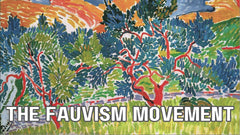
Table of Contents:[hide]
- Early Life and Artistic Beginnings
- From Impressionism to Fauvism
- Raoul Dufy's Painting Style: Colour, Line and Movement
- Regattas, Horse Racing, Cities and the French Riviera
- Textiles, Fashion and Decorative Arts
- La Fée Électricité
- Later Years and Legacy
- Raoul Dufy Prints and Canvas Panels
- Frequently Asked Questions
- Explore Related Art and Artists
Raoul Dufy (1877–1953) was one of the most distinctive French artists of the early twentieth century. Celebrated for luminous colour, fluid drawing and an unmistakable sense of movement, he transformed racecourses, regattas, Mediterranean resorts, Parisian streets, concerts and fashionable social gatherings into exuberant celebrations of modern life.
Although closely associated with Fauvism, Dufy's career extended far beyond a single movement. His paintings absorbed influences from Impressionism, Post-Impressionism and modernist experimentation, while his work in textiles, illustration, ceramics and decorative design made him an important figure in the broader visual culture of his era. Today, his joyful imagery remains highly recognisable, and the extensive Raoul Dufy prints collection at GalleryThane brings together his landscapes, regattas, racing scenes, city views, still lifes and decorative compositions.

Early Life and Artistic Beginnings
Raoul Dufy was born on 3 June 1877 in Le Havre, the Normandy port that had already played an important role in the development of modern French painting. He began studying art at the École Municipale des Beaux-Arts in Le Havre, where his fellow students included Othon Friesz, before continuing his training in Paris.
Normandy's coastline, harbours and changing light provided subjects that remained important throughout Dufy's career. His earliest paintings were comparatively naturalistic, and his interest in atmospheric colour owed much to the generation of Impressionist painters who had transformed French landscape painting during the preceding decades.
The work of artists such as Claude Monet and Camille Pissarro helped demonstrate how colour, light and immediate visual sensation could take precedence over highly finished academic technique.
From Impressionism to Fauvism
A decisive change occurred when Dufy encountered the radical new painting of the Fauves. The intense, non-naturalistic colour used by Henri Matisse, André Derain and their contemporaries demonstrated that colour could operate independently of literal description.
Dufy embraced this liberation enthusiastically. Buildings, trees, beaches and figures could be constructed from brilliant blues, reds, greens and yellows rather than faithfully reproducing their observed colours. His work from this period places him firmly within the history of the Fauvist movement, although he soon began developing a visual language that was increasingly his own.
Raoul Dufy's Painting Style: Colour, Line and Movement
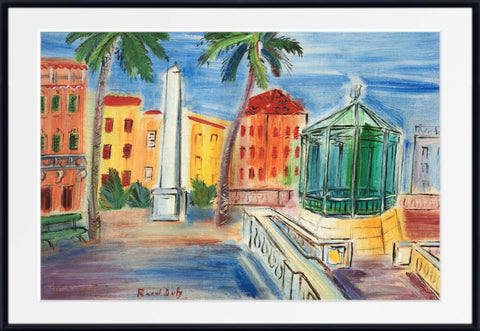
Fauvism was only one stage in Dufy's artistic development. His encounter with the work of Paul Cézanne encouraged a greater concern with structure, while his subsequent experiments gradually produced the characteristic style for which he is now best known.
Dufy increasingly separated drawing from colour. Rapid, calligraphic lines describe buildings, boats, horses and figures, while areas of transparent colour often appear to float beneath or around those outlines rather than remaining confined by them. This deliberate separation creates the remarkable sense of spontaneity and movement that distinguishes mature Raoul Dufy paintings.
The technique is sometimes described as stenographic because Dufy could suggest a complex scene through an economical vocabulary of marks. A few sweeping lines might indicate a horse and rider; a cluster of verticals could establish a harbour; arcs of blue could evoke sea, sky and movement simultaneously.
Far from being unfinished, these abbreviated forms were the result of a highly developed visual language. Dufy reduced scenes to their essential rhythms, allowing colour and line to communicate atmosphere rather than painstaking description.
Regattas, Horse Racing, Cities and the French Riviera
Dufy's mature art is closely associated with the pleasures and spectacle of modern life. Regattas, yacht races, seaside promenades, casinos, orchestras and horse-racing meetings repeatedly appear in his work. These subjects gave him the ideal combination of colour, movement, crowds and changing light.
His numerous paintings of sailing boats and coastal resorts connect naturally with the wider tradition of seascape art, but Dufy's interpretation is unmistakably modern. Rather than carefully recording individual vessels or precise maritime conditions, he created rhythmic arrangements of sails, flags, waves and spectators.
Horse racing offered similar possibilities. Paintings of Deauville, Ascot and other fashionable race meetings are filled with jockey silks, spectators, horses and sweeping tracks. Works such as Weighing at Deauville show how effectively Dufy could turn a social event into a decorative composition alive with colour.
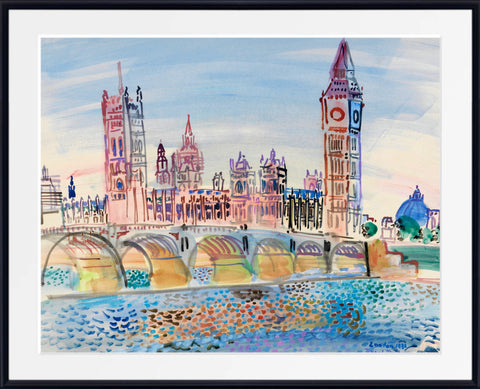
Cities also fascinated him. Paris, London, Venice and towns along the Mediterranean coast became recurring subjects. Dufy's architectural paintings combine recognisable landmarks with the same fluid visual shorthand seen in his regattas. His city paintings can be explored alongside GalleryThane's broader collection of architecture and cityscape prints.
Textiles, Fashion and Decorative Arts
Dufy's importance extends well beyond easel painting. He worked extensively as an illustrator and designer and became particularly influential through his textile designs.
His association with fashion designer Paul Poiret and the textile manufacturer Bianchini-Férier allowed his energetic drawing and brilliant colour combinations to move from paintings into fabrics and fashionable interiors. Floral motifs, animals, shells, landscapes and abstracted patterns translated especially well into printed textiles.
This connection between fine art, fashion and interior decoration helps explain why Dufy's work sits so comfortably alongside twentieth-century decorative design. Selected compositions are therefore also represented within GalleryThane's Art Deco prints collection, particularly works reflecting the glamour, travel, leisure and sophisticated visual culture of the interwar period.
Dufy's willingness to work across painting, textiles, ceramics, illustration and monumental decoration was not peripheral to his career. It was central to his belief that art and colour could enrich everyday surroundings.
La Fée Électricité
One of Dufy's most ambitious achievements was La Fée Électricité — The Electricity Fairy — created for the 1937 Exposition Internationale in Paris. The enormous composition celebrates the history and technological possibilities of electricity while bringing together scientists, inventions, architecture and allegorical imagery within an expansive field of brilliant colour.
The project demonstrated that Dufy's apparently effortless style could function on a monumental scale. His characteristic combination of freely drawn figures, sweeping lines and transparent colour allowed an enormous quantity of visual information to remain lively rather than becoming heavy or static.
A related Study for the Electricity Fairy by Raoul Dufy can be found in the GalleryThane collection.
Later Years and Legacy
Dufy developed rheumatoid arthritis during his later years, making painting increasingly difficult. Nevertheless, he continued working and adapted his methods as his mobility became more restricted.
He died in 1953, leaving an exceptionally varied body of work encompassing painting, drawing, printmaking, book illustration, textiles, ceramics and large-scale decorative projects.
His lasting reputation rests partly on his immediately recognisable style. Few twentieth-century painters achieved such an individual balance between drawing and colour. Dufy's paintings are decorative without being merely ornamental and spontaneous without being accidental. Beneath their apparent lightness lies an exceptionally controlled understanding of composition and rhythm.
His work also occupies an interesting position within modern art. Dufy participated in the radical experiments of Fauvism yet evolved away from its raw intensity towards something more lyrical. His paintings preserve the expressive freedom of modernism while celebrating recognisable places, people and experiences.

Raoul Dufy Prints and Canvas Panels
GalleryThane's Raoul Dufy prints collection brings together more than a hundred works spanning many of the artist's best-loved subjects, including regattas, Mediterranean landscapes, horse racing, Paris, London, Venice, flowers, still lifes and decorative compositions.
Dufy's strong outlines and luminous palette make his paintings particularly well suited to reproduction as fine art prints, framed wall art and canvas panels. Bright blues, reds, greens and yellows can bring colour to neutral interiors, while his elegant drawing works equally well in traditional and contemporary rooms.
Popular subjects include sailing and regatta paintings for coastal interiors, racing scenes for studies and living rooms, Mediterranean landscapes for colourful relaxed spaces, and architectural works for anyone seeking distinctive European city art.
Explore the complete Raoul Dufy prints collection →
Frequently Asked Questions
Who was Raoul Dufy?
Raoul Dufy was a French painter, illustrator and designer born in Le Havre in 1877. He became associated with Fauvism before developing a highly individual style based on fluid drawing, brilliant colour and lively representations of modern life.
Was Raoul Dufy a Fauvist painter?
Yes. Dufy was closely associated with Fauvism during an important stage of his early career and was strongly influenced by the intense colour of artists such as Henri Matisse and André Derain. He later developed a lighter and more distinctive personal style. Explore more works in GalleryThane's Fauvism prints collection.
What is Raoul Dufy's painting style known for?
Dufy's mature paintings are known for brilliant colour, rapid calligraphic lines, transparent washes and a deliberate separation between colour and drawing. This creates the distinctive impression of movement, lightness and spontaneity seen throughout his work.
What subjects did Raoul Dufy paint?
His favourite subjects included regattas, sailing boats, horse racing, concerts, Mediterranean resorts, Parisian streets, London landmarks, flowers, still lifes and fashionable social gatherings.
What are some famous works by Raoul Dufy?
Among his best-known achievements is the monumental La Fée Électricité of 1937. His extensive body of work also includes celebrated paintings of Deauville, Nice, the French Riviera, regattas, race meetings and major European cities.
Why did Dufy frequently paint regattas and horse races?
Both subjects offered the elements that fascinated him most: movement, colour, crowds, flags, fashionable clothing and rapidly changing visual impressions. Sailing and racing scenes allowed him to transform modern leisure into rhythmic decorative compositions.
Did Raoul Dufy design textiles?
Yes. Dufy became an important textile designer and worked with fashion designer Paul Poiret and textile manufacturer Bianchini-Férier. His vivid patterns helped bring modern painting into fashion and interior decoration.
Are Raoul Dufy prints suitable for modern interiors?
Yes. Dufy's combination of clean flowing lines and vivid colour can work particularly well in contemporary interiors. His blue seascapes and regattas suit coastal or Scandinavian-inspired spaces, while colourful racing scenes, floral compositions and city views can create stronger focal points.
Where can I buy Raoul Dufy prints?
GalleryThane offers an extensive selection of Raoul Dufy prints and wall art, available across a range of subjects, sizes and print formats.
Explore Related Art and Artists
If you enjoy the colour, movement and modernity of Raoul Dufy's paintings, explore these related GalleryThane collections and articles:
- Raoul Dufy Prints
- Fauvism Prints
- Exploring Fauvism: A Revolution in Colour and Expression
- Art Deco Prints
- Seascape Art Prints
- Architecture and Cityscape Art Prints
- Impressionist Art Prints
- Henri Matisse: Life and Paintings
- Paul Cézanne: A Master of Post-Impressionism