

Henri Matisse (1869–1954) transformed modern art through colour. From the revolutionary paintings of Fauvism to richly patterned interiors and the radical paper cut-outs of his final years, Matisse spent more than six decades searching for increasingly direct ways to express form, rhythm and emotion.
His career encompasses some of the defining images of twentieth-century art: Woman with a Hat, The Joy of Life, Harmony in Red, Dance, The Red Studio, the Jazz portfolio and the celebrated Blue Nudes. Yet these apparently different works are connected by a remarkably consistent question: how much could Matisse simplify an image while making its colour and visual impact stronger?
This guide explores Henri Matisse's life, paintings, Fauvist period, artistic style and most famous works, from his unexpected decision to become an artist to the extraordinary cut-paper compositions of his final decade.
To explore artworks available for your home, browse GalleryThane's complete collection of Henri Matisse prints, including fine art prints, framed wall art and canvas options.
Contents
- Who Was Henri Matisse?
- Early Life and Artistic Training
- Cézanne, Signac and the Road to Fauvism
- Collioure 1905: Matisse and André Derain
- The 1905 Salon d'Automne and the Birth of Fauvism
- Woman with a Hat
- The Joy of Life
- Why Matisse's Use of Colour Was Revolutionary
- Moving Beyond Fauvism
- Harmony in Red
- Sergei Shchukin, Dance and Music
- Matisse in Morocco
- Matisse, Picasso and Cubism
- The Experimental Paintings of the 1910s
- The Blue Window
- The Red Studio
- The Nice Period and the Odalisque Paintings
- Still Lifes, Interiors and Goldfish
- Drawing, Sculpture and the Human Figure
- The Invention of the Cut-Out
- Matisse's Jazz
- The Blue Nudes
- The Chapel of the Rosary at Vence
- Famous Henri Matisse Paintings
- Henri Matisse's Painting Style
- Matisse's Influence on Modern Art
- Choosing Henri Matisse Prints
- Frequently Asked Questions
Who Was Henri Matisse?
Henri Émile Benoît Matisse was born in Le Cateau-Cambrésis in northern France on 31 December 1869. He became a painter, draughtsman, sculptor, printmaker and designer and is now regarded as one of the most influential artists of the twentieth century.
Matisse's importance rests particularly upon his transformation of colour.
For centuries, Western painters had generally used colour to describe the visible world: green for foliage, flesh tones for skin, blue for sky and progressively darker tones to create shadow and volume.
Matisse increasingly rejected those restrictions.
A face could contain green. A tree might become red. A wall could engulf an entire composition in saturated crimson. Blue paper could describe the complete human body.
Colour was no longer simply a property of an object. It became an independent expressive and structural force.
This idea first exploded publicly through Fauvism, but Matisse continued developing it for almost another fifty years.
Early Life: From Law to Painting
Matisse did not initially intend to become an artist.
He trained in law and worked briefly within the legal profession before becoming seriously interested in painting at around the age of twenty-one.
In 1891 he moved to Paris to study art.
His training initially followed the conventional academic route. He attended the Académie Julian under the conservative academic painter William-Adolphe Bouguereau before entering the École des Beaux-Arts, where he studied under Gustave Moreau.
Gustave Moreau and Matisse's Artistic Education
Moreau became an important teacher for a remarkable generation of artists.
His pupils included Matisse, Albert Marquet, Henri Manguin and Georges Rouault.
Although Moreau himself was associated with Symbolism, his importance as a teacher lay partly in his encouragement of individual artistic development.
Matisse consequently received rigorous training in drawing and traditional art while simultaneously encountering a rapidly changing Parisian art world.
Impressionism had already challenged academic conventions. Paul Gauguin and Vincent van Gogh had demonstrated increasingly expressive colour. Georges Seurat and Paul Signac were investigating optical colour through Neo-Impressionism, while Paul Cézanne was reconstructing painting around form and pictorial structure.
Matisse absorbed lessons from all of them.
Cézanne, Signac and the Road to Fauvism
Two influences became particularly important before Matisse's Fauvist breakthrough: Paul Cézanne and Paul Signac.
Cézanne demonstrated that a painting did not need to reproduce conventional Renaissance perspective perfectly. Objects could tilt, viewpoints could shift and colour could help establish form and structure.
Matisse admired Cézanne deeply and owned one of his paintings, regarding his example as a source of reassurance during difficult periods in his own development.
Signac offered a different lesson.
During the summer of 1904 Matisse visited him at Saint-Tropez. Through Signac and Henri-Edmond Cross, he encountered the intense Mediterranean light and the Neo-Impressionist idea that relatively pure neighbouring colours could increase one another's luminosity.
Matisse responded with Luxe, calme et volupté, painted in 1904 and exhibited at the Salon des Indépendants in spring 1905.
The painting still shows the influence of Divisionist technique, but its brilliant palette points directly towards the more radical experiments that followed.
Collioure 1905: Matisse and André Derain
The decisive breakthrough came during the summer of 1905.
Matisse travelled to Collioure, a small fishing port on the Mediterranean coast close to the Spanish border. He was joined by his younger friend André Derain.
During approximately nine intense weeks, the two artists painted the harbour, surrounding hills, boats, streets, trees and one another.
They worked closely and discussed artistic theory, but each developed an individual approach.
Both increasingly abandoned the requirement that colour correspond exactly with natural appearance.
In Matisse's paintings, the Mediterranean landscape becomes a testing ground for extraordinary chromatic relationships.
Orange, violet, turquoise, green, red and pink can coexist within a single view. Brushwork remains exposed. Areas of raw or lightly covered canvas sometimes appear between strokes.

Landscape at Collioure (1905) by Henri Matisse — painted during the decisive Fauvist summer in southern France.
GalleryThane's collection includes several works associated with this pivotal phase, including Landscape at Collioure and Olive Trees at Collioure.
Why Collioure Changed Modern Painting
The importance of Collioure lies not simply in brighter colour.
Matisse and Derain began allowing colour to perform work previously assigned to modelling, perspective and naturalistic description.
A red patch did not need to represent a red object.
It could balance a green elsewhere in the painting.
Blue could create shadow. Orange could establish a mountain. Unpainted canvas could become part of the final image.
The paintings began to reveal their construction openly.
This was one of the foundations of Fauvism.
The 1905 Salon d'Automne and the Birth of Fauvism
Later in 1905, paintings by Matisse, Derain, Maurice de Vlaminck, Henri Manguin, Albert Marquet and related artists appeared at the Salon d'Automne in Paris.
Their intense colour provoked a famous response from critic Louis Vauxcelles.
Encountering a comparatively traditional sculpture surrounded by brilliantly coloured modern paintings, he described the effect with a phrase comparing Donatello with les fauves — “the wild beasts”.
The name remained.
Fauvism became the term used for the brief but revolutionary movement centred upon liberated colour and direct brushwork.
It was never a tightly organised group. There was no Fauvist manifesto, fixed membership or agreed painting method.
What united the artists temporarily was a willingness to allow colour far greater independence from conventional naturalism.
Woman with a Hat
Among the most controversial paintings at the 1905 Salon d'Automne was Matisse's Woman with a Hat.
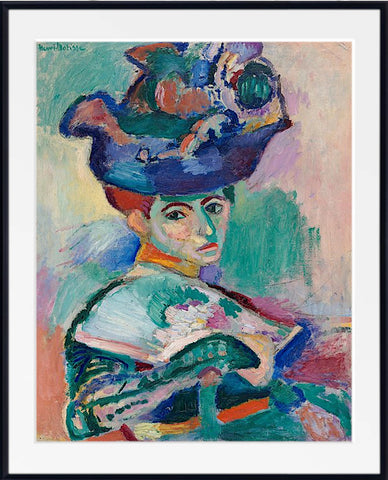
Woman with a Hat (1905) — Matisse's portrait of Amélie Matisse and one of the defining works of Fauvism.
The sitter was Matisse's wife, Amélie.
Traditional portrait painting normally depended upon subtle flesh tones, coherent lighting and carefully modelled form.
Matisse replaced that restraint with an extraordinary mixture of green, orange, yellow, blue, pink and violet.
The result was shocking partly because the subject itself was conventional.
A respectable woman wearing a fashionable hat had been painted using colours that appeared completely inappropriate according to academic expectations.
Matisse demonstrated that colour could describe an emotional or pictorial relationship rather than merely visible appearance.
Woman with a Hat became one of the defining images of Fauvism.
The Joy of Life
Soon after the 1905 breakthrough, Matisse produced one of the great turning points of modern art: Le Bonheur de vivre — The Joy of Life.
Painted between late 1905 and early 1906, the monumental canvas shows nude figures resting, embracing, playing music and dancing within an imaginary landscape.
The subject recalls the pastoral tradition of Western art, yet Matisse transforms it completely.
Figures are simplified and distorted. Scale shifts unexpectedly. Colour does not obey naturalistic rules. The landscape is organised through flowing curves and broad chromatic zones.
The painting also contains a small circle of dancers that anticipates Matisse's later monumental Dance compositions.
The Joy of Life once belonged to Leo and Gertrude Stein and is now held by the Barnes Foundation.
Its importance extends far beyond Fauvism. The work helped demonstrate that modern painting could create a self-contained visual world governed by the artist's own rules.
Why Matisse's Use of Colour Was Revolutionary
Matisse did not simply favour bright colours.
His real innovation lay in understanding colour relationally.
A colour acquires much of its visual character from the colours surrounding it.
Red appears more intense beside green. Orange can advance against blue. A large field of one hue can unite otherwise separate elements of a composition.
This allowed Matisse to reduce his dependence upon conventional modelling.
Colour could:
- create visual depth
- flatten conventional perspective
- separate or connect forms
- establish rhythm
- direct the viewer's eye
- create emotional atmosphere
- unify an entire composition
For Matisse, colour was therefore not decoration added after drawing.
It was one of the fundamental structures of painting.
Moving Beyond Fauvism
Fauvism itself was short-lived.
By around 1907 the artists associated with the movement were already developing in different directions.
Matisse did not abandon the lessons of Fauvism. Instead, he expanded them.
Large, flat areas of colour became increasingly important. Decorative pattern spread across interiors. Arabesque lines connected figures, textiles and objects. Scale became more monumental.
In 1908 Matisse published Notes of a Painter, an important statement of his ideas about colour, composition and artistic expression.
During approximately the same period he also established the private Académie Matisse, where he taught an international group of younger artists until 1911.
Matisse studied at the École des Beaux-Arts, but his own teaching activity was centred upon the privately organised Académie Matisse rather than a professorship at the École.
Harmony in Red
Matisse's development beyond Fauvism can be seen brilliantly in The Dessert – Harmony in Red of 1908.

The Dessert – Harmony in Red (1908) — colour and pattern almost eliminate the conventional boundary between table and wall.
A woman arranges fruit on a dining table while an open window reveals a green landscape outside.
Yet conventional interior space has been almost overwhelmed by colour.
The same intense red covers both wall and tablecloth. Flowing blue arabesques spread across them, making it difficult to determine exactly where one plane ends and another begins.
The room remains recognisable, but the painting continually reminds us that we are also looking at a flat surface.
This represented a major development from Fauvism.
Rather than using numerous separate bursts of intense colour, Matisse allows one enormous red field to organise almost the entire composition.
Sergei Shchukin, Dance and Music
One of Matisse's most important early patrons was the Russian collector Sergei Ivanovich Shchukin.
Shchukin assembled an extraordinary collection of modern French art for his Moscow home and became one of Matisse's most significant supporters.
For him, Matisse created the monumental decorative panels Dance and Music in 1909–10.
In Dance, five nude figures form a circle against large expanses of intense blue and green.
Detail has been stripped away.
The bodies are simplified to such an extent that movement, rhythm and colour dominate everything else.
The work demonstrates a fundamental principle that remained with Matisse throughout his career: simplification could increase rather than reduce expressive power.
Matisse in Morocco
Matisse travelled to Tangier, Morocco, during 1912 and 1913.
The experience introduced him to new combinations of architecture, gardens, textiles, clothing and North African light.
His Moroccan paintings include landscapes, windows, cafés and portraits such as The Seated Riffian.
Rather than treating Morocco solely as an exotic subject, Matisse used the experience to deepen concerns already central to his art.
How could figure and background be unified?
How could a window function simultaneously as architecture and as a framed field of colour?
How could patterned textiles become structural components of a painting?
The resulting works form an important bridge between the decorative paintings of the preceding years and the more austere experiments of the 1910s.
Matisse, Picasso and Cubism
Henri Matisse and Pablo Picasso became the two dominant figures of the early twentieth-century Parisian avant-garde.
Their relationship involved rivalry, admiration and sustained artistic dialogue.
They pursued very different solutions to many of the same problems.
Picasso and Georges Braque developed Cubism by fragmenting objects and reconsidering how multiple viewpoints could operate within a picture.
Matisse engaged seriously with the structural questions raised by Cubism, particularly during the 1910s, but he did not become a Cubist painter.
He absorbed aspects of Cubist structure while retaining his own priorities: colour, rhythm, line, surface and the emotional unity of the composition.
The Experimental Paintings of the 1910s
Between approximately 1913 and 1917, Matisse produced some of the most austere and experimental paintings of his career.
Works such as View of Notre-Dame, French Window at Collioure, The Piano Lesson and Bathers by a River reduce conventional description dramatically.
Forms become increasingly geometric.
Colour can become darker or more restrained.
Large areas approach abstraction.
These paintings demonstrate that Matisse cannot be reduced to a painter of pleasant colour.
He repeatedly questioned the foundations of representation and was willing to abandon successful formulas whenever a new problem interested him.
The Blue Window
The Blue Window is an excellent example of Matisse's increasingly sophisticated approach to the interior.
Rather than treating blue as the colour of one isolated object, Matisse allows related blue tones to spread through the room, objects and view beyond the window.
The boundaries between interior and exterior become less absolute.
The window functions simultaneously as an opening into another space and as a rectangular element within the overall design.
This was one of Matisse's great recurring subjects.
Windows allowed him to place two worlds within the same painting: the enclosed room and the landscape outside.
The Red Studio
Painted in 1911, The Red Studio has become one of Matisse's most influential paintings.
The composition depicts the artist's studio at Issy-les-Moulineaux.
Paintings, sculptures and ceramics are visible around the room, but virtually the entire architectural space has been flooded with red.
Furniture and structural details survive largely as pale lines where the red does not completely cover the underlying forms.
The real studio was not red.
Matisse chose the colour because of what it did to the composition.
Depth and flatness coexist.
The artworks within the studio retain their individual colours while the surrounding red binds the room together.
Today The Red Studio is recognised as a landmark of modern painting and a major precursor to later experiments with large fields of colour.
The Nice Period and the Odalisque Paintings
In late 1917 Matisse travelled to Nice on the French Riviera and increasingly based himself in southern France.
The period from approximately 1917 to 1930 is commonly described as his Nice period.
His paintings became more intimate after the severe experimentation of the wartime years.
Women seated or reclining in interiors became a major subject.
Patterned screens, rugs, decorative fabrics, flowers and furniture fill the rooms.
The odalisque appears repeatedly.
These works reflect Matisse's long-standing interest in the female figure as well as his encounters with North African visual culture and the nineteenth-century European tradition of Orientalist painting.
Formally, their importance lies particularly in the way figure and decoration interact.
The model is rarely isolated from her surroundings. Clothing, wallpaper, carpets, cushions and furniture create one continuous visual environment.
Still Lifes, Interiors and Goldfish
Still life remained important to Matisse throughout his career.
Flowers, fruit, bowls, pitchers, textiles and decorative objects allowed him to construct compositions with unusual freedom.
Explore GalleryThane's wider collection of Still Life Prints to compare Matisse's approach with other periods and artists.
Blue Still Life
In Blue Still Life (Nature morte bleue) of 1907, patterned textile, fruit and vessels compete for attention.
Foreground and background remain recognisable but increasingly interact as decorative surfaces.
The painting points towards the radical flattening Matisse would achieve a year later in Harmony in Red.
Goldfish
Goldfish became another important Matisse motif during the early 1910s.
The brilliant orange fish offered a natural complementary contrast with surrounding greens and blues.
The aquarium also presented unusual spatial problems.
Its curved transparent surface could distort objects and combine reflection, transparency and depth within a single form.
Even a quiet studio still life could therefore become an experiment in colour and perception.
Drawing, Sculpture and the Human Figure
Matisse was not only a painter.
Drawing and sculpture remained important throughout his career.
His sculptures often allowed him to investigate mass and the human body in three dimensions, while drawing encouraged increasing economy of line.
The female figure was a particularly persistent subject.
Matisse drew and painted standing, seated and reclining figures repeatedly, gradually reducing anatomy to the lines and shapes he considered essential.
This process of simplification should not be confused with lack of technical skill.
Matisse had rigorous academic training and spent decades studying the figure.
The apparent simplicity of his mature work was hard won.
GalleryThane's Nude Art Prints collection places Matisse's approach to the body alongside a much wider tradition of figurative art.
Illness and the Invention of the Cut-Out
During the 1940s, physical limitations increasingly changed the way Matisse worked.
Rather than ending his career, these circumstances contributed to one of its greatest transformations.
Matisse began working extensively with sheets of paper painted in gouache.
He cut directly into the coloured sheets with scissors and arranged the resulting shapes on walls or large paper supports.
Assistants could pin and repin the pieces while Matisse adjusted the composition.
This became known as the cut-out.
For Matisse, the technique brought drawing and colour together with extraordinary directness.
Instead of drawing a contour and subsequently filling it with pigment, he could create the coloured form and its outline in the same physical action.
Organic leaves, stars, dancers, swimmers, birds and abstract shapes could all be reduced to clear silhouettes.
The technique eventually expanded from individual sheets to room-sized environments.
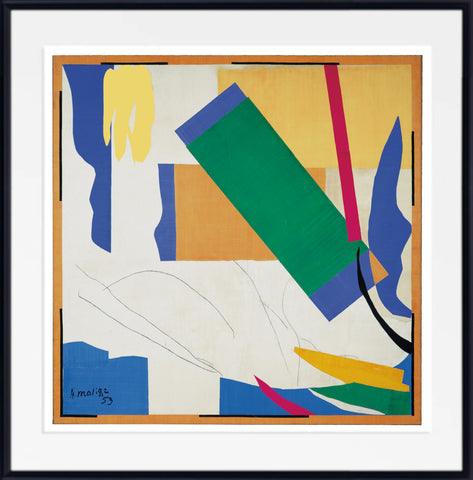
Memory of Oceania — an example of the bold flat colour and simplified shapes characteristic of Matisse's late cut-out work.
Matisse's Jazz
One of the most celebrated results of the cut-paper method was Jazz, published in 1947.
The portfolio contains twenty images based upon cut-paper designs.
Matisse wanted the printed plates to retain the intensity of the original gouache colours, so they were reproduced through pochoir, a stencil-printing process.
Many of the compositions draw upon circus imagery, theatre and movement.
GalleryThane's Matisse collection includes works associated with the series such as The Circus, The Codomas, The Cowboy, The Knife Thrower, The Nightmare of the White Elephant and the Lagoon compositions.
The extraordinary aspect of Jazz is its economy.
Complex action is communicated through very few shapes.
Black, red, blue, yellow and green are used with remarkable clarity.
There is almost no conventional modelling.
Yet the images are full of movement.
The Blue Nudes
The Blue Nudes of 1952 represent one of the culminating achievements of Matisse's cut-out technique.
The body is constructed almost entirely from pieces of intense blue paper arranged against a pale ground.
Arms, legs, torso and head interlock into one rhythmic shape.
Works such as Blue Nude I demonstrate how closely Matisse's late art approached abstraction while still retaining the human figure.
Despite their apparent simplicity, the Blue Nudes required extensive adjustment.
Matisse and his assistants repeatedly moved and altered pieces until the balance of positive and negative space felt correct.
The works therefore represent the culmination of a problem that had occupied him throughout his career: how to unite colour and drawing.
Their reduction of the human body to essential shapes also creates a natural connection with GalleryThane's broader Abstract Art Prints collection.
The Chapel of the Rosary at Vence
Between 1948 and 1951 Matisse devoted extraordinary attention to the Chapel of the Rosary for the Dominican sisters at Vence in southern France.
The project brought together many forms of design.
Matisse worked on the stained-glass windows, ceramic wall decorations, liturgical vestments, architectural details and other elements of the chapel.
Strong blue, green and yellow stained glass interacts with bold black line drawings on white ceramic surfaces.
The result translates ideas developed throughout his career into an architectural environment.
Colour is created partly through light itself.
Drawing is reduced to enormous sweeping lines.
Individual objects are subordinated to the total visual experience.
The chapel was blessed in June 1951.
Matisse regarded it as the culmination of his artistic life.
Famous Henri Matisse Paintings
Matisse produced an enormous body of work, but several paintings and cut-outs are particularly useful for understanding the development of his art.
Luxe, calme et volupté (1904)
A Neo-Impressionist work created after Matisse's experience of Mediterranean light and colour theory around Saint-Tropez. It forms an important bridge towards Fauvism.
Woman with a Hat (1905)
One of the defining paintings of the 1905 Salon d'Automne. Matisse's portrait of Amélie uses startling non-naturalistic colour and helped establish his reputation as the leading Fauvist.
Landscape at Collioure (1905)
A remarkably direct Fauvist landscape in which brilliant individual strokes and areas of exposed canvas reveal Matisse's revolutionary experiments during the summer with André Derain.
The Joy of Life (1905–06)
A monumental pastoral scene in which simplified bodies, distorted scale, curving contours and liberated colour create an entirely self-contained pictorial world.
Blue Nude: Memory of Biskra (1907)
A powerful figure painting marking the end of Matisse's concentrated Fauvist phase and his growing interest in monumental, simplified form.
Harmony in Red (1908)
One of Matisse's great decorative breakthroughs. Red wall and table almost merge while blue arabesques flatten conventional interior space.
Dance (1909–10)
Five simplified figures move in a continuous circle across huge fields of blue and green. The painting reduces movement, body and colour to extraordinary essentials.
The Red Studio (1911)
Matisse floods his own studio with red, leaving furniture and architecture as minimal linear traces while artworks retain their individual colour.
The Blue Window (1913)
An interior dominated by blue in which objects, window and exterior view are united through colour and increasingly simplified structure.
The Piano Lesson (1916)
One of Matisse's most austere experimental paintings, using severe geometry and restricted colour during his dialogue with Cubist ideas.
Jazz (1947)
A portfolio of twenty pochoir prints developed from cut-paper designs, combining vivid colour with radically simplified silhouettes and movement.
Blue Nudes (1952)
A celebrated series of cut-outs reducing the human body to interlocking shapes of intense blue paper.
The Swimming Pool (1952)
A vast site-specific cut-out in which blue swimmers and aquatic forms move across a continuous white band surrounding the walls of Matisse's room.
Henri Matisse's Painting Style
It is difficult to define a single Henri Matisse painting style because his work changed repeatedly.
Nevertheless, several characteristics recur throughout his career.
Expressive Colour
Colour is the most obvious feature of Matisse's art, but its use is carefully organised rather than simply bright.
Complementary and contrasting colours establish relationships across the entire composition.
Simplified Form
Matisse repeatedly reduced objects and figures to increasingly essential shapes.
His late cut-outs demonstrate the culmination of this search.
Rhythmic Line
Curving contours and arabesques connect different areas of a composition.
A line may describe a body while simultaneously contributing to a larger decorative rhythm.
Pattern
Textiles, wallpaper, rugs, screens and plant forms frequently become major pictorial elements.
Pattern often challenges conventional depth by pulling background surfaces towards the viewer.
Flexible Perspective
Tables tilt, rooms flatten and windows operate as coloured rectangles.
Matisse alters perspective whenever doing so strengthens the whole composition.
Balance and Harmony
However radical individual elements may appear, Matisse continually sought coherence across the complete image.
The position, scale, shape and colour of each element depends upon everything around it.
How Henri Matisse Influenced Modern Art
Matisse's influence extends far beyond Fauvism.
His liberation of colour helped make later Expressionist painting possible.
His use of broad chromatic fields anticipated aspects of post-war Colour Field painting.
His decorative flattening of interior space influenced generations of painters who rejected conventional perspective.
The paper cut-outs demonstrated that large-scale art could be created from remarkably simple materials and helped dissolve boundaries between painting, drawing, collage and design.
Matisse also influenced artists internationally through the Académie Matisse and through the circulation of his paintings among important early collectors.
His dialogue with Picasso became one of the central artistic relationships of twentieth-century modernism.
Within Fauvism itself, comparing Matisse with André Derain, Raoul Dufy and Henri Manguin reveals how differently artists developed the movement's discovery of liberated colour.
Choosing Henri Matisse Prints for Your Home
The remarkable variety of Matisse's career means that Henri Matisse prints can work within very different interiors.
For Strong Red Wall Art
Harmony in Red creates one of the most dramatic options. Its huge red field and blue arabesque pattern make it particularly effective as a central focal point above a sofa, sideboard or dining area.
For Blue Interiors
The Blue Window, Blue Still Life and the Blue Nude designs offer very different approaches to blue, ranging from atmospheric interiors to highly simplified late cut-outs.
For Colourful Modern Interiors
Early Fauvist works such as Woman with a Hat, Landscape at Collioure and Olive Trees at Collioure introduce numerous contrasting colours within a single composition.
For Minimalist and Scandinavian Interiors
Matisse's later cut-outs work particularly effectively in restrained interiors because their clear silhouettes and strong blocks of colour contrast well with white, cream, putty and pale neutral walls.
For Living Rooms
Horizontal interiors and still lifes can work particularly well above sofas and sideboards. Large Matisse prints can provide the principal source of colour in an otherwise neutral room.
For Bedrooms
Figure studies, floral works and quieter interiors can introduce colour without the visual intensity of some of the most dramatic Fauvist paintings.
For Gallery Walls
Matisse's long career makes it possible to combine very different works while retaining a clear connection through colour and line. A Fauvist landscape, an interior and a later cut-out can create a gallery wall that also tells the story of his artistic development.
Explore Henri Matisse Prints at GalleryThane
GalleryThane's Henri Matisse Prints collection brings together works from across the artist's career, including Fauvist landscapes, portraits, still lifes, colourful interiors and later cut-out designs.
Prints are available in a range of sizes and formats, including fine art paper prints, framed prints and canvas wall art, allowing Matisse's extraordinary use of colour to work within both contemporary and traditional interiors.
You can also explore the wider Fauvism Prints collection to compare Matisse with the artists who shared the brief but revolutionary colour experiments of the early twentieth century.
Frequently Asked Questions
Who was Henri Matisse?
Henri Matisse (1869–1954) was a French painter, draughtsman, sculptor, printmaker and designer and one of the most influential artists of twentieth-century modernism. He is particularly celebrated for his use of expressive colour, his leadership within Fauvism and his late paper cut-outs.
When was Henri Matisse born?
Matisse was born on 31 December 1869 in Le Cateau-Cambrésis in northern France.
When did Henri Matisse die?
Matisse died in Nice on 3 November 1954 at the age of 84.
Did Henri Matisse originally train as an artist?
No. Matisse initially trained in law. He became seriously interested in art at around the age of twenty-one and subsequently moved to Paris to study painting.
Where did Henri Matisse study art?
Matisse studied at the Académie Julian and later at the École des Beaux-Arts in Paris, where Gustave Moreau became an important teacher.
Did Henri Matisse teach at the École des Beaux-Arts?
No. Matisse studied at the École des Beaux-Arts but later taught through his own private school, generally known as the Académie Matisse, which operated during the years around 1908–11.
What is Henri Matisse most famous for?
Matisse is most famous for his revolutionary use of colour, his role as the leading artist of Fauvism, his decorative interiors and figures, and his late paper cut-outs.
What is Fauvism?
Fauvism was a brief early twentieth-century movement associated with intense, frequently non-naturalistic colour and direct brushwork. The name derives from the French term les fauves, meaning “the wild beasts”.
Was Henri Matisse the founder of Fauvism?
Matisse was the movement's leading figure, but Fauvism developed through the experiments of several artists. His work with André Derain at Collioure during the summer of 1905 was particularly important to its development.
Why was Collioure important to Matisse?
Working at Collioure with André Derain in 1905 encouraged Matisse to use colour with unprecedented freedom. The landscapes they produced there became central to the emergence of Fauvism.
Why did Matisse use unrealistic colours?
Matisse increasingly selected colours according to their expressive and compositional relationships rather than simply copying natural appearance. A green or red could strengthen neighbouring colours and help organise the whole painting.
Who is the woman in Woman with a Hat?
The sitter is Matisse's wife, Amélie Matisse. The portrait became one of the defining paintings of the 1905 Salon d'Automne and early Fauvism.
What is The Joy of Life about?
The Joy of Life presents nude figures relaxing, embracing, playing music and dancing within an invented pastoral landscape. Its simplified forms and expressive colour made it one of the watershed paintings of early modernism.
What is Harmony in Red?
Harmony in Red, also known as The Red Room or The Dessert, is Matisse's 1908 painting of a dining-room interior in which the same intense red and blue pattern spreads across table and wall.
Who was Sergei Shchukin?
Sergei Shchukin was a pioneering Russian collector of modern French art and one of Matisse's most important early patrons. He commissioned Matisse's monumental Dance and Music panels for his Moscow home.
Did Matisse visit Morocco?
Yes. Matisse worked in Tangier during 1912 and 1913. The light, architecture, gardens, figures and textiles he encountered there contributed to an important group of paintings.
Was Matisse a Cubist?
No. Matisse engaged closely with the structural experiments of Cubism, particularly during the 1910s, but he developed an independent style rather than becoming a Cubist painter like Picasso or Braque.
Were Henri Matisse and Pablo Picasso friends?
Their relationship combined friendship, rivalry, respect and artistic competition. Each paid close attention to the other's work, and together they became the two dominant figures of early twentieth-century modern art.
What is The Red Studio?
The Red Studio is Matisse's 1911 painting of his studio at Issy-les-Moulineaux. Almost the entire room is covered by one field of red, dramatically flattening conventional space.
What was Matisse's Nice period?
The term generally refers to the years beginning in 1917 when Matisse increasingly worked in Nice and southern France. Interiors, female figures, odalisques, still lifes and elaborate patterned fabrics became especially prominent.
Why did Henri Matisse paint goldfish?
Goldfish offered Matisse a particularly strong orange colour that contrasted beautifully with greens and blues. Their glass bowls and aquariums also allowed him to explore transparency, reflection and unusual spatial relationships.
What are Henri Matisse cut-outs?
Matisse's cut-outs were compositions created from sheets of paper painted with gouache and cut into shapes with scissors. The pieces could then be arranged and rearranged until he achieved the desired composition.
Did Matisse invent the paper cut-out technique because he could no longer paint?
Physical limitations contributed to the growing importance of cut paper in his late career, but the technique should not be regarded merely as a substitute for painting. Matisse developed it into an independent medium capable of producing some of his most ambitious works.
What is Jazz by Henri Matisse?
Jazz is a 1947 illustrated publication containing twenty images based on Matisse's cut-paper designs. The plates were reproduced using the pochoir stencil process to retain the intensity of the original gouache colours.
What are the Blue Nudes?
The Blue Nudes are a group of late Matisse cut-outs from 1952 in which the female body is constructed from simplified pieces of intense blue paper arranged against a pale ground.
What was Matisse's final major project?
One of his greatest late projects was the Chapel of the Rosary at Vence, created between 1948 and 1951. Matisse designed stained glass, ceramic decorations, vestments and other elements as a unified environment.
What are Henri Matisse's most famous paintings?
His best-known works include Woman with a Hat, The Joy of Life, Blue Nude: Memory of Biskra, Harmony in Red, Dance, The Red Studio and The Piano Lesson, alongside the later Jazz images and Blue Nude cut-outs.
What other artists should I explore if I like Henri Matisse?
For Fauvist colour, explore André Derain, Henri Manguin and early Raoul Dufy. Paul Signac and Henri-Edmond Cross provide useful connections to Neo-Impressionism, while Pablo Picasso offers a very different but equally important route through twentieth-century modernism.
Where can I buy Henri Matisse prints?
GalleryThane offers a wide collection of Henri Matisse prints, including Fauvist paintings, landscapes, still lifes, interiors and late cut-out designs, available across a choice of fine art print, framed and canvas formats.
What interior styles suit Matisse prints?
Matisse prints work particularly well with contemporary, Scandinavian-inspired, mid-century and eclectic interiors. Neutral walls provide an effective background for his saturated colour, while natural timber complements many of his Mediterranean and botanical subjects.
Are Henri Matisse prints suitable for gallery walls?
Yes. Combining works from different stages of Matisse's career can create an especially interesting gallery wall. Fauvist landscapes, colourful interiors and late cut-outs can look dramatically different while remaining connected through colour, line and simplification.