


The most disturbing paintings in art history include Francisco Goya's Saturn Devouring His Son, Hieronymus Bosch's The Garden of Earthly Delights, Caravaggio's Judith Beheading Holofernes, Henry Fuseli's The Nightmare, Edvard Munch's The Scream and Théodore Géricault's The Raft of the Medusa. Some horrify through violence or death; others create unease through ambiguity, taboo, psychological tension or visions of the supernatural.
This guide explores 20 of the most disturbing paintings of all time, preserving the shocking, controversial and unsettling masterpieces that have long fascinated GalleryThane readers while expanding the story to include some of the darkest and scariest paintings in Western art. The result ranges from Renaissance visions of Hell and Baroque violence to nineteenth-century surgery, political murder, madness, witchcraft and modern psychological anxiety.
What makes disturbing art so compelling is that fear is rarely its only subject. These works confront power, mortality, sexuality, suffering, guilt, religion, violence and the instability of the human mind. Some once shocked contemporary audiences but now seem historically familiar; others remain genuinely difficult to look at centuries after they were painted.


GalleryThane's Mythology, Religious and Occult Art collection brings together demons, witches, apocalyptic visions, tragic myths and dramatic biblical subjects. Related works can also be explored in the Witches and Witchcraft Art Prints collection, the Portraits and People collection and the Nude Art Prints collection.
Table of Contents:
What Are the Most Disturbing Paintings of All Time?
Among the most disturbing paintings of all time are Saturn Devouring His Son by Francisco Goya, The Garden of Earthly Delights by Hieronymus Bosch, Judith Beheading Holofernes by Caravaggio, The Nightmare by Henry Fuseli, Ilya Repin's Ivan the Terrible and His Son Ivan, Théodore Géricault's The Raft of the Medusa and The Scream by Edvard Munch.
The scariest paintings do not all rely on monsters or gore. Goya makes mythology feel like psychosis; Bosch fills Hell with invented punishments; Fuseli turns sleep into supernatural assault; Munch visualises anxiety itself. Other works disturb because they are rooted in real events: surgery in The Gross Clinic, revolutionary assassination in The Death of Marat, shipwreck and cannibalism behind The Raft of the Medusa, and the murder case associated with Walter Sickert's The Camden Town Murder.
A concise list of ten particularly disturbing, dark or frightening paintings would include:
- Saturn Devouring His Son – Francisco Goya
- The Garden of Earthly Delights – Hieronymus Bosch
- Judith Beheading Holofernes – Caravaggio
- The Nightmare – Henry Fuseli
- Ivan the Terrible and His Son Ivan – Ilya Repin
- The Raft of the Medusa – Théodore Géricault
- The Scream – Edvard Munch
- Witches' Sabbath – Francisco Goya
- The Severed Heads – Théodore Géricault
- The Gross Clinic – Thomas Eakins


Timeline of Disturbing Paintings Through Art History
Disturbing art is not confined to one period or movement. Renaissance painters imagined infernal punishment; Baroque artists brought biblical violence close to the viewer; Romantic painters explored nightmares, shipwrecks and death; Realists exposed surgery and modern urban anxiety; modern artists turned disturbance inward, towards sexuality, alienation and psychological crisis.
| Date | Painting | Artist | Why it disturbs |
|---|---|---|---|
| c. 1490–1510 | The Garden of Earthly Delights | Hieronymus Bosch | Surreal punishments, hybrid monsters and an unforgettable vision of Hell |
| c. 1598–1599 | Judith Beheading Holofernes | Caravaggio | Graphic biblical violence made physically immediate |
| c. 1611–1612 | The Massacre of the Innocents | Peter Paul Rubens | Frenzied violence directed against mothers and children |
| 1781 | The Nightmare | Henry Fuseli | Sleep, sexuality and supernatural terror merge in a claustrophobic vision |
| 1793 | The Death of Marat | Jacques-Louis David | Political assassination transformed into a quiet martyr image |
| c. 1797–1800 | The Nude Maja | Francisco Goya | A direct, secular nude that defied accepted conventions |
| 1798 | Witches' Sabbath | Francisco Goya | Occult ritual, grotesque figures and sacrifice under a night sky |
| c. 1818–1819 | The Severed Heads | Théodore Géricault | Unidealised studies of death based on real human remains |
| 1818–1819 | The Raft of the Medusa | Théodore Géricault | Shipwreck, abandonment, starvation and cannibalism drawn from a real disaster |
| c. 1819–1823 | Saturn Devouring His Son | Francisco Goya | Mythological cannibalism rendered as raw, irrational horror |
| 1850 | Dante and Virgil | William-Adolphe Bouguereau | Two damned souls locked in savage physical combat |
| 1863 | Olympia | Édouard Manet | A modern nude whose direct gaze scandalised contemporary Paris |
| 1866 | L'Origine du Monde | Gustave Courbet | Unprecedented sexual directness and a long history of concealment |
| 1875 | The Gross Clinic | Thomas Eakins | Blood, exposed surgery and uncompromising medical realism |
| 1885 | Ivan the Terrible and His Son Ivan | Ilya Repin | A father's horror after fatally striking his son |
| c. 1890 | The Bat-Woman | Albert Joseph Penot | Erotic fantasy fused with a monstrous nocturnal transformation |
| 1893 | The Scream | Edvard Munch | An iconic visualisation of anxiety, isolation and existential terror |
| Late nineteenth century | The Sin | Heinrich Lossow | Erotic historical fantasy associated with a notorious and disputed papal scandal |
| 1907 | Les Demoiselles d'Avignon | Pablo Picasso | Aggressive fragmentation and confrontation with the viewer |
| 1908 | The Camden Town Murder | Walter Sickert | Ambiguous domestic violence linked by title to a sensational real murder case |
What Makes a Painting Disturbing, Scary or Dark?
A disturbing painting does not need to be gruesome. Some works provoke a physical reaction through blood, death or mutilation; others create a slower unease because the viewer cannot fully explain what is happening. The darkest paintings often combine several sources of discomfort at once.
Visceral violence and the vulnerability of the body
Caravaggio, Rubens, Goya and Géricault force the viewer to confront bodies under extreme pressure. Their disturbing power comes partly from physical specificity: blood, muscle, pallor, wounds, terror and the unmistakable presence of death. The body is no longer idealised or protected by distance.
Psychological fear and loss of control
The Scream, The Nightmare and Ivan the Terrible and His Son Ivan are frightening because they make inner states visible. Anxiety deforms the world; sleep becomes invasion; remorse becomes unbearable. The viewer is not simply watching an event but is drawn into a mind in crisis.
Ambiguity and the unseen
Walter Sickert's The Camden Town Murder is disturbing partly because it withholds certainty. The title suggests violence, but the painted scene remains ambiguous. Fear grows in the gap between what is shown and what the viewer imagines.
Taboo, sexuality and social transgression
Olympia, The Nude Maja, L'Origine du Monde and Les Demoiselles d'Avignon were not designed as horror paintings. Their historical disturbance came from directness, sexuality, modernity and refusal to obey established rules about how bodies could be represented. Disturbance is therefore historically variable: what once caused scandal may later become canonical, while still retaining its power to challenge.
1. Olympia – Édouard Manet
Date: 1863
Movement: Realism and early modern art
Collection: Musée d'Orsay, Paris
Why it is disturbing: A confrontational modern nude that stripped away the mythological disguise traditionally used to make female nudity acceptable.
Édouard Manet's Olympia caused one of the great scandals of nineteenth-century French art. The reclining woman is not presented as Venus, a nymph or an allegorical figure. She appears unmistakably modern, meets the viewer's gaze directly and refuses the passivity expected of the traditional female nude.

When the painting was shown at the 1865 Paris Salon, viewers were disturbed not merely by nudity but by recognition. Olympia's accessories, the flowers carried by her maid and the directness of her pose suggested the contemporary world of prostitution. Manet also rejected the smooth modelling of Academic painting, using flatter areas of colour and abrupt tonal contrasts.
Today, the picture is foundational to modern art. Its ability to disturb lies in the way it turns looking into a confrontation. Explore further works in the Édouard Manet collection and read the GalleryThane Manet artist profile.
2. The Gross Clinic – Thomas Eakins
Date: 1875
Movement: American Realism
Collection: Philadelphia Museum of Art and Pennsylvania Academy of the Fine Arts
Why it is disturbing: A monumental surgical scene showing blood, exposed flesh and medical intervention without sentimental softening.
The Gross Clinic depicts the surgeon Dr Samuel D. Gross operating on a patient before students in a medical amphitheatre. Eakins treats surgery as a modern heroic subject, yet he does not conceal its physical reality. Blood stains the surgeon's hand; instruments and assistants surround the body; a seated woman recoils at the edge of the scene.

The painting disturbed viewers because of its scale, blood and contemporary subject. A scene that might have belonged in a specialist medical illustration was elevated to the dimensions and seriousness of history painting. The unease comes from being placed inside the operating theatre, close enough to feel implicated.
Eakins's realism was grounded in his deep study of anatomy and movement. More works can be found in the Thomas Eakins Prints collection, while related imagery appears in GalleryThane's Science and Medicine in Art collection.
3. Judith Beheading Holofernes – Caravaggio
Date: c. 1598–1599
Movement: Baroque
Collection: Palazzo Barberini, Rome
Why it is disturbing: The decisive instant of decapitation is shown with startling physical immediacy.
Caravaggio's Judith Beheading Holofernes depicts the biblical heroine killing the Assyrian general who threatened her people. Judith leans away even as she draws the sword through his neck; Holofernes cries out; an elderly servant waits with a bag to receive the severed head.

The painting's horror is concentrated by Caravaggio's tenebrism. The figures emerge from darkness under a fierce directional light, eliminating distractions and making the violence feel immediate. Yet Judith's expression complicates the scene: determination mixes with revulsion, suggesting both moral purpose and human recoil.
Caravaggio repeatedly made sacred stories feel physically present and psychologically urgent. Explore the Caravaggio Baroque Fine Art Prints collection or read the Caravaggio artist profile.
4. Saturn Devouring His Son – Francisco Goya
Date: c. 1819–1823
Movement: Romanticism; one of Goya's Black Paintings
Collection: Museo del Prado, Madrid
Why it is disturbing: Cannibalistic mythology is transformed into a raw image of panic, madness and destructive power.
Few candidates for the world's most disturbing painting are as immediately terrifying as Saturn Devouring His Son. Goya shows the titan gripping a mutilated body and biting into it with bulging eyes and uncontrolled desperation.

According to the myth, Saturn devoured his children because he feared being overthrown by one of them. Earlier artists could treat the story as an elegant classical subject; Goya removes elegance entirely. His Saturn is not a noble god but a frantic creature caught in darkness, apparently horrified by his own act and yet unable to stop.
The painting originally formed part of the private murals later known as the Black Paintings, made on the walls of Goya's house. Its roughness and lack of public commission contribute to its disturbing intimacy. More dark and visionary works can be explored in the Francisco Goya Fine Art Prints collection.
5. The Garden of Earthly Delights – Hieronymus Bosch
Date: c. 1490–1510
Movement: Early Netherlandish painting
Collection: Museo del Prado, Madrid
Why it is disturbing: Bosch fills Hell with impossible machines, hybrid creatures and grotesque punishments whose logic remains mysterious.
The Garden of Earthly Delights is one of the most bizarre and endlessly scrutinised paintings in Western art. Its three interior panels move from Eden through an immense field of earthly pleasure to a dark Hell populated by monstrous beings and inventive torments.

The right-hand panel is especially disturbing. Giant musical instruments become instruments of torture; bodies disappear into hybrid monsters; a tree-like figure with a hollow torso stares back at the viewer. Bosch's creatures are frightening because they obey no familiar natural law.
The painting's meaning remains debated, but its vision of temptation, consequence and human folly has lost none of its imaginative power. Explore more visionary works in the Hieronymus Bosch Fine Art Prints collection.
6. The Sin – Heinrich Lossow
Date: Late nineteenth century
Movement: Academic and historical painting
Why it is disturbing: A densely staged erotic fantasy linked to one of the Renaissance papacy's most notorious and disputed scandal stories.
Heinrich Lossow's The Sin depicts an imagined scene associated with the so-called Banquet of Chestnuts, an event alleged to have taken place in the Papal Palace during the era of Pope Alexander VI and Cesare Borgia. The historical reliability of accounts surrounding the banquet has long been disputed, but the story became a durable symbol of corruption, excess and sexual scandal.

Lossow crowds the interior with bodies, architectural splendour, candlelight and voyeuristic detail. Unlike Goya's darkness or Géricault's realism, the disturbance here comes from theatrical excess and the collision between sacred institutional space and imagined debauchery.
For a deeper examination of the painting and the legend surrounding it, read GalleryThane's complete article The Sin Painting by Heinrich Lossow.
7. Dante and Virgil – William-Adolphe Bouguereau
Date: 1850
Movement: French Academic painting
Collection: Musée d'Orsay, Paris
Why it is disturbing: Two damned souls engage in savage bodily combat, rendered with polished anatomical precision.
Dante and Virgil depicts a violent episode from Dante's Inferno. Dante and his guide witness the damned falsifier Gianni Schicchi attack the alchemist Capocchio, sinking his teeth into the other man's neck.

Bouguereau is often associated with polished ideal beauty, but this painting displays extraordinary aggression. Muscles strain, limbs lock together and Capocchio's skin buckles under the bite. The elegance of the technique makes the brutality more, not less, unsettling.
Discover more works by the artist in the William-Adolphe Bouguereau collection or read about his highly finished technique in William-Adolphe Bouguereau: Academic Paintings.
8. L'Origine du Monde – Gustave Courbet
Date: 1866
Movement: Realism
Collection: Musée d'Orsay, Paris
Why it is disturbing: Its radical sexual directness eliminates the distance of mythology, allegory and conventional portraiture.
Gustave Courbet's L'Origine du Monde, or The Origin of the World, focuses tightly on a woman's torso and genitals. Few major nineteenth-century paintings approach the body with comparable directness.

The painting remained in private collections for much of its history and was often hidden from public view. Its power lies not in violence or supernatural horror but in the way it challenges boundaries between the private body, public display, art and censorship.
More works can be found in the Gustave Courbet Fine Art Prints collection. The painting is also examined in GalleryThane's guide to the most famous nude paintings of all time.
9. The Nude Maja – Francisco Goya
Date: c. 1797–1800
Movement: Spanish Romanticism
Collection: Museo del Prado, Madrid
Why it is disturbing: A naked woman confronts the viewer directly without the protective fiction of a goddess or mythological subject.
The Nude Maja is one of the boldest secular nudes painted before Manet. The reclining woman is awake, self-possessed and entirely aware of being seen.

Its historical controversy was heightened by the existence of an almost identical clothed version and by scrutiny from the Spanish Inquisition. The painting's disturbance is therefore cultural rather than horrific: Goya removes the mythological alibi and presents sexuality with unusual confidence.
The work belongs to a much wider and darker career ranging from court portraiture to war, witchcraft and the Black Paintings. Explore the Francisco Goya collection for further examples.
10. Les Demoiselles d'Avignon – Pablo Picasso
Date: 1907
Movement: Proto-Cubism and modern art
Collection: Museum of Modern Art, New York
Why it is disturbing: Five figures confront the viewer through fractured anatomy, compressed space and mask-like faces.
Les Demoiselles d'Avignon broke violently with Renaissance conventions of beauty, perspective and coherent anatomy. Five nude women fill the canvas, their bodies sharpened into angular planes and their faces ranging from stylised Iberian forms to mask-like distortions.

The painting is not frightening in a conventional narrative sense, yet its aggression remains palpable. The figures do not retreat into illusionistic space; they press towards the surface and look back. The viewer is denied comfortable distance.
The work helped prepare the way for Cubism and remains one of the defining breaks in modern art. Explore GalleryThane's Cubism collection for related works.
11. The Camden Town Murder – Walter Sickert
Date: 1908
Movement: British modern art; Camden Town Group
Why it is disturbing: An ambiguous bedroom scene acquires menace through its title and association with a sensational real murder case.
The Camden Town Murder belongs to Walter Sickert's group of dark domestic interiors inspired in part by the 1907 murder of Emily Dimmock in Camden Town. Yet the painting does not illustrate a clear crime scene. A clothed man sits beside a nude woman on a bed, and the exact relationship between them remains uncertain.

That uncertainty is precisely what makes the work disturbing. Sickert uses dim colour, cramped space and psychological distance rather than explicit violence. The title encourages the viewer to invent a narrative that the paint itself never confirms.
More of Sickert's moody urban interiors and portraits can be discovered in the Walter Sickert collection and the GalleryThane Walter Sickert artist profile.
12. The Severed Heads – Théodore Géricault
Date: c. 1818–1819
Movement: Romanticism
Why it is disturbing: Two decapitated heads are studied with uncompromising realism and almost still-life concentration.
The Severed Heads belongs to Géricault's intense studies of death and decomposition made during the period in which he prepared The Raft of the Medusa. Rather than idealising mortality, he confronts the colour, weight and silence of actual human remains.

The arrangement recalls a still life, but the subjects are human. This tension between formal beauty and bodily horror gives the painting its lasting power. The heads are not theatrical props; they seem heavy, individual and recently alive.
Explore more work by the artist in the Théodore Géricault collection.
13. The Nightmare – Henry Fuseli
Date: 1781
Movement: Romanticism
Collection: Detroit Institute of Arts
Why it is disturbing: A sleeping woman's body becomes the stage for supernatural intrusion, erotic tension and paralysis.
The Nightmare is one of the most famous frightening paintings in art history. A woman lies sprawled across a bed while a squat incubus sits on her chest. Behind them, the head of a horse emerges through curtains with glaring eyes.

Fuseli never provides a single explanation. The scene can be understood as a literal nightmare, a supernatural assault, a sexual fantasy or a visualisation of sleep paralysis. Its ambiguity has allowed the image to remain unsettling long after the specific Gothic culture of the eighteenth century.
Explore more Gothic and psychological imagery in the Henry Fuseli Prints collection.
14. The Scream – Edvard Munch
Date: 1893
Movement: Expressionism and Symbolism
Collection: National Museum, Oslo, for the 1893 painted version
Why it is disturbing: The world itself appears to warp under the pressure of anxiety and existential fear.
The Scream contains no visible act of violence, yet it is one of the darkest paintings ever made about the inner life. A figure stands on a bridge, hands pressed to its face, while the sky and landscape bend into waves of red, orange, blue and black.

The face has become an almost universal symbol of anxiety because it is so radically simplified. The figure could be anyone. Munch's innovation was to make the surrounding world participate in the emotion: the landscape does not merely contain fear but seems to vibrate with it.
Explore the Edvard Munch Fine Art Prints collection or read Edvard Munch: A Journey Through Art and Emotion.
15. Witches' Sabbath – Francisco Goya
Date: 1798
Movement: Romanticism
Collection: Museo Lázaro Galdiano, Madrid
Why it is disturbing: Goya combines occult ritual, grotesque faces and possible sacrifice beneath the figure of a horned goat.
Witches' Sabbath centres on a large black goat surrounded by a circle of figures. Some hold emaciated infants while others stare towards the animal in a night landscape filled with unease.

Goya's witchcraft imagery can be read in relation to superstition, folklore, social criticism and the irrational forces that fascinated him throughout his career. The painting does not invite belief in the supernatural so much as it creates a world in which fear and credulity acquire physical form.
Discover related works in the Witches and Witchcraft Art Prints collection or read GalleryThane's article Witches and Witchcraft in Art.
16. The Death of Marat – Jacques-Louis David
Date: 1793
Movement: Neoclassicism
Collection: Royal Museums of Fine Arts of Belgium, Brussels
Why it is disturbing: A recent political assassination is transformed into an austere image of martyrdom.
Jacques-Louis David's The Death of Marat depicts the murdered revolutionary journalist Jean-Paul Marat slumped in his bath after being stabbed by Charlotte Corday. David was politically aligned with Marat and presents the dead man with extraordinary solemnity.
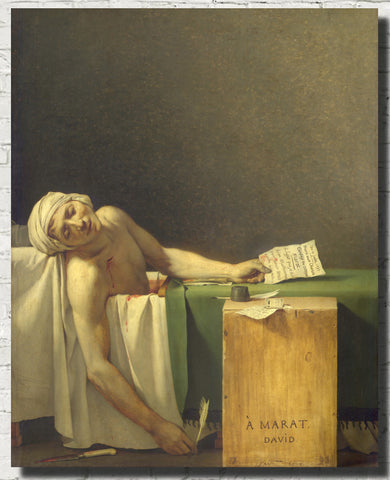
The disturbance is quiet rather than graphic. Marat's wound is visible, but the composition suppresses chaos. The dark empty space above him and the simplicity of the wooden box create the visual language of a memorial. Political propaganda, personal grief and classical restraint merge in one of the most famous images of revolutionary death.
Read the full GalleryThane analysis, The Death of Marat by Jacques-Louis David, for historical context, symbolism and legacy.
17. The Massacre of the Innocents – Peter Paul Rubens
Date: c. 1611–1612
Movement: Baroque
Collection: Art Gallery of Ontario, Toronto
Why it is disturbing: Rubens turns a biblical atrocity into a compressed struggle of mothers, soldiers and children.
The Massacre of the Innocents depicts the killing of children ordered by King Herod in the Gospel of Matthew. Rubens packs the scene with twisting bodies, desperate gestures and violent diagonals.

The horror is intensified by physical proximity. There is little open space and almost no escape from the collisions of limbs, weapons and bodies. Baroque movement becomes a vehicle for panic.
Explore more works by the artist in the Peter Paul Rubens collection.
18. Ivan the Terrible and His Son Ivan – Ilya Repin
Date: 1885
Movement: Russian Realism
Collection: State Tretyakov Gallery, Moscow
Why it is disturbing: A father embraces the son he has fatally wounded, his face consumed by terror and remorse.
Ilya Repin's Ivan the Terrible and His Son Ivan on 16 November 1581 depicts the aftermath of a legendary act of filicide. Ivan holds his dying son against his chest while blood spreads across the younger man's temple and the floor.

The painting's emotional centre is Ivan's expression. His eyes are wide with the recognition that nothing can reverse what has happened. Repin avoids the heroic distance of traditional history painting and focuses instead on shock, grief and the unbearable instant after violence.
Few paintings make remorse so physically immediate. The blood is disturbing, but the father's face is what stays in the memory.
19. The Raft of the Medusa – Théodore Géricault
Date: 1818–1819
Movement: Romanticism
Collection: Musée du Louvre, Paris
Why it is disturbing: A monumental painting based on a real shipwreck whose survivors endured abandonment, starvation and cannibalism.
The Raft of the Medusa was inspired by the wreck of the French naval frigate Méduse in 1816. More than a hundred people were left on a makeshift raft; only a small number survived. Accounts of starvation, violence and cannibalism made the disaster a political scandal.

Géricault chose the moment when survivors desperately signal a distant ship. Hope rises at the top of the composition, while the foreground is crowded with exhaustion and death. The painting's scale gives contemporary suffering the monumental gravity traditionally reserved for ancient history or religion.
Géricault studied corpses and severed body parts while preparing the work, a practice reflected in The Severed Heads. Explore further works in the Théodore Géricault collection.
20. The Bat-Woman – Albert Joseph Penot
Date: c. 1890
Movement: Academic fantasy and macabre art
Why it is disturbing: A nude female figure is transformed into a supernatural bat-like being suspended against a dark sky.
The Bat-Woman by Albert Joseph Penot occupies a peculiar territory between erotic figure painting, fantasy and horror. The woman's pale body is framed by enormous dark wings, while her raised arms and direct gaze make the transformation feel theatrical and uncanny.

Unlike the moral seriousness of Géricault or the psychological anguish of Munch, Penot's darkness is deliberately fantastical. Yet the combination of beauty and monstrosity is precisely what gives the image its lasting visual charge.
More works by the artist can be found in the Albert Joseph Penot collection.
Which Artists Created the Darkest and Most Disturbing Art?
Francisco Goya is perhaps the strongest candidate for the most disturbing major artist in Western art. His career moved from court portraiture and tapestry designs to war, witchcraft, madness and the private Black Paintings. Saturn Devouring His Son remains one of the darkest paintings of all time because it compresses fear, violence and irrationality into a single unforgettable image.
Hieronymus Bosch created disturbing worlds through invention rather than realism. His hybrid monsters, impossible landscapes and visions of punishment anticipate surrealism while remaining rooted in late medieval religious culture.
Théodore Géricault brought the real body into Romantic art with unusual intensity. His studies of severed heads and limbs were connected to his preparation for The Raft of the Medusa, a painting based on a modern political scandal and human catastrophe.
Henry Fuseli specialised in nightmares, supernatural visitations and psychologically charged fantasy. Edvard Munch later shifted disturbance inward, giving modern anxiety a visual language of distorted colour and unstable form. Caravaggio, meanwhile, made biblical violence feel physically immediate through close observation and dramatic darkness.
Together, these artists show that disturbing art can operate through many different means: gore, religious terror, mythology, fantasy, bodily realism, psychological crisis or the quiet suggestion that something terrible has just happened—or is about to.
Disturbing Art Prints and Dark Paintings for the Home
Dark and disturbing art can create a powerful focal point in an interior, particularly when the image combines strong composition with a compelling story. Works such as The Scream, The Nightmare, Saturn Devouring His Son, Witches' Sabbath and The Bat-Woman suit collectors drawn to Gothic imagery, Symbolism, mythology, psychological art and the supernatural.
GalleryThane offers many of the paintings in this guide as fine art prints, framed prints or canvas panels. The broader Mythology, Religious and Occult Art collection is a strong starting point for dramatic biblical subjects, demons, witches, legends and visionary art, while the Witches and Witchcraft collection focuses more narrowly on occult and supernatural imagery.
For viewers interested in the human body as a source of controversy, vulnerability or confrontation, GalleryThane's Nude Art Prints collection includes works ranging from classical mythology to modern figurative art.
Frequently Asked Questions
What is considered the most disturbing painting of all time?
There is no objective answer, but Francisco Goya's Saturn Devouring His Son is one of the strongest candidates. Its cannibalistic subject, frantic brushwork, staring eyes and almost private intensity make it exceptionally difficult to forget. Other frequent contenders include Bosch's The Garden of Earthly Delights, Caravaggio's Judith Beheading Holofernes, Fuseli's The Nightmare and Repin's Ivan the Terrible and His Son Ivan.
What is the scariest painting ever made?
Henry Fuseli's The Nightmare is among the most famous scary paintings because it combines sleep, helplessness, sexuality and supernatural intrusion. Goya's Saturn Devouring His Son is more viscerally horrifying, while Munch's The Scream expresses psychological fear rather than depicting a literal threat.
Why is Saturn Devouring His Son so disturbing?
Goya removes the classical dignity usually associated with mythology. Saturn appears frantic and almost animal-like as he tears into a mutilated body. The dark setting, staring eyes and rough handling of paint make the scene feel less like an ancient myth than a nightmare unfolding in real time.
Which artists are known for dark or disturbing paintings?
Francisco Goya, Hieronymus Bosch, Théodore Géricault, Henry Fuseli, Edvard Munch and Caravaggio are among the most important artists associated with dark, disturbing or psychologically intense imagery. Other significant examples include Walter Sickert, Ilya Repin, Albert Joseph Penot and Peter Paul Rubens.
What are examples of disturbing Renaissance paintings?
Hieronymus Bosch's The Garden of Earthly Delights is one of the most famous disturbing works associated with the northern Renaissance, especially its nightmarish Hell panel. Other Renaissance and Mannerist artists also explored martyrdom, judgement, monsters and violent biblical subjects, but Bosch remains exceptional for the density and originality of his invented creatures and punishments.
Why are people drawn to disturbing art?
Disturbing art allows viewers to encounter fear, death, taboo, violence and psychological crisis within the controlled space of an image. It can provoke curiosity, empathy, revulsion or fascination. The strongest works do more than shock: they use discomfort to make viewers think about history, morality, power, mortality and the human mind.
Are disturbing paintings the same as controversial paintings?
No. Some disturbing paintings are controversial, but the categories are not identical. A work can be disturbing because of horror or psychological unease, while another can be controversial because it challenges social, religious, sexual or artistic conventions. Olympia and L'Origine du Monde are important examples of paintings whose disturbing power is closely tied to historical controversy and taboo.
Conclusion: Why the Most Disturbing Paintings Endure
The most disturbing paintings of all time endure because they reach beyond shock. Goya's Saturn is about destructive power and terror; Bosch turns sin and punishment into impossible worlds; Géricault confronts death and catastrophe; Fuseli transforms sleep into vulnerability; Munch gives anxiety a universal face.
Other works disturb through history rather than horror. Olympia, The Nude Maja and L'Origine du Monde challenged boundaries around the body and sexuality. The Gross Clinic made modern surgery monumental. The Camden Town Murder allows ambiguity to do the work of fear.
Together, these 20 paintings reveal that dark art is not one genre. It is a recurring human impulse to look at what frightens, repels or unsettles us—and to transform that discomfort into images powerful enough to survive for centuries.
Related Reading
- Five Shocking Paintings
- The Sin Painting by Heinrich Lossow
- The Death of Marat by Jacques-Louis David: A Comprehensive Analysis
- Caravaggio Artist Profile
- Edvard Munch: A Journey Through Art and Emotion
- Witches and Witchcraft in Art
- Most Famous Nude Paintings of All Time