


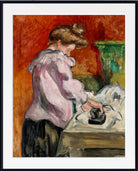
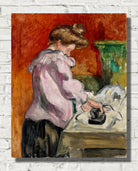
The Ironer (1908) by Louis Valtat
Couldn't load pickup availability
BUY WITH CONFIDENCE
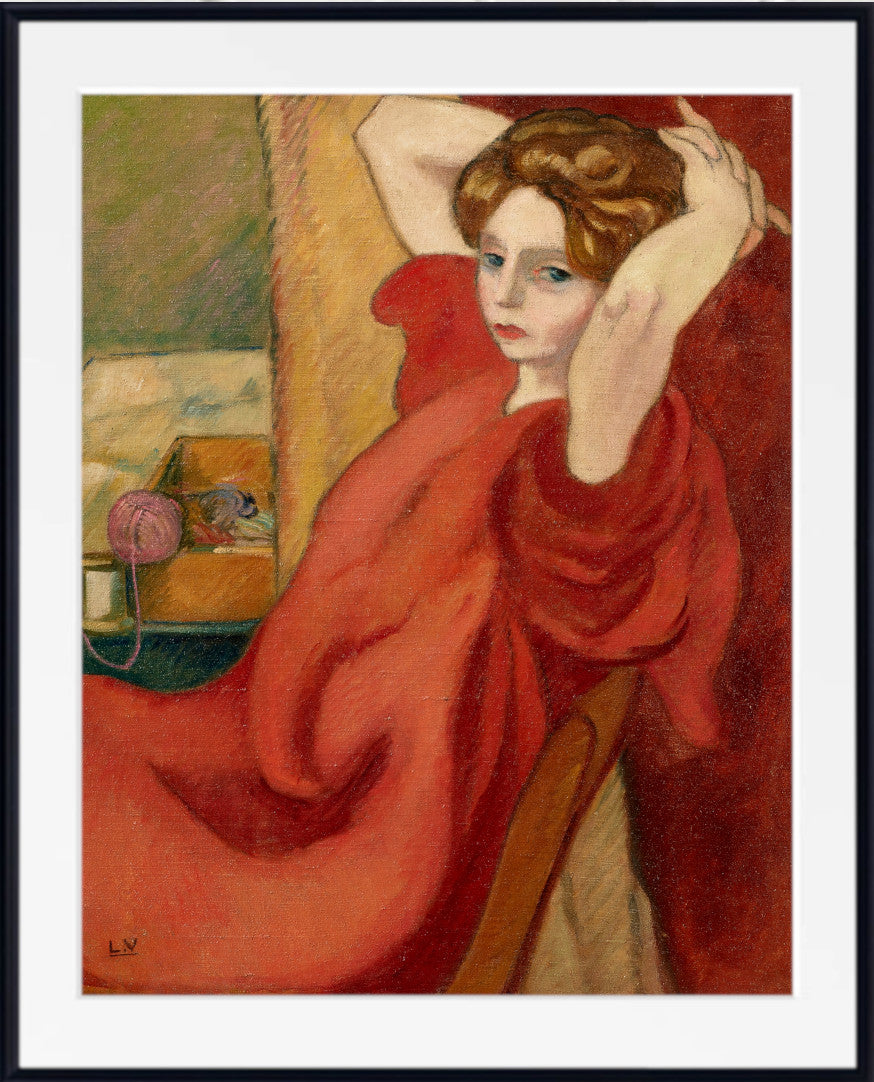
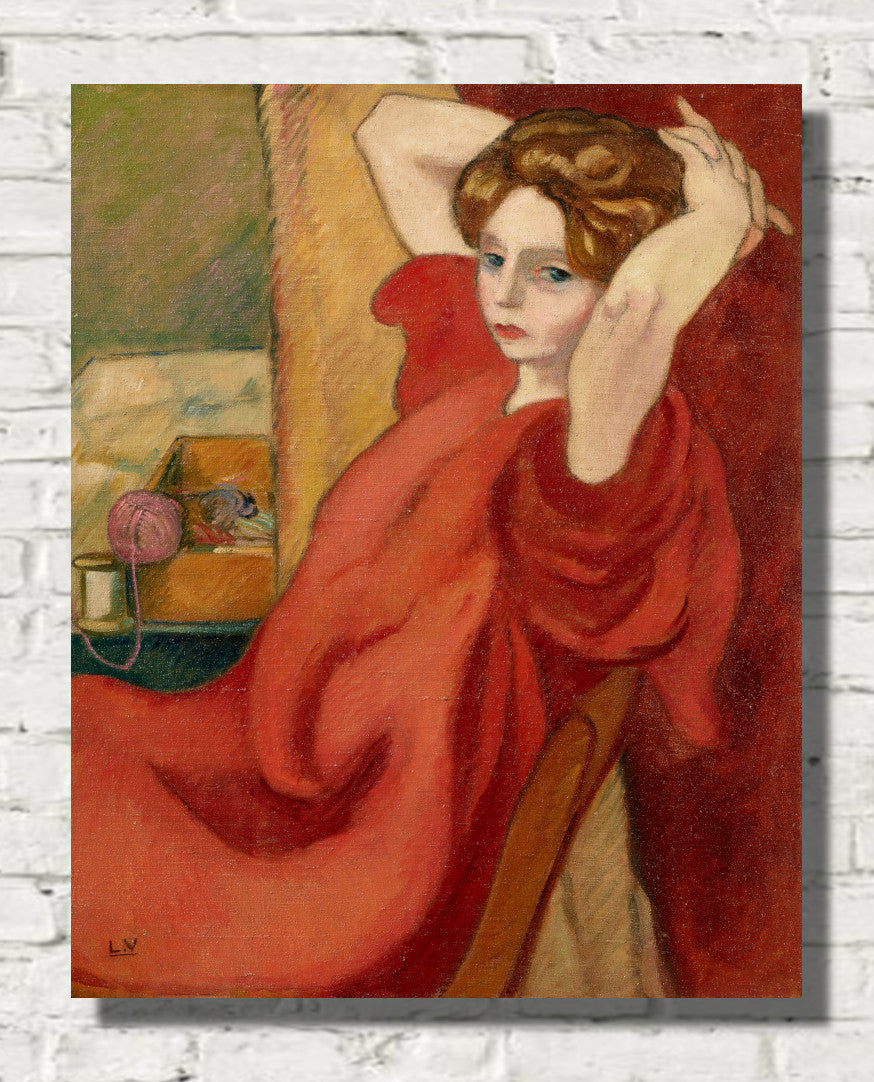
The Ironer (La Repasseuse) (c.1908) by Louis Valtat transforms an ordinary domestic task into a vivid example of early twentieth-century modern painting. A woman is shown absorbed in the physical action of ironing, her figure and surroundings unified by Valtat's characteristically strong colour, simplified forms and direct, expressive brushwork.
This Louis Valtat The Ironer print demonstrates how the artist brought the same chromatic intensity found in his Mediterranean landscapes and floral still lifes into scenes of everyday life. Rather than treating domestic work as a minor subject, Valtat makes the figure, ironing table, fabric and surrounding interior part of a carefully balanced composition of colour and form. Available as a fine art print, framed print or canvas panel, La Repasseuse is an appealing choice for admirers of Valtat, Fauvist-era art, figurative painting and colourful scenes of everyday life.
The Ironer – Everyday Life in Modern French Painting
La Repasseuse belongs to a long tradition of artists finding serious artistic subjects within ordinary daily activity.
There is nothing theatrical about ironing.
It is repetitive domestic work, normally performed privately and rarely intended to attract attention.
That very ordinariness made it an intriguing subject for modern painters.
Rather than relying upon historical narratives, mythology or elaborate symbolism, an artist could focus instead upon gesture, posture, colour and the structure of the surrounding room.
Valtat approaches the subject in precisely this way.
The woman is defined principally through her activity.
Her concentration, body position and relationship with the ironing surface create the human centre of the composition.
The scene feels observed rather than staged.
A Woman Absorbed in Her Work
The act of ironing naturally produces a distinctive physical posture.
The body leans towards the work surface while one arm controls the iron and the other manages the fabric.
This creates a series of diagonals and curves that can structure an entire figurative composition.
Valtat was particularly sensitive to such natural gestures.
He frequently painted figures engaged in ordinary activities rather than presenting them in rigid formal poses.
That gives The Ironer a sense of immediacy.
The figure is not performing for the viewer.
She appears occupied by the task in front of her.
This quality places the painting within the broader modern interest in contemporary life that had developed strongly during the nineteenth century and continued into the twentieth.
Domestic Work as a Subject for Modern Art
Scenes of women sewing, ironing, reading and working within interiors appeared repeatedly in modern French painting.
Such subjects allowed artists to explore familiar life without depending upon grand narratives.
They also provided an opportunity to study the relationship between figure and interior.
A dress could become a major area of colour.
White fabric could introduce a strong passage of light.
Furniture could create horizontal and vertical structures.
The walls and floor could be simplified into large coloured planes.
In this way, a completely ordinary domestic activity could become the basis for highly sophisticated pictorial experimentation.
Valtat and Scenes of Everyday Life
Although Louis Valtat is especially admired for his Mediterranean landscapes and colourful flower paintings, scenes of contemporary life remained important throughout his career.
He painted family members, women sewing, people reading, figures on beaches and individuals engaged in domestic tasks.
These subjects allowed him to combine portraiture and genre painting without needing to produce a formal likeness.
The individual figure could remain psychologically convincing while also functioning as part of the overall arrangement of colour.
La Repasseuse is particularly effective in this respect.
The subject remains immediately understandable, yet the painting is equally concerned with how the woman's body, clothing, surrounding objects and interior space fit together visually.
Colour Gives the Scene Its Modern Character
Valtat's approach to colour separates The Ironer from more conventional nineteenth-century domestic painting.
He had spent years developing an increasingly saturated palette, particularly during extended stays along the Mediterranean coast.
By the period around 1908, colour had become one of the defining elements of his art.
He did not simply reproduce every local colour exactly as it appeared.
A colour could be intensified, simplified or adjusted according to the needs of the entire composition.
Warm and cool hues could be deliberately juxtaposed so that each strengthened the other.
This approach connects Valtat with the broader transformation of colour associated with Post-Impressionism and Fauvism.
A Figure Constructed Through Colour
Traditional academic figure painting often depended heavily upon tonal modelling.
Gradual changes from light to dark created the illusion of rounded bodies and convincing three-dimensional form.
Valtat increasingly relied upon colour itself.
Larger colour areas establish clothing and surrounding forms, while stronger accents define important boundaries.
The figure retains physical presence but does not need to be modelled through countless subtle tonal transitions.
This simplification gives the image greater directness.
The viewer immediately understands the action while remaining aware of the coloured surface from which the figure has been constructed.
Visible Brushwork
Valtat does not attempt to hide the physical process of painting.
His brushwork remains visible and contributes directly to the vitality of the image.
Different marks can suggest fabric, clothing, furniture or surrounding space without describing each surface in minute detail.
This direct technique was increasingly important to modern painting.
Brushstrokes were no longer merely an invisible means of reproducing reality.
They could become part of the expressive character of the finished work.
In a subject concerned with physical activity, this visible energy is especially appropriate.
The act of painting and the act of ironing both involve repeated movement.
Fabric as an Important Visual Element
Fabric is central to the subject of La Repasseuse.
It provides the practical reason for the woman's activity, but it also offers considerable pictorial opportunity.
Folded and unfolded cloth produces irregular shapes.
Light fabric can introduce strong pale passages within a darker or more colourful interior.
Creases and edges create directional lines that can lead the viewer's eye across the composition.
Valtat frequently showed an interest in textiles, clothing and patterned surfaces.
Here, fabric is not decorative ornament added to the scene.
It is part of the structure of the painting.
The Ironing Table as a Structural Device
The horizontal work surface provides an important counterweight to the human figure.
The woman introduces curves and diagonals through her body and arms.
The table or ironing surface establishes a firmer horizontal structure.
This creates stability within the composition.
Objects placed upon or around the work surface can then become smaller accents of colour and shape.
Valtat repeatedly used furniture in this way.
A table is not simply an item represented within the scene.
It becomes a means of organising pictorial space.
Interior Space without Academic Precision
Valtat generally retained a stronger sense of recognisable space than the most radical Fauvist painters.
Yet he did not allow perspective to dominate his compositions.
An interior could be simplified so that wall, furniture and figure formed comparatively broad interconnected areas.
The purpose was not to construct a mathematically exact room.
Instead, space needed to support the relationships between colours and shapes.
This balance is characteristic of Valtat.
He modernised representation without completely abandoning recognisable reality.
The Ironer and Fauvism
The Ironer dates from around 1908, several years after the celebrated Salon d'Automne exhibition of 1905 associated with the naming of Fauvism.
By this time the small group of artists identified with the movement was already developing in different directions.
Fauvism itself had never been a tightly organised movement with a formal manifesto.
Its artists were linked principally by a period of extraordinary experimentation with colour.
Valtat's relationship with Fauvism was distinctive because his own experiments had begun considerably earlier.
He therefore should not be understood simply as an artist who adopted the style after 1905.
Louis Valtat as a Proto-Fauve
Modern accounts of Valtat increasingly use terms such as proto-Fauve or precursor of Fauvism.
This reflects the chronology of his work.
During the 1890s and early 1900s, Valtat was already intensifying colour and simplifying forms in paintings of southern France.
These experiments preceded the famous summer of 1905 when Henri Matisse and André Derain worked together at Collioure.
Valtat later exhibited alongside artists associated with Fauvism, but he maintained an independent style.
His colour could be exceptionally strong, yet he generally preserved more natural structure than Matisse, Derain or Maurice de Vlaminck at their most radical.
Beyond the Mediterranean Landscape
Valtat's reputation as a colourist was built substantially upon his paintings of the Mediterranean coast.
The brilliant light around Agay, Anthéor and other southern locations encouraged him to use stronger reds, oranges, greens and blues.
Yet those discoveries were not restricted to landscape.
Once Valtat had developed a more liberated palette, he could apply it equally to a domestic interior.
The sunlit rocks and vegetation of the south disappear, but the fundamental idea remains.
Colour is allowed to organise the painting.
The Ironer therefore demonstrates how Valtat's modern colour language could operate even within an enclosed everyday setting.
Valtat's Move Back towards Parisian Life
The approximate 1908 date places the work during a period when Valtat was balancing his Mediterranean work with increasing periods in and around Paris.
He had established a new Paris studio in the years immediately before this painting and continued moving between the capital, Normandy and southern France.
Domestic and family subjects became an important complement to landscapes.
This gave his work unusual breadth.
The same painter could depict a Mediterranean cliff, a vase of flowers, a busy Parisian scene or a woman engaged in household work without abandoning his distinctive chromatic identity.
Valtat's Family as Artistic Subjects
Family life played an important role in Valtat's painting.
His wife Suzanne was one of his most frequent models and appeared in numerous domestic and informal settings.
Museum scholarship notes that Valtat repeatedly portrayed her sewing, embroidering and ironing, integrating intimate family life into his art.
However, the surviving public catalogue information for this particular La Repasseuse does not explicitly identify its sitter by name.
It is therefore more accurate to describe the subject simply as a woman ironing rather than assign an identity that has not been securely documented for this specific canvas.
Around 1908: A Changing Moment in Modern Art
The years around 1908 were exceptionally important in European painting.
Fauvism had demonstrated that colour could operate independently from naturalistic description.
Paul Cézanne's influence was becoming increasingly important to younger artists.
Pablo Picasso and Georges Braque were beginning the experiments that would lead towards Cubism.
Henri Matisse was developing the flatter, increasingly decorative interiors represented by works such as Harmony in Red.
Valtat followed none of these directions completely.
His art retained its own balance between colour, direct observation and physical form.
This independence is one reason his work occupies such an interesting position within early twentieth-century French painting.
Valtat and Henri Matisse
Valtat and Henri Matisse shared an interest in expressive colour but approached pictorial structure differently.
Matisse increasingly flattened his compositions and allowed pattern to overwhelm conventional depth.
Valtat usually retained a greater sense of physical space.
A figure remains solid.
A table still functions convincingly as a table.
An interior remains readable as an interior.
Yet colour is far stronger than it would have been within conventional academic painting.
This makes Valtat's work an illuminating comparison with the more radical experiments of Matisse.
Valtat and André Derain
André Derain also pushed colour to extraordinary extremes during the Fauvist years.
His landscapes at Collioure and L'Estaque often transform trees, water and mountains into intense fields of red, orange, blue or green.
Valtat's colour can be comparably rich but tends to remain more closely tied to the observed subject.
He therefore represents a different route towards modernism.
Rather than dismantling representation, he strengthens it through colour.
The Influence of Neo-Impressionism
Valtat's development was also connected with the colour experiments of Neo-Impressionism.
He knew Paul Signac and Henri-Edmond Cross, whose paintings explored how neighbouring pure colours could increase one another's intensity.
Valtat never adopted the strict Pointillist method associated with Georges Seurat.
His brushwork remained much freer.
Nevertheless, the underlying principle of colour interaction remained important.
Warm and cool colours could be balanced across a composition to create luminosity and energy.
This principle continued to inform Valtat's work long after his earliest experiments.
Valtat and Pierre-Auguste Renoir
Valtat maintained an important friendship with Pierre-Auguste Renoir, whom he visited repeatedly in southern France.
Their relationship helps explain Valtat's unusual position between artistic generations.
Renoir belonged to the great Impressionist generation.
Matisse and Derain represented the younger Fauvist avant-garde.
Valtat stood between them chronologically and stylistically.
From Renoir he could appreciate the sensuous qualities of paint, colour and the human figure.
From the developing modern movement came increasing freedom of colour and simplification.
Valtat combined these influences without becoming an imitator of either generation.
Ambroise Vollard and Valtat
The influential dealer Ambroise Vollard began representing Valtat in 1904.
Vollard was one of the central figures in the development of modern French art, working with artists including Cézanne, Gauguin, Picasso and several painters associated with Fauvism.
For a period he purchased Valtat's production and helped circulate the artist's work among collectors.
This relationship is significant because it demonstrates that Valtat's work had attracted serious commercial attention before Fauvism became historically established.
By the time La Repasseuse was painted around 1908, Valtat had already spent many years working within these influential modern-art networks.
The Ironer in the Tradition of Degas
The subject of a woman ironing has particularly strong associations with Edgar Degas.
Degas repeatedly painted and drew laundresses during the late nineteenth century.
His interest was partly connected with the modern urban world and the physically demanding labour performed by working women.
Those paintings helped establish ironing as a legitimate subject for ambitious modern art.
Valtat's treatment belongs to a later generation and is visually different.
Where Degas often emphasised unusual viewpoints, fatigue and observational realism, Valtat's principal contribution lies increasingly in colour and simplified form.
The subject provides a useful illustration of how modern painting evolved from Impressionism towards the stronger chromatic experimentation of the twentieth century.
The Modernity of an Ordinary Gesture
One of the enduring qualities of The Ironer is the familiarity of the action.
Nothing extraordinary needs to happen.
The woman's concentration and repeated movement are sufficient.
Modern painters increasingly recognised that contemporary life did not need to be idealised before it could become art.
A café, railway station, beach, dining room or laundry task could provide a subject as legitimate as classical mythology.
Valtat takes this idea and combines it with the modern liberation of colour.
The result is simultaneously intimate and formally adventurous.
Why The Ironer Matters
La Repasseuse brings together several characteristics that make Valtat's figurative work distinctive:
- an ordinary domestic activity treated as a serious modern subject
- a figure absorbed naturally in her task rather than formally posing
- strong colour replacing excessive tonal modelling
- visible, energetic brushwork
- simplified but recognisable forms
- fabric and furniture used to structure the composition
- a balance between pictorial flatness and believable physical space
- the chromatic freedom associated with Valtat's proto-Fauvist development
- a connection between nineteenth-century modern-life painting and twentieth-century colour
The painting demonstrates that Valtat's contribution to modern art extended considerably beyond Mediterranean landscape.
His colour language could transform even the most familiar domestic scene.
Louis Valtat's Painting Style
Louis Valtat developed an individual style from a complex mixture of influences.
His early work absorbed aspects of Impressionism, Neo-Impressionism and Post-Impressionism.
His contact with the Mediterranean intensified his palette and encouraged greater simplification.
By the early twentieth century, strong reds, oranges, greens, blues and violets had become characteristic of his painting.
Yet Valtat generally maintained recognisable form and spatial coherence.
He therefore occupies an important position between the Impressionist tradition and the more radical experiments of Fauvism.
His landscapes, interiors, portraits, still lifes and flower paintings share an emphasis upon direct brushwork and chromatic richness.
The Ironer shows those qualities operating within the human figure and domestic interior.
About Louis Valtat
Louis Valtat (1869–1952) was a French painter and printmaker recognised as an important precursor to Fauvism and a significant figure in the transition from nineteenth-century Impressionism to twentieth-century modern colour painting.
Born in Dieppe, Normandy, Valtat studied in Paris at the École des Beaux-Arts and later at the Académie Julian.
He began exhibiting at the Salon des Indépendants during the 1890s and developed within an artistic environment influenced by Impressionism, Neo-Impressionism, the Nabis and Post-Impressionism.
Health problems encouraged him to spend extended periods in southern France, where Mediterranean light profoundly affected his palette.
Valtat became acquainted with artists including Paul Signac, Henri-Edmond Cross and Pierre-Auguste Renoir and later worked with the influential dealer Ambroise Vollard.
His unusually strong colour was already apparent before the public emergence of Fauvism at the Salon d'Automne of 1905.
Valtat himself exhibited at that historic Salon and remained associated with the Fauvist circle, although his style developed independently and generally retained greater natural structure than the most radical Fauvist paintings.
Throughout his long career he painted landscapes, seascapes, portraits, domestic scenes, still lifes and flowers.
He continued working until deteriorating eyesight eventually prevented him from painting and died in Paris in 1952.
The Original The Ironer
The original La Repasseuse, or The Ironer, is dated circa 1908.
It was painted by Louis Valtat in oil on canvas.
Auction records give the dimensions as approximately 92 × 73 cm, equivalent to approximately 36¼ × 28⅝ inches.
The painting is signed L. Valtat at the lower right.
Bridgeman Images records the original under the titles La Repasseuse and A Woman Ironing and identifies it as belonging to a private collection.
Publicly accessible documentation consulted for this work does not establish a permanent museum collection.
It also does not explicitly identify the sitter in this particular canvas.
Although Valtat frequently painted his wife Suzanne engaged in domestic activities, including ironing, it would therefore be inappropriate to identify the woman in this exact painting as Suzanne without more specific documentary evidence.
A Louis Valtat The Ironer Print for Your Interior
A Louis Valtat The Ironer print combines figurative art with the rich colour and expressive brushwork of early twentieth-century French modernism.
Unlike a formal portrait, the subject is engaged in an ordinary activity, giving the image an intimate and natural character.
The strong colour and simplified forms nevertheless prevent the work from appearing conventionally domestic or sentimental.
Its vertical format makes it particularly effective on narrower wall spaces, beside fireplaces, above console tables or within a curated gallery wall.
The painting can work particularly well against white, cream, putty, pale grey and other neutral backgrounds, allowing Valtat's stronger colours to remain prominent.
Natural timber furniture complements the warm domestic character of the scene, while contemporary and Scandinavian-inspired interiors provide an effective contrast with its expressive painted surface.
The Ironer is particularly suitable for living rooms, dining rooms, bedrooms, hallways, studies and home offices.
For admirers of Fauvism and modern French art, however, its appeal extends beyond decoration. It demonstrates how Valtat could bring the chromatic freedom developed through landscape painting into the quiet setting of everyday domestic life.
Frequently Asked Questions
When did Louis Valtat paint The Ironer?
The painting is dated circa 1908.
What is the French title of The Ironer?
The French title is La Repasseuse.
What does The Ironer depict?
The painting depicts a woman engaged in ironing, transforming a familiar domestic task into a colourful modern figurative composition.
Who is the woman in The Ironer?
The publicly accessible documentation consulted for this particular painting does not explicitly identify the sitter. Valtat frequently painted his wife Suzanne undertaking domestic activities, including ironing, but it would be speculative to identify the sitter in this exact canvas without specific documentary evidence.
Is The Ironer a Fauvist painting?
The work dates from around 1908 and reflects the strong colour associated with Valtat's relationship to Fauvism. Valtat is often described more precisely as a precursor or proto-Fauve because his experiments with saturated colour had begun before Fauvism emerged publicly in 1905.
Why is Louis Valtat considered a proto-Fauve?
Valtat was already using unusually intense colour during the 1890s and early 1900s. His Mediterranean paintings anticipated several of the chromatic qualities that later became associated with Matisse, Derain and the Fauves.
Did other modern artists paint women ironing?
Yes. Edgar Degas famously painted and drew laundresses and ironing women during the nineteenth century. Valtat belongs to a later generation and treats the subject with the stronger colour and simplification characteristic of early twentieth-century modernism.
Why were domestic subjects important to Valtat?
Domestic scenes allowed Valtat to combine figure painting with an informal observation of everyday life. Clothing, textiles, furniture and interiors also gave him opportunities to explore colour and composition.
What medium did Louis Valtat use for The Ironer?
The original was painted in oil on canvas.
What size is the original The Ironer?
Auction records give the dimensions as approximately 92 × 73 cm.
Is The Ironer signed?
Yes. The painting is signed L. Valtat at the lower right.
Where is the original The Ironer by Louis Valtat?
Bridgeman Images identifies the original as belonging to a private collection. No permanent public museum location has been securely established in the documentation consulted.
How does The Ironer relate to Fauvism?
The painting uses the stronger colour and simplified forms that connect Valtat with Fauvism, while retaining more recognisable physical structure than some of the most radical Fauvist paintings by Matisse or Derain.
How does Valtat differ from Henri Matisse?
Matisse increasingly flattened space and allowed colour and pattern to operate with great independence from observed reality. Valtat generally retained a stronger connection with recognisable form, while still using exceptionally rich colour.
Was Valtat represented by Ambroise Vollard?
Yes. Ambroise Vollard began representing Valtat in 1904 and purchased his production for several years, helping connect the artist with the influential Parisian market for modern art.
Did Valtat know Renoir?
Yes. Valtat maintained a friendship with Pierre-Auguste Renoir and visited him in southern France. The relationship reflects Valtat's position between the Impressionist generation and the younger artists associated with Fauvism.
Is The Ironer available as a framed Louis Valtat print?
Yes. GalleryThane offers The Ironer (La Repasseuse) in a choice of sizes and formats, including fine art paper prints, framed prints and canvas options.
Where would a Louis Valtat The Ironer print work well?
Its vertical figurative composition makes it particularly suitable for living rooms, bedrooms, dining rooms, hallways, studies and home offices. It works especially well in contemporary, Scandinavian-inspired, mid-century and eclectic interiors.
All orders for unframed fine art prints and original paintings are dispatched within 2 working days of receipt of payment.
Orders for custom framed prints are dispatched within 4 working days.
All orders are fully tracked from dispatch to delivery at your home or business.
All print and original painting orders are fully insured against loss or damage in transit. We refund or replace any damaged or lost orders.
Buy with confidence - read what our satisfied customers have to say - Reviews
Fine art papers are printed without any additional white border Please let us know at the time of ordering if you would like a small additional white border.
Rolled canvas options have an additional white border of approximately 2.5 inches (7cm) on all 4 sides to aid stretching.
Ready to hang canvas panels are stretched on 1.5 inch deep solid pine frames from sustainable forestry sources. The image is mirrored on all 4 sides to give an aesthetically pleasing finish.
Why not have us gift wrap your order and attach a personalised message to the recipient. Available for all orders. Each order is hand wrapped in high quality gift wrap with meatllic ribbon and bow. Your personalised message is printed on a card which is included with your order.
Have your hand wrapped gift delivered directly to the recipient.
Full tracking and insurance included with every order.
Please note design may vary depending upon availability
Just purchase the gift wrap option HERE
We have a wide range of frames in standard sizes and we also make custom size frames.
To order a framed print:
1. select the print size you would like along with the print materials (matte paper, fine art paper).
2. Add your print choice to the basket.
3. Choose from our range of frames
4. Select the same size as the print you have added to your basket. If the frame size you want is not listed please contact us
5. Choose from the mount or no-mount option
6. Add your frame choice to the basket
7. Proceed to checkout.
Why Choose GalleryThane?
- Printed and framed in-house
- Free UK delivery
- Free EU and USA delivery on orders over £200
- Tracking and insurance included in every order
- Fast 1-3 day dispatch
- Gift wrapping service available
- Gallery quality materials
- Sustainable, eco-friendly packaging
- Great customer support
Explore related collections
What makes our Prints and Canvas Panels so special

Latest Giclee Printing Technology
We have invested in the latest wide format print technology to produce museum quality giclee prints utilising the highest quality pigment inks to give outstanding colour reproduction.

Museum Quality Archival Fine Art Papers
We print on the finest quality fine art papers with textured, smooth and lustre finishes for prints which last a lifetime.
From aceo miniatures to 40x80 inch large format, every print has our lifetime quality guaranteee.

Solid Wood Frames, Cotton Canvas
All of the wood for our canvas panels and frames is responsibly sourced from manages forests. Our cotton canvas is completely seedless for the highest quality reproduction possible.

Have Your Gift Wrapped


