




Interior with a Young Girl (Girl Reading) by Henri Matisse
Couldn't load pickup availability
BUY WITH CONFIDENCE
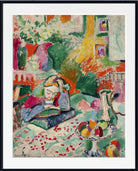
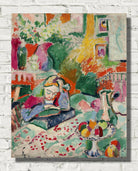
Interior with a Young Girl (Girl Reading) (1905–06) by Henri Matisse is an intimate Fauvist portrait of the artist's eleven-year-old daughter Marguerite absorbed in a book. Seated at a small table in the Matisse family's Paris studio, she rests her head against one hand while brilliant reds, greens, blues, yellows and pinks transform the surrounding room into a vibrant field of colour.
This Henri Matisse Girl Reading print captures one of the defining qualities of Fauvism: an ordinary moment made extraordinary through liberated colour. Marguerite's hair contains green, furniture is painted in intense contrasting hues and the table tilts dramatically towards the viewer, flattening conventional perspective. Available as a fine art print, framed print or canvas panel, Interior with a Young Girl is an outstanding choice for admirers of Matisse, Fauvist interiors, colourful figurative art and paintings celebrating reading and quiet domestic life.
Interior with a Young Girl – Marguerite Matisse Reading
The young reader in the painting is Marguerite Matisse, Henri Matisse's daughter.
Born in 1894 to Matisse and Caroline Joblaud, Marguerite became part of the household created after Matisse married Amélie Parayre in 1898. Amélie raised Marguerite alongside the couple's sons Jean and Pierre, and Marguerite remained exceptionally close to the family throughout her life.
She also became one of her father's most important models.
In this painting, Marguerite is approximately eleven years old. She sits quietly at a small table, her forehead supported by one hand as she looks down at an open book.
The gesture is immediately recognisable: she is completely absorbed in reading.
Yet Matisse surrounds this calm human moment with some of the most energetic colour and brushwork of his early career.
The contrast between Marguerite's concentration and the visual excitement of the room gives the painting much of its fascination.
The Matisse Family Studio at Quai Saint-Michel
Matisse painted the work in the family's studio at 19 quai Saint-Michel in Paris.
The building stood on the Left Bank of the Seine directly opposite the Île de la Cité and Notre-Dame.
Matisse had worked in this neighbourhood for several years, and the studio provided the setting for numerous paintings of his family, models and domestic interiors.
The room itself was relatively narrow.
Rather than disguising those limitations, Matisse turns the compressed space into an advantage.
Table, chair, figure and surrounding furniture are pushed together across the picture plane. Objects overlap and the conventional recession of the room is deliberately weakened.
The interior consequently feels intimate and enclosed, perfectly suited to the solitary activity of reading.
A Quiet Moment Painted with Explosive Colour
The emotional character of the subject is remarkably restrained.
Marguerite is not posing theatrically. She is not looking towards the viewer and appears unaware of being observed.
Her attention remains entirely with the book.
Matisse's technique could hardly be more different.
The room is constructed from bold, rapid strokes of intense colour. Red, blue, green, yellow, pink, white and darker accents compete across the canvas.
The sitter's quiet concentration and the restless painted surface therefore operate in deliberate opposition.
This is one of the great achievements of the picture.
Fauvist colour does not destroy the intimacy of the scene. Instead, it makes that ordinary domestic moment appear newly vivid.
Marguerite's Green Hair
One of the clearest signs that Matisse has abandoned conventional naturalism appears in Marguerite's hair.
Parts of it are painted green.
Matisse is not suggesting that his daughter literally had green hair.
The colour has been selected because of its relationship with the other hues in the painting.
Green can interact with neighbouring reds and pinks, strengthening the chromatic structure of the entire composition.
This principle was fundamental to Fauvism.
Colour was no longer required to function simply as a description of an object's local appearance.
A face, shadow, wall or piece of furniture could take whatever colour best served the painting as a whole.
Marguerite remains entirely recognisable despite this freedom.
Colour Relationships Rather Than Local Colour
Matisse repeatedly emphasised the importance of relationships between colours.
In Interior with a Young Girl, no colour exists completely independently.
A red becomes more forceful because of the green beside it. Blue gains intensity against warmer orange or yellow passages. Areas of white contain traces of surrounding colour rather than behaving as completely neutral zones.
The result is a tightly interconnected chromatic structure.
This explains why the room feels coherent despite the extraordinary variety of hues.
Matisse is not simply adding bright colours indiscriminately.
He is balancing one colour against another across the whole canvas.
The painting's harmony therefore comes from relationships rather than realism.
The Tilted Table
The table in front of Marguerite is one of the painting's most radical structural elements.
Matisse tips its surface sharply forwards towards the viewer.
Under conventional linear perspective, a horizontal tabletop would recede into space.
Here, it seems almost to rise vertically.
The adjustment makes the book and objects on the table easier to see, but its importance goes considerably further.
By tipping the table forward, Matisse reduces the apparent depth of the room.
The tabletop becomes another coloured shape distributed across the flat surface of the canvas.
MoMA specifically identifies this device as part of Matisse's effort to flatten the scene.
It is an excellent example of the artist altering observed reality in order to strengthen the overall composition.
Flattening the Interior
The tilted table is only one part of Matisse's challenge to conventional pictorial space.
The surrounding room contains furniture and architectural details, but the relationships between them are deliberately compressed.
Strong areas of colour continually pull distant surfaces towards the viewer.
Ordinarily, a background wall would recede behind a seated figure.
Matisse's vivid colour makes it compete directly with Marguerite.
This produces an important tension between depth and flatness.
We recognise a girl sitting in a room, yet the painting can simultaneously be experienced as a network of coloured shapes arranged across a rectangle.
This growing awareness of the painted surface itself became one of the defining developments of modern art.
The Room Is as Important as the Sitter
Traditional portraiture normally establishes a clear hierarchy.
The sitter is the principal subject, while furniture and surroundings provide secondary context.
Matisse refuses to maintain that hierarchy.
The chair, table, walls and objects around Marguerite demand considerable attention because their colours are just as intense as those of the figure.
MoMA notes that the surrounding room and furniture compete visually with the sitter and foreground objects.
This does not make Marguerite unimportant.
Instead, she becomes integrated into the complete decorative structure of the interior.
Figure and environment are treated as parts of the same pictorial problem.
This principle would become central to Matisse's mature interiors.
Rapid and Expressive Brushwork
The painting's brushwork reinforces its immediacy.
Matisse does not polish the surface until every individual stroke disappears.
Marks remain visible and energetic.
Some establish the shape of furniture. Others describe Marguerite's clothing, hair or face. Broader areas create the surrounding walls and floor.
The Musée d'Art Moderne de Paris has highlighted the contrast between Marguerite's concentrated, introspective pose and the rapid, dynamic touch with which Matisse paints the scene.
This visible handling gives the interior a pulse of movement even though the sitter herself remains still.
The painting therefore communicates two different experiences at once: the stillness of reading and the energy of painting.
Painted Immediately After the Collioure Summer
The date of the painting is particularly significant.
Matisse created it in Paris during the autumn and winter of 1905–06, immediately after the extraordinary summer he had spent at Collioure with André Derain.
At Collioure, the two artists had radically transformed their use of colour.
Mountains became orange or red. Shadows could become blue, green or violet. Tree trunks and human skin no longer needed to conform to conventional local colour.
Returning to Paris, Matisse brought those discoveries into the domestic interior.
The Mediterranean landscape was replaced by his daughter, a table, chairs and a familiar room.
Yet the chromatic freedom remained.
Interior with a Young Girl therefore demonstrates that Fauvism was not dependent upon brilliant southern sunlight. Its principles could transform everyday life inside a Paris studio just as radically.
The Salon d'Automne and the Fauvist Breakthrough
The painting was created in the immediate aftermath of the famous 1905 Salon d'Automne.
At that exhibition, intensely coloured paintings by Matisse, André Derain, Henri Manguin, Albert Marquet and other associated artists provoked a famous critical reaction.
Louis Vauxcelles used the expression les fauves — “the wild beasts” — to describe the painters whose colour appeared startlingly uncontrolled to contemporary viewers.
Matisse emerged as the leading figure of the group.
MoMA places Interior with a Young Girl firmly within Fauvism, and the painting makes the movement's central principles unusually easy to understand.
Its subject is entirely ordinary.
Its colour is anything but ordinary.
From Landscape Fauvism to the Domestic Interior
Many of the most famous early Fauvist paintings are landscapes.
Collioure, Chatou, L'Estaque and the Mediterranean coast provided artists with boats, hills, trees, rivers and brilliant sunlight.
Interior with a Young Girl demonstrates that Matisse could apply the same pictorial freedom to domestic life.
A green passage in Marguerite's hair functions much as a red tree trunk might in a Fauvist landscape.
The furniture can become brilliant colour just as mountains and water could.
The boundaries between objects become opportunities for complementary contrasts.
This transition was important because the interior would eventually become one of Matisse's defining subjects.
Rooms filled with figures, textiles, screens, patterned walls and furniture occupied him repeatedly throughout the following decades.
The Beginnings of Matisse's Great Interior Paintings
Looking back from Matisse's later career, Interior with a Young Girl appears remarkably prophetic.
In later interiors he increasingly allowed walls, patterned textiles, floors, furniture and figures to merge into a unified decorative field.
Perspective became more flexible.
Pattern grew increasingly important.
Background and foreground could compete rather than maintaining a clear hierarchy.
Those ideas are already visible here.
The tilted table, compressed room, vivid furniture and integration of Marguerite into her surroundings all point towards the decorative interiors that would become among Matisse's greatest achievements.
The painting is therefore both a major Fauvist work and an important early stage in his lifelong exploration of interior space.
Marguerite Matisse as Her Father's Model
Marguerite occupied a special position within Matisse's art.
Because she grew up surrounded by her father's work, sitting for him became part of family life rather than an isolated formal event.
She appears in numerous paintings and drawings across different stages of his development.
Her childhood had also been physically difficult.
After suffering diphtheria, she underwent a tracheotomy and often concealed the resulting scar with a high collar or dark ribbon in portraits.
Matisse nevertheless avoided turning her into a symbol of fragility.
His portraits frequently show an alert, self-contained personality.
Here, her absorbed reading creates precisely that impression.
The viewer observes an intelligent young person occupying her own private world.
Reading as a Subject
The act of reading contributes strongly to the painting's enduring appeal.
Reading is visually quiet.
Unlike dancing, conversation or outdoor activity, it involves very little physical movement.
This allows Matisse to concentrate attention on posture and concentration.
Marguerite's lowered head and hand against her forehead immediately communicate absorption.
The book also creates a small visual centre within the dramatically tilted tabletop.
The painting consequently carries a mood of privacy despite its brilliant colour.
For modern viewers, that combination makes it particularly appealing: it celebrates the familiar experience of becoming absorbed in a book while surrounding that moment with one of the most adventurous colour languages of modern painting.
Why Interior with a Young Girl Matters
The painting brings together many of the characteristics that define Matisse's breakthrough around 1905:
- brilliant, non-naturalistic colour
- Marguerite's hair partly transformed into green
- strong complementary colour relationships
- rapid and clearly visible brushwork
- conventional perspective deliberately altered
- a tabletop tipped forward towards the viewer
- background and foreground given comparable visual importance
- the human figure integrated into an overall decorative structure
- an ordinary domestic subject transformed through Fauvist colour
- the beginnings of Matisse's mature approach to interior painting
The work is therefore far more than a charming image of the artist's daughter reading.
It is one of the paintings in which Matisse demonstrates how radically modern art could transform even the simplest aspects of everyday experience.
Henri Matisse's Fauvist Painting Style
Henri Matisse became the leading figure of Fauvism and one of the most important colourists in the history of modern art.
His early career passed through numerous influences, including academic art, Impressionism, Paul Cézanne and Neo-Impressionist colour theory.
The decisive breakthrough occurred around 1905.
Working alongside André Derain at Collioure, Matisse increasingly liberated colour from conventional naturalistic description.
By the time he painted Interior with a Young Girl, he could apply those discoveries just as confidently to figures and interiors.
Matisse never treated Fauvism as a fixed formula.
He rapidly developed its discoveries into a broader visual language based upon expressive colour, rhythmic line, simplified form and decorative harmony.
The freedom visible in this painting therefore became a foundation for much of his subsequent career.
About Henri Matisse
Henri Matisse (1869–1954) was a French painter, draughtsman, sculptor and printmaker and one of the defining artists of twentieth-century modernism.
Born at Le Cateau-Cambrésis in northern France, Matisse initially trained in law before turning towards painting.
His development incorporated lessons from Impressionism, Post-Impressionism, Paul Cézanne and Neo-Impressionism before his experiments with colour helped establish Fauvism.
The summer of 1905 at Collioure with André Derain became one of the pivotal moments of his career.
Matisse subsequently moved beyond the brief historical period of Fauvism while retaining its fundamental liberation of colour.
Figures, interiors, still lifes, patterned textiles and Mediterranean settings became recurring subjects.
Throughout his career he explored how increasingly economical lines and carefully balanced colours could create harmony across an entire composition.
During his later years he developed his celebrated paper cut-outs, extending those principles into one of the most distinctive artistic achievements of the twentieth century.
The Original Interior with a Young Girl
The original painting is officially catalogued by The Museum of Modern Art as Interior with a Young Girl (Girl Reading).
Matisse painted it in Paris in 1905–06, with more detailed scholarship dating the work to the autumn and winter of 1905–06.
The scene depicts his daughter Marguerite Matisse, then approximately eleven years old, reading in the family's studio at quai Saint-Michel.
The work was created in oil on canvas and measures approximately 72.7 × 59.7 cm.
The original is held by The Museum of Modern Art in New York, where it is recorded under object number 79.1991.
The painting has an important documented ownership history.
It belonged to the influential French critic and collector Félix Fénéon, one of the most perceptive early supporters of modern French painting and an important advocate for Matisse.
Following the dispersal of Fénéon's collection, the work passed through Galerie Castelucho-Diana in Paris and later entered the collection of William and Edith Goetz in Los Angeles.
The painting was sold at Sotheby's in London in 1970 and subsequently entered the collection of David and Peggy Rockefeller.
The Rockefellers gave the work to The Museum of Modern Art in 1991.
It has since appeared in major exhibitions devoted to Matisse, Fauvism and the Rockefeller collection and is recognised by MoMA as a key example of Fauvist painting.
A Henri Matisse Girl Reading Print for Your Interior
A Henri Matisse Interior with a Girl Reading print combines colourful modern art with an unusually intimate domestic subject.
The reading figure makes the work especially appropriate for spaces associated with relaxation, study and books, while the Fauvist palette provides considerably more visual energy than a conventional interior scene.
Its reds, greens, blues, yellows and pinks work particularly well against white, cream, putty and pale grey walls.
Natural timber furniture complements the domestic character of the painting and allows Matisse's stronger colours to become the focal point.
The work is particularly well suited to contemporary, Scandinavian-inspired, mid-century and eclectic interiors.
Its vertical format makes it useful for narrower walls, beside bookcases, above console tables or within a gallery wall.
It can work especially well in living rooms, bedrooms, studies, reading areas, libraries, hallways and home offices.
For admirers of Matisse and Fauvism, however, its appeal extends considerably beyond interior decoration. It captures the artist at precisely the moment when the radical colour discoveries of Collioure were being brought into the intimate world of his Paris home and family.
Frequently Asked Questions
When did Henri Matisse paint Interior with a Girl Reading?
Matisse painted the work in Paris during 1905–06. More detailed scholarship dates it to the autumn and winter of 1905–06.
What is the official title of the painting?
The Museum of Modern Art catalogues the work as Interior with a Young Girl (Girl Reading). It is also commonly known as Interior with a Girl Reading.
Who is the girl reading in the painting?
The sitter is Henri Matisse's daughter Marguerite Matisse, who was approximately eleven years old when the painting was created.
Where was Interior with a Young Girl painted?
The scene was painted in the Matisse family's studio at quai Saint-Michel in Paris.
Is Interior with a Young Girl a Fauvist painting?
Yes. The Museum of Modern Art classifies the work within Fauvism. Its brilliant non-naturalistic colours, strong contrasts, expressive brushwork and flattened space are characteristic of Matisse's breakthrough style around 1905.
Why is some of Marguerite's hair green?
Matisse was no longer using colour simply to reproduce natural appearance. Green could be used in Marguerite's hair because of the way it interacts with neighbouring reds, pinks and other colours across the composition.
Why does the table appear tilted?
Matisse deliberately tips the tabletop towards the viewer. This reduces conventional perspective, makes the objects on its surface more visible and helps flatten the interior into a stronger decorative composition.
Why is the room painted with such bright colours?
Fauvist painters treated colour as an expressive and structural element rather than merely a description of observed reality. Matisse selected colours according to their relationships across the painting.
Was this painted after Matisse worked at Collioure?
Yes. Matisse painted the work shortly after returning from his transformative 1905 summer at Collioure, where he had worked closely with André Derain and helped develop the colour experiments associated with Fauvism.
Why is Marguerite important in Matisse's art?
Marguerite was Matisse's daughter and one of his important recurring models. Her portraits document several phases of his artistic development and also provide an unusually intimate record of his family life.
What medium did Henri Matisse use?
The original Interior with a Young Girl (Girl Reading) was painted in oil on canvas.
What size is the original painting?
The original measures approximately 72.7 × 59.7 cm.
Where is the original Interior with a Young Girl?
The painting is held by The Museum of Modern Art in New York.
What is the MoMA object number?
The Museum of Modern Art records the painting under object number 79.1991.
Who owned the painting before MoMA?
Its documented owners include the French critic Félix Fénéon, William and Edith Goetz and David and Peggy Rockefeller. The Rockefellers gave the painting to MoMA in 1991.
How does the painting relate to Matisse's later interiors?
The compressed space, strong colour, tilted perspective and equal emphasis on figure and surroundings anticipate the richly patterned and increasingly flattened interiors that became central to Matisse's mature art.
Is Interior with a Girl Reading available as a framed Henri Matisse print?
Yes. GalleryThane offers Interior with a Young Girl (Girl Reading) in a choice of sizes and formats, including fine art paper prints, framed prints and canvas options.
Where would a Matisse Girl Reading print work well?
Its vertical composition and intimate reading subject make it particularly suitable for living rooms, bedrooms, studies, libraries, reading areas, hallways and home offices. It works especially well in contemporary, Scandinavian-inspired, mid-century and eclectic interiors.
All orders for unframed fine art prints and original paintings are dispatched within 2 working days of receipt of payment.
Orders for custom framed prints are dispatched within 4 working days.
All orders are fully tracked from dispatch to delivery at your home or business.
All print and original painting orders are fully insured against loss or damage in transit. We refund or replace any damaged or lost orders.
Buy with confidence - read what our satisfied customers have to say - Reviews
Fine art papers are printed without any additional white border Please let us know at the time of ordering if you would like a small additional white border.
Rolled canvas options have an additional white border of approximately 2.5 inches (7cm) on all 4 sides to aid stretching.
Ready to hang canvas panels are stretched on 1.5 inch deep solid pine frames from sustainable forestry sources. The image is mirrored on all 4 sides to give an aesthetically pleasing finish.
Why not have us gift wrap your order and attach a personalised message to the recipient. Available for all orders. Each order is hand wrapped in high quality gift wrap with meatllic ribbon and bow. Your personalised message is printed on a card which is included with your order.
Have your hand wrapped gift delivered directly to the recipient.
Full tracking and insurance included with every order.
Please note design may vary depending upon availability
Just purchase the gift wrap option HERE
We have a wide range of frames in standard sizes and we also make custom size frames.
To order a framed print:
1. select the print size you would like along with the print materials (matte paper, fine art paper).
2. Add your print choice to the basket.
3. Choose from our range of frames
4. Select the same size as the print you have added to your basket. If the frame size you want is not listed please contact us
5. Choose from the mount or no-mount option
6. Add your frame choice to the basket
7. Proceed to checkout.
Why Choose GalleryThane?
- Printed and framed in-house
- Free UK delivery
- Free EU and USA delivery on orders over £200
- Tracking and insurance included in every order
- Fast 1-3 day dispatch
- Gift wrapping service available
- Gallery quality materials
- Sustainable, eco-friendly packaging
- Great customer support
Explore related collections







What makes our Prints and Canvas Panels so special

Latest Giclee Printing Technology
We have invested in the latest wide format print technology to produce museum quality giclee prints utilising the highest quality pigment inks to give outstanding colour reproduction.

Museum Quality Archival Fine Art Papers
We print on the finest quality fine art papers with textured, smooth and lustre finishes for prints which last a lifetime.
From aceo miniatures to 40x80 inch large format, every print has our lifetime quality guaranteee.

Solid Wood Frames, Cotton Canvas
All of the wood for our canvas panels and frames is responsibly sourced from manages forests. Our cotton canvas is completely seedless for the highest quality reproduction possible.

Have Your Gift Wrapped


