


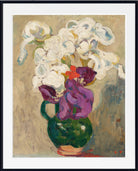
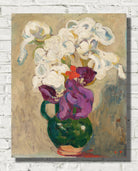
Bouquet of iris in a green pitcher (1905) by Louis Valtat
Couldn't load pickup availability
BUY WITH CONFIDENCE
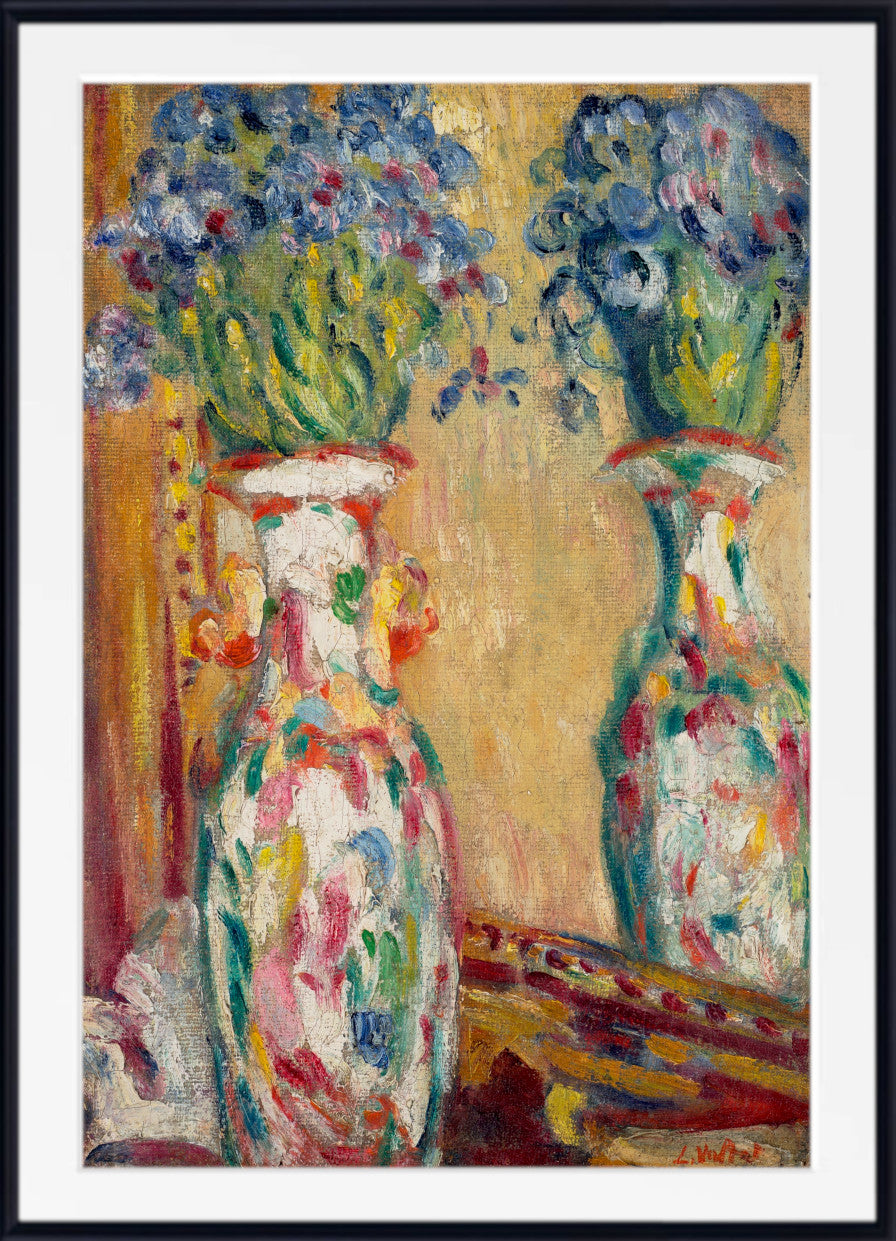
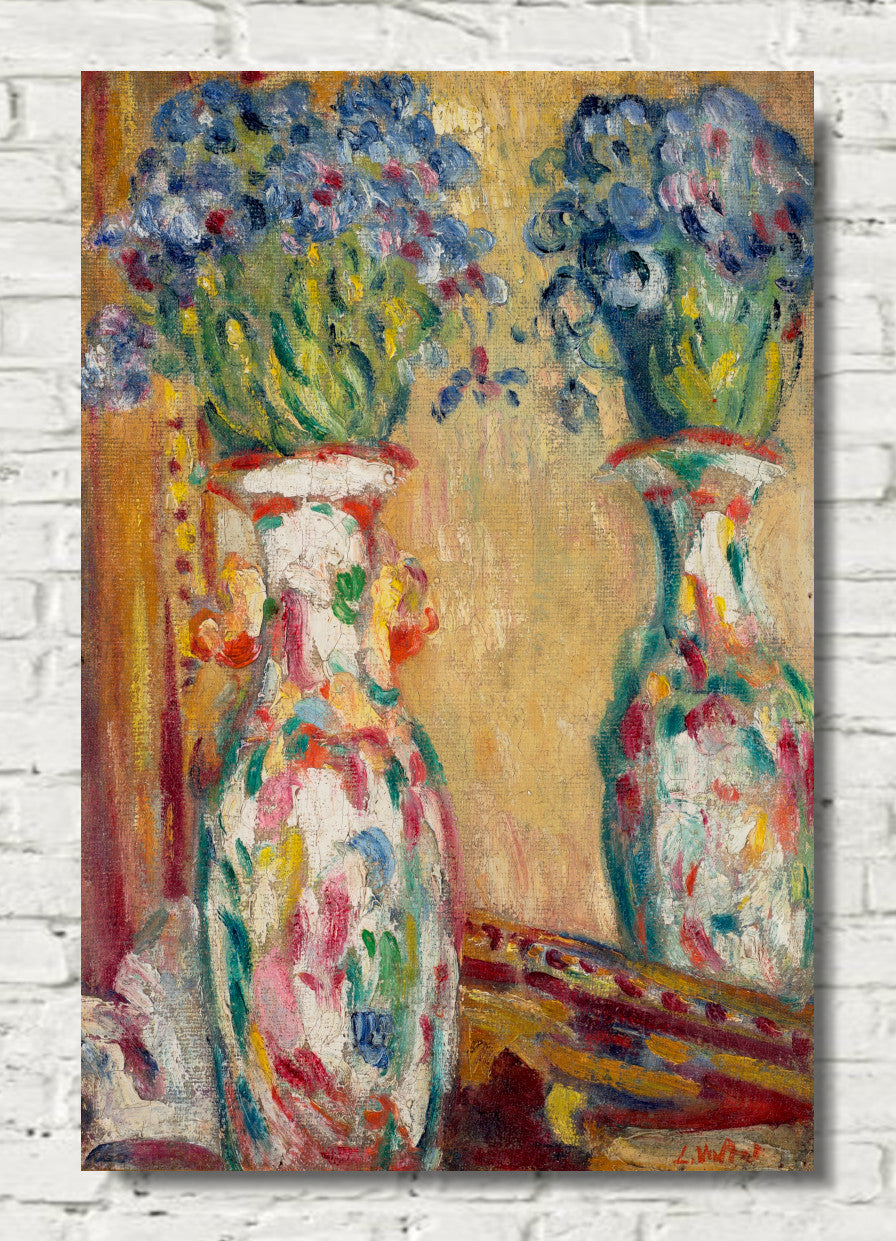
Bouquet of Iris in a Green Pitcher (c.1905) by Louis Valtat, known in French as Bouquet d'iris au pichet vert, is a vibrant floral still life from the period immediately surrounding the emergence of Fauvism. Purple and white irises rise from a compact green pitcher, their long stems and irregular petals creating an energetic vertical arrangement enlivened by Valtat's saturated colour and vigorous brushwork.
This Louis Valtat Bouquet of Iris print demonstrates how successfully the artist could apply the chromatic freedom developed in his Mediterranean landscapes to the intimate world of still life. The flowers remain immediately recognisable, but colour, shape and rhythm are given greater importance than botanical precision. Available as a fine art print, framed print or canvas panel, Bouquet d'iris au pichet vert is an excellent choice for admirers of Valtat, Fauvist floral art, colourful still lifes and early twentieth-century modern painting.
Bouquet of Iris in a Green Pitcher – Flowers Transformed by Colour
Valtat's Bouquet d'iris au pichet vert takes one of the most traditional subjects in European painting and gives it a distinctly modern character.
A group of irises has been placed in a simple green pitcher.
The flowers rise vertically, opening into irregular purple and pale blossoms whose forms contrast with the heavier, more stable container below.
Valtat does not attempt to catalogue every petal, leaf or stem with botanical precision.
Instead, the bouquet is constructed through energetic areas of colour.
Stems become directional lines. Petals are translated into broader strokes and patches. The pitcher provides a compact block of green that anchors the more restless floral forms above it.
The result preserves the freshness of cut flowers while transforming them into a carefully balanced arrangement of colour and shape.
The Iris as a Modern Still-Life Subject
Irises offered unusually rich possibilities to an artist interested in expressive colour.
Their elongated stems create clear vertical lines, while their flowers unfold into complex groups of curling and overlapping petals.
Purple, violet, blue and white can appear within the same bloom.
These characteristics made the iris especially suitable for the increasingly liberated painting of the late nineteenth and early twentieth centuries.
Valtat could simplify the flower without making it unrecognisable.
A handful of confident brushstrokes could suggest an entire blossom.
Long stems could simultaneously describe the plant and provide structural lines through the composition.
The bouquet therefore becomes both a representation of flowers and an arrangement of pictorial rhythms.
The Green Pitcher
The pitcher is essential to the composition.
Its comparatively simple shape provides stability beneath the irregular bouquet.
While the flowers spread and twist in several directions, the pitcher forms a more compact visual mass.
Its green colour also establishes an important chromatic relationship with the purple irises.
Green and violet are sufficiently different to separate vessel and flowers clearly, while still belonging comfortably within the richer palette of the painting.
The colour of the pitcher also connects naturally with the stems and leaves above it.
This allows the container to function as more than an isolated household object.
It becomes the chromatic foundation from which the bouquet seems to grow.
Colour Rather Than Botanical Precision
Valtat was not interested in producing a botanical illustration.
The purpose of the painting is not to allow the viewer to identify every physical detail of the individual flowers.
Instead, he concentrates on the overall sensation created by the bouquet.
Purple and white petals provide contrasting areas of colour. Green stems move vertically through the arrangement. Darker accents help distinguish individual blossoms, while warmer surrounding tones increase the visual intensity of the cooler flowers.
The eye receives the bouquet as a complete chromatic experience before beginning to analyse its individual components.
This emphasis on the total visual effect was fundamental to the development of modern colour painting.
Valtat and the Liberation of Colour
By around 1905, Louis Valtat had already spent many years developing an unusually saturated palette.
His experiments did not begin as a response to Fauvism after the movement appeared publicly.
They preceded it.
Extended periods along the Mediterranean coast had encouraged him to intensify greens, blues, reds, oranges and yellows well before the celebrated Salon d'Automne of 1905.
This is one reason Valtat occupies such an interesting position in the history of modern art.
He was associated with the Fauvist circle and exhibited alongside its leading artists, yet his own experiments with expressive colour had already developed independently.
Bouquet of Iris in a Green Pitcher shows those discoveries being applied to still life.
From Mediterranean Landscape to Floral Still Life
Valtat is particularly celebrated for his landscapes of southern France.
Locations such as Agay, Anthéor and the Mediterranean coast encouraged the strong palette for which he became known.
Yet the discoveries made outdoors could be transferred directly into still-life painting.
A flower arrangement offered the same opportunities for colour contrast as a landscape.
Purple flowers could be intensified against green stems. The green pitcher could be strengthened by surrounding warmer tones. Light could be suggested through colour rather than carefully graded tonal modelling.
The scale of the subject changed, but the artistic problem remained closely related.
Valtat was still asking how colour could organise an entire painting.
Painted Around the Birth of Fauvism
The approximate date of 1905 places the painting at one of the most significant moments in the development of modern European art.
That autumn, the Salon d'Automne in Paris became associated with the public emergence of Fauvism.
Paintings by Henri Matisse, André Derain, Maurice de Vlaminck, Henri Manguin, Albert Marquet and related artists attracted considerable attention because of their brilliant and often non-naturalistic colour.
Critic Louis Vauxcelles famously used the expression les fauves — “the wild beasts”.
Valtat exhibited at the Salon d'Automne and has subsequently been closely associated with the movement.
Yet he had already been pursuing strong colour for considerably longer.
This makes a work dating from around 1905 particularly revealing.
Was Louis Valtat a Fauvist?
Valtat is frequently described as a Fauvist, but the historical reality is more nuanced.
He shared many qualities with the painters associated with the movement:
- saturated colour
- visible brushwork
- simplified forms
- strong warm and cool contrasts
- reduced dependence on conventional tonal modelling
- an increasing emphasis on the decorative organisation of the canvas
However, Valtat had developed many of these characteristics before Fauvism received its name.
He also generally retained a stronger connection with physical structure and observed nature than the most radical works of Matisse or Derain.
For this reason, modern scholarship often describes him more accurately as a precursor or proto-Fauve.
Visible Brushwork and the Life of the Bouquet
The vitality of the flowers depends partly upon Valtat's brushwork.
He does not conceal the movements required to construct the bouquet.
Individual marks remain visible.
A stroke can establish the direction of a stem. A small group of marks can suggest an opening iris. Broader applications of colour create the heavier mass of the pitcher.
The result communicates a sense of freshness.
The flowers do not appear frozen into a polished academic surface.
Instead, the viewer remains aware of the physical act of painting.
This directness was an important feature of Post-Impressionist and Fauvist-era painting.
Purple and Green
The relationship between purple and green gives the composition much of its distinctive character.
The purple flowers occupy the upper portion of the painting, while the green pitcher provides a more concentrated area below.
Similar greens reappear within stems and foliage, connecting the vessel to the bouquet.
Neither colour operates in isolation.
They gain strength through their relationship with surrounding lighter, darker and warmer passages.
This approach reflects one of the fundamental principles behind Valtat's painting.
Colour is most powerful when considered relationally.
The question is not simply whether a particular iris is accurately purple or whether the pitcher is accurately green.
The important question is how each colour affects every other colour across the painting.
White Flowers and the Creation of Light
The paler irises introduce another important element.
White is rarely completely neutral in modern colour painting.
It can contain neighbouring tones and appear warmer or cooler according to its surroundings.
Valtat's pale blossoms create areas of visual brightness among the darker purple flowers and green stems.
They help break up the denser bouquet and prevent the upper half of the composition from becoming overly heavy.
The eye moves between these pale accents and the stronger colours around them.
Light is therefore created through contrast rather than through elaborate modelling of every petal.
The Bouquet as a Rhythmic Structure
The arrangement is not simply a cluster of flowers placed randomly in a vessel.
The stems establish a sequence of rising lines.
Some remain relatively vertical, while others lean outwards and create diagonals.
The flowers themselves punctuate these lines with larger irregular forms.
The pitcher brings the movement together at the base.
This creates a rhythm that can almost be read from bottom to top:
solid pitcher, rising stems, spreading blossoms.
The structure gives the painting balance despite the natural irregularity of the flowers.
Valtat therefore allows spontaneity and order to coexist.
Still Life as a Laboratory for Modern Art
Still life became one of the most important experimental genres in modern painting.
Artists could arrange objects according to their own requirements rather than depending upon an existing landscape or sitter.
Fruit could be moved. Vases could be repositioned. Flowers could be selected according to colour and shape.
The genre therefore provided an ideal environment for investigating formal questions.
Paul Cézanne had already demonstrated how radically a still life could challenge conventional perspective and pictorial structure.
For Valtat, flowers offered a similar opportunity to investigate colour.
The bouquet could remain familiar while its painted treatment became increasingly modern.
Flowers and Fauvist Colour
Flowers were especially well suited to the artistic climate surrounding Fauvism.
Their naturally varied colours gave artists considerable freedom.
Viewers readily accept strong reds, purples, yellows, greens and blues within a floral arrangement.
This allowed painters to intensify colour substantially without making the subject completely unfamiliar.
At the same time, irregular petals and stems encouraged freer brushwork.
A painter did not need a rigid outline to communicate the identity of a flower.
A group of vivid marks could be enough.
The floral still life consequently provided an ideal meeting point between recognisable nature and increasingly independent colour.
Valtat and Paul Signac
Valtat's understanding of colour developed partly within an artistic environment shaped by Paul Signac.
Signac was one of the leading figures in Neo-Impressionism and a major painter of Mediterranean light.
He demonstrated how neighbouring areas of relatively pure colour could intensify one another.
Valtat knew Signac and shared his fascination with strong chromatic relationships.
Valtat never adopted a strict Pointillist system, however.
His brushwork remained much freer.
Instead of constructing the surface from uniform dots, he varied the shape and direction of his strokes according to the subject.
This greater spontaneity helped connect his work with the developing language of Fauvism.
Valtat and Henri-Edmond Cross
Henri-Edmond Cross was another significant figure within Valtat's artistic circle.
Cross's Mediterranean paintings combined Neo-Impressionist colour theory with increasingly broad and decorative strokes.
His work helped demonstrate how the principles of divided colour could become freer and less systematic.
Valtat's own development followed a similarly independent path.
He absorbed lessons about colour contrast without allowing technique to become formulaic.
This freedom is particularly appropriate in a flower painting, where individual marks need to respond to the irregular shapes of petals and stems.
Valtat and Renoir
Valtat also maintained an important friendship with Pierre-Auguste Renoir.
He visited the older Impressionist painter in southern France and worked within the artistic circle around him.
Renoir's emphasis on rich colour and the sensuous physical qualities of paint provided another important point of connection.
The relationship illustrates Valtat's unusual historical position.
He belonged to a generation younger than the major Impressionists but developed before the younger Fauves had fully established their reputations.
His art consequently connects several generations of French colour painting.
Ambroise Vollard and Valtat
The influential dealer Ambroise Vollard recognised Valtat's work during this crucial period.
Beginning in 1904, Vollard represented the artist and acquired his production for several years.
Vollard was one of the central figures in the commercial development of modern French art and worked with artists including Cézanne, Gauguin, Picasso and several painters associated with Fauvism.
His support helped place Valtat within the major modern-art networks of Paris.
The relationship also reinforces the fact that Valtat's increasingly adventurous colour was receiving serious attention before Fauvism had fully emerged as a recognised movement.
The Durand-Ruel Provenance
Bouquet d'iris au pichet vert later passed through Galerie Durand-Ruel in Paris.
The name carries considerable significance in the history of modern French art.
Paul Durand-Ruel had been one of the pioneering dealers responsible for supporting and promoting Impressionist painters including Monet, Renoir, Degas, Pissarro and Sisley at a time when their work was still controversial.
By the time Valtat's painting entered the firm's stock, Durand-Ruel had become internationally associated with progressive French painting.
The work's documented presence with the gallery therefore forms an interesting connection between the Impressionist generation and Valtat's more modern approach to colour.
From Paris to New York
The painting later entered the stock of Hirschl & Adler Galleries in New York.
This established American gallery handled a wide range of important European and American art.
The work was acquired from Hirschl & Adler by the family of a subsequent owner in 1965.
This documented chain of ownership gives the painting an unusually clear modern provenance for a Valtat still life of this period.
Why Bouquet of Iris in a Green Pitcher Matters
Bouquet d'iris au pichet vert combines several characteristics central to Valtat's importance:
- painted around 1905 at the moment Fauvism emerged publicly
- purple and white irises organised around a strong green pitcher
- colour given greater importance than botanical precision
- visible, direct brushwork
- stems and flowers used as rhythmic pictorial elements
- recognisable forms retained despite simplification
- strong connections with Valtat's broader experiments in modern colour
- a documented provenance through major Paris and New York galleries
The painting therefore provides a particularly accessible example of Valtat's contribution to early twentieth-century modern art.
Its subject is familiar and intimate, yet its treatment reflects the same liberation of colour that was transforming European painting around 1905.
Louis Valtat's Painting Style
Louis Valtat developed an individual style combining aspects of Impressionism, Neo-Impressionism and the increasingly expressive colour associated with Fauvism.
He never entirely abandoned recognisable form.
Landscapes retain structure. Figures retain physical presence. Flowers remain identifiable.
Yet colour becomes increasingly independent.
Valtat could intensify a hue, simplify an object or alter tonal relationships if doing so strengthened the composition.
This balance distinguishes him from some of the more radical Fauves.
His art occupies a productive middle ground between direct observation and decorative colour.
Bouquet of Iris in a Green Pitcher demonstrates this approach particularly clearly.
About Louis Valtat
Louis Valtat (1869–1952) was a French painter and printmaker whose pioneering use of saturated colour made him an important precursor of Fauvism.
Born in Dieppe in Normandy, Valtat studied in Paris at the École des Beaux-Arts and the Académie Julian.
He began exhibiting at the Salon des Indépendants during the late nineteenth century and developed within an artistic environment shaped by Impressionism, Neo-Impressionism and Post-Impressionism.
Extended stays along the Mediterranean coast had a profound influence on his palette.
Valtat knew artists including Paul Signac, Henri-Edmond Cross and Auguste Renoir and was represented for several years by Ambroise Vollard.
His experiments with vivid colour began before Fauvism received its name, which is why he is frequently described as a precursor or proto-Fauve.
He exhibited at the historic Salon d'Automne of 1905 alongside painters associated with the emergence of Fauvism.
Throughout his long career Valtat painted landscapes, portraits, still lifes, flowers and scenes of everyday life, maintaining a distinctive balance between strong chromatic expression and recognisable natural form.
The Original Bouquet of Iris in a Green Pitcher
The original Bouquet d'iris au pichet vert, or Bouquet of Iris in a Green Pitcher, was painted by Louis Valtat circa 1905.
The work was created in oil on board laid down on panel.
It measures approximately 39.3 × 30.5 cm.
The painting is signed with the initials L.V at the lower right.
Its documented provenance includes Galerie Durand-Ruel et Cie. in Paris.
The painting subsequently passed to Hirschl & Adler Galleries in New York in 1962.
It was acquired from Hirschl & Adler by the family of a subsequent owner in 1965.
Christie's later offered the work and records that it will be included in the forthcoming Louis Valtat catalogue raisonné currently being prepared by Les Amis de Louis Valtat.
The available documentation does not identify a permanent museum collection for the painting, so it should be regarded as remaining in private ownership rather than attributed to a public institution.
A Louis Valtat Bouquet of Iris Print for Your Interior
A Louis Valtat Bouquet of Iris print combines the enduring appeal of floral wall art with the stronger colour and brushwork of early modern French painting.
The purple and white irises provide the principal focal point, while the green pitcher introduces a strong complementary colour at the base of the bouquet.
The painting works particularly well against white, cream, putty, pale grey and other neutral wall colours.
Natural timber furniture provides an effective complement to the green and floral tones, while purple, plum, sage and muted blue furnishings can echo individual colours within the painting.
The vertical format makes the work particularly useful for narrower wall spaces, above console tables, beside fireplaces or within a gallery wall.
It is especially suitable for living rooms, dining rooms, bedrooms, kitchens, hallways and home offices.
The combination of floral subject and modern colour works particularly well in contemporary, Scandinavian-inspired, mid-century and eclectic interiors.
For admirers of Fauvism, Bouquet d'iris au pichet vert offers additional historical appeal as a floral still life painted at precisely the moment when Valtat's long-running experiments with saturated colour coincided with the public emergence of Fauvism.
Frequently Asked Questions
When did Louis Valtat paint Bouquet of Iris in a Green Pitcher?
Christie's dates Bouquet d'iris au pichet vert to circa 1905.
What is the French title of Bouquet of Iris in a Green Pitcher?
The French title is Bouquet d'iris au pichet vert.
What flowers are shown in the painting?
The still life centres on a bouquet of irises, including purple and paler blossoms, arranged in a green pitcher.
Is Bouquet of Iris in a Green Pitcher a Fauvist painting?
The painting dates from around 1905, the year Fauvism emerged publicly. Valtat was closely associated with the movement, although his experiments with strong colour had begun considerably earlier and he is often described more precisely as a precursor or proto-Fauve.
Why is Louis Valtat considered a precursor of Fauvism?
Valtat was already using unusually saturated colour during the 1890s and early 1900s, before the famous Salon d'Automne exhibition of 1905 gave Fauvism its name.
Why did Valtat paint so many flowers?
Floral still lifes gave Valtat an ideal opportunity to explore strong colour, rhythmic brushwork and the relationship between recognisable natural forms and increasingly decorative composition.
Why is the green pitcher important?
The compact green vessel provides a stable visual base beneath the irregular flowers and connects chromatically with their stems and leaves.
What medium did Louis Valtat use?
The original was painted in oil on board laid down on panel.
What size is the original Bouquet of Iris in a Green Pitcher?
The original measures approximately 39.3 × 30.5 cm.
Is the original signed?
Yes. Valtat signed the painting with the initials L.V at the lower right.
Who owned Bouquet of Iris in a Green Pitcher?
Its documented provenance includes Galerie Durand-Ruel in Paris and Hirschl & Adler Galleries in New York. It was acquired from Hirschl & Adler by the family of a subsequent owner in 1965.
Was the painting handled by Durand-Ruel?
Yes. Christie’s records Galerie Durand-Ruel et Cie. in Paris in the documented provenance of the painting.
Is the painting included in the Louis Valtat catalogue raisonné?
Christie's records that the work will be included in the forthcoming Valtat catalogue raisonné currently being prepared by Les Amis de Louis Valtat.
Where is the original Bouquet of Iris in a Green Pitcher?
The accessible provenance does not identify the work as belonging to a permanent public museum collection, so it should be regarded as privately owned unless later documentation establishes otherwise.
Did Valtat exhibit at the 1905 Salon d'Automne?
Yes. Valtat exhibited at the famous 1905 Salon d'Automne associated with the public emergence and naming of Fauvism.
How does Valtat's style differ from Matisse and Derain?
Valtat shared their enthusiasm for strong colour but generally retained a closer connection with recognisable form and conventional spatial structure than the most radical Fauvist paintings by Matisse and Derain.
Is Bouquet of Iris in a Green Pitcher available as a framed Louis Valtat print?
Yes. GalleryThane offers Bouquet of Iris in a Green Pitcher in a choice of sizes and formats, including fine art paper prints, framed prints and canvas options.
Where would a Louis Valtat Bouquet of Iris print work well?
Its vertical floral composition makes it particularly suitable for living rooms, dining rooms, bedrooms, kitchens, hallways and home offices. It works especially well in contemporary, Scandinavian-inspired, mid-century and eclectic interiors.
All orders for unframed fine art prints and original paintings are dispatched within 2 working days of receipt of payment.
Orders for custom framed prints are dispatched within 4 working days.
All orders are fully tracked from dispatch to delivery at your home or business.
All print and original painting orders are fully insured against loss or damage in transit. We refund or replace any damaged or lost orders.
Buy with confidence - read what our satisfied customers have to say - Reviews
Fine art papers are printed without any additional white border Please let us know at the time of ordering if you would like a small additional white border.
Rolled canvas options have an additional white border of approximately 2.5 inches (7cm) on all 4 sides to aid stretching.
Ready to hang canvas panels are stretched on 1.5 inch deep solid pine frames from sustainable forestry sources. The image is mirrored on all 4 sides to give an aesthetically pleasing finish.
Why not have us gift wrap your order and attach a personalised message to the recipient. Available for all orders. Each order is hand wrapped in high quality gift wrap with meatllic ribbon and bow. Your personalised message is printed on a card which is included with your order.
Have your hand wrapped gift delivered directly to the recipient.
Full tracking and insurance included with every order.
Please note design may vary depending upon availability
Just purchase the gift wrap option HERE
We have a wide range of frames in standard sizes and we also make custom size frames.
To order a framed print:
1. select the print size you would like along with the print materials (matte paper, fine art paper).
2. Add your print choice to the basket.
3. Choose from our range of frames
4. Select the same size as the print you have added to your basket. If the frame size you want is not listed please contact us
5. Choose from the mount or no-mount option
6. Add your frame choice to the basket
7. Proceed to checkout.
Why Choose GalleryThane?
- Printed and framed in-house
- Free UK delivery
- Free EU and USA delivery on orders over £200
- Tracking and insurance included in every order
- Fast 1-3 day dispatch
- Gift wrapping service available
- Gallery quality materials
- Sustainable, eco-friendly packaging
- Great customer support
Explore related collections
What makes our Prints and Canvas Panels so special

Latest Giclee Printing Technology
We have invested in the latest wide format print technology to produce museum quality giclee prints utilising the highest quality pigment inks to give outstanding colour reproduction.

Museum Quality Archival Fine Art Papers
We print on the finest quality fine art papers with textured, smooth and lustre finishes for prints which last a lifetime.
From aceo miniatures to 40x80 inch large format, every print has our lifetime quality guaranteee.

Solid Wood Frames, Cotton Canvas
All of the wood for our canvas panels and frames is responsibly sourced from manages forests. Our cotton canvas is completely seedless for the highest quality reproduction possible.

Have Your Gift Wrapped


