


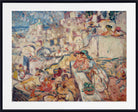
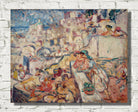
Algiers, The Casbah (circa 1906) by Louis Valtat
Couldn't load pickup availability
BUY WITH CONFIDENCE
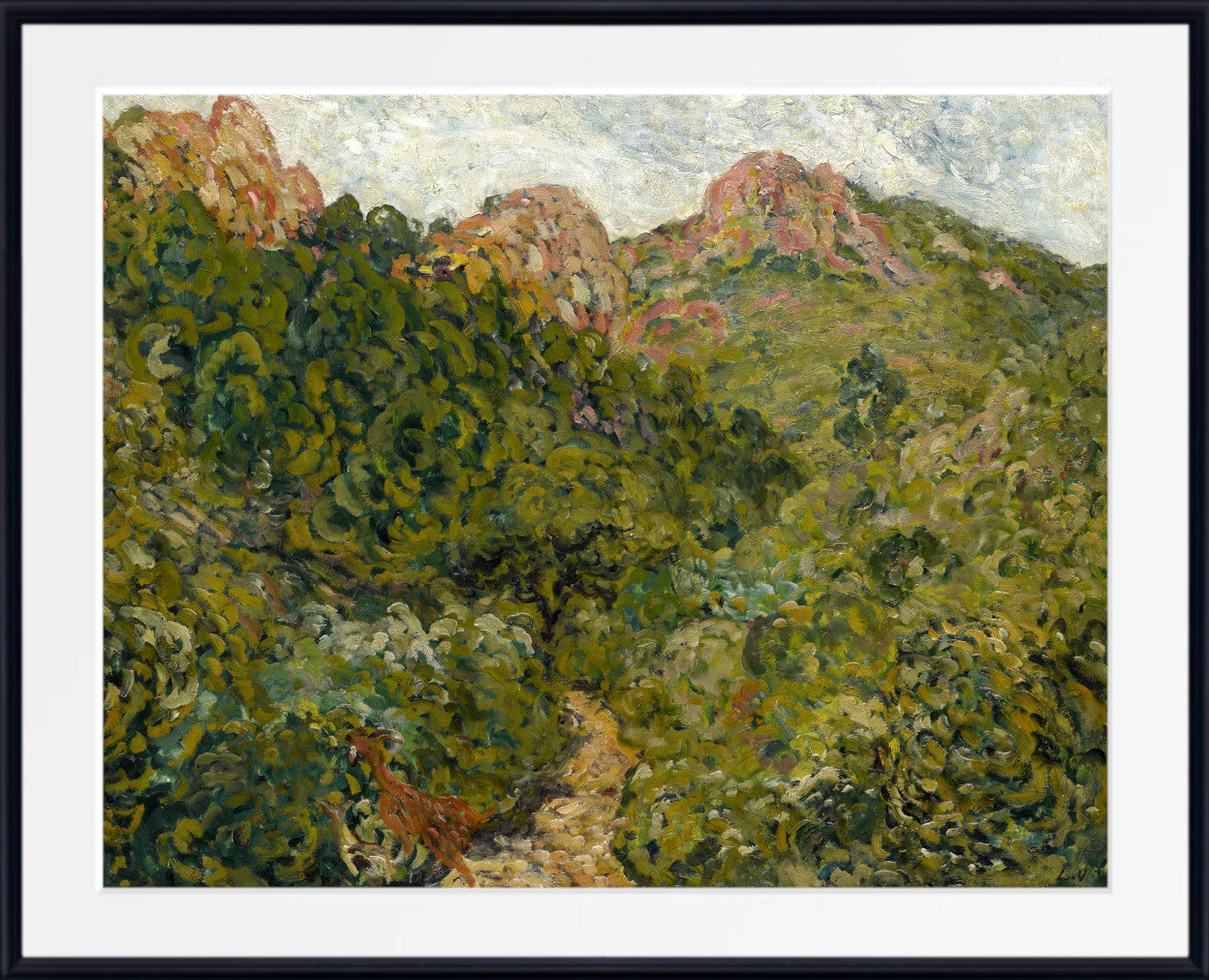
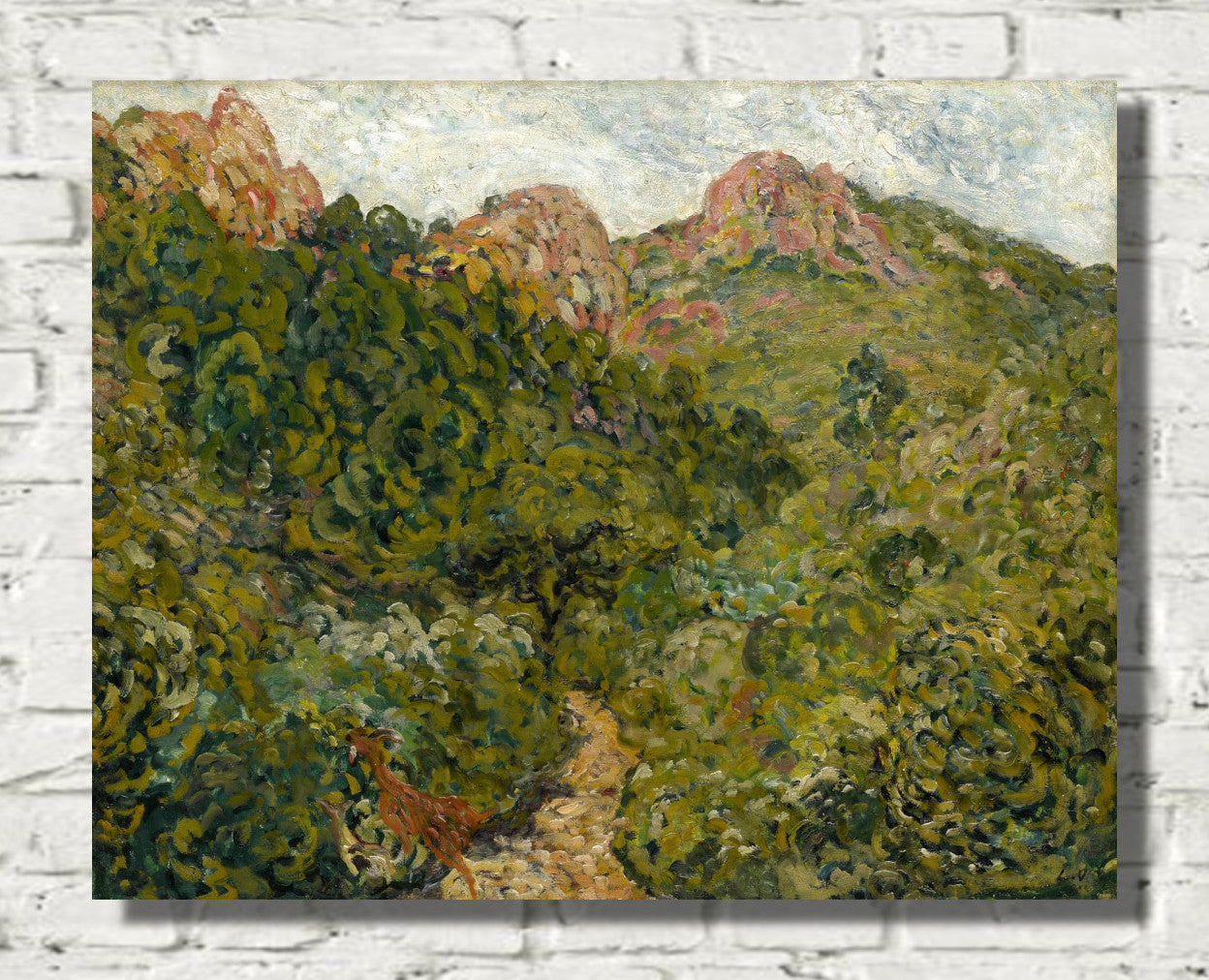
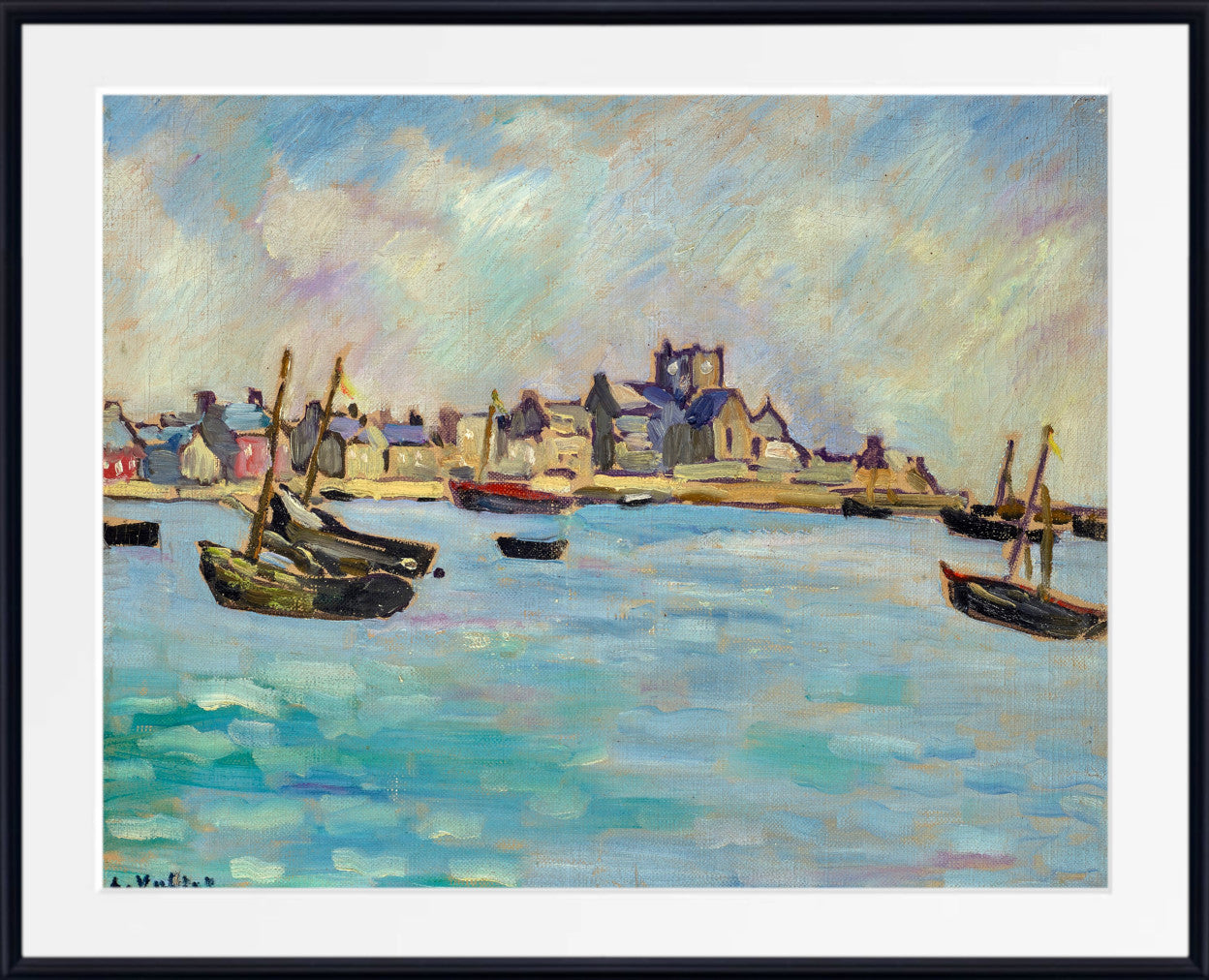
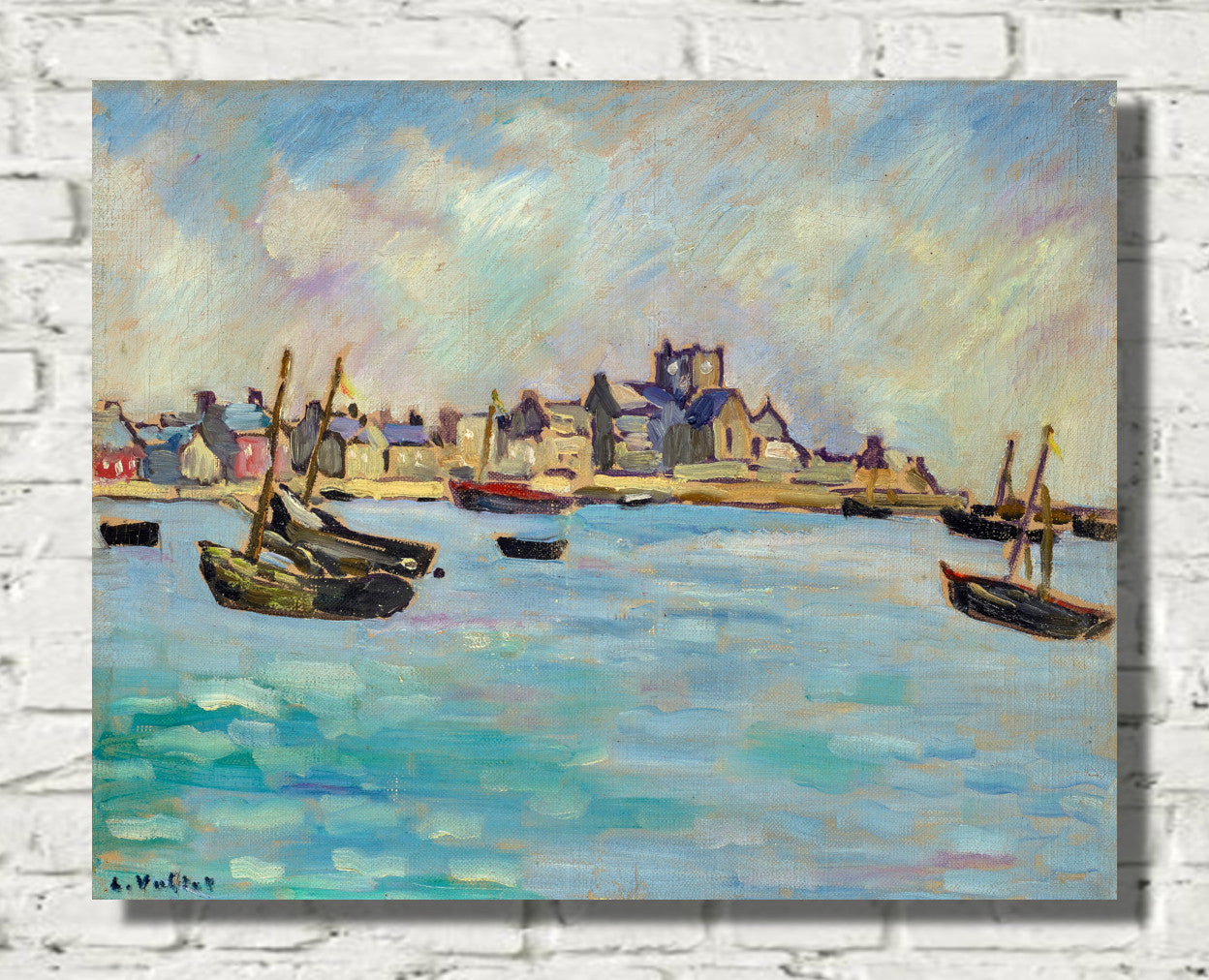
Algiers, The Casbah (c.1906) by Louis Valtat, known in French as Alger, La Casbah, is a vibrant North African cityscape painted during the artist's journey to Algeria in 1906. Women converse on the heights above Algiers while the distinctive architecture of the Casbah unfolds across the hillside, transformed through Valtat's characteristic combination of saturated colour, simplified form and vigorous brushwork.
This Louis Valtat Algiers print captures the artist at a particularly fascinating moment in his career. Valtat had already developed his unusually powerful approach to colour before the public emergence of Fauvism in 1905, and the brilliant North African light offered another environment in which to explore intense greens, blues, reds, ochres and warm sunlit tones. Available as a fine art print, framed print or canvas panel, Alger, La Casbah is an outstanding choice for admirers of Valtat, Fauvist-era painting, colourful cityscapes and early twentieth-century modern art.
Algiers, The Casbah – A North African Landscape in Colour
Valtat painted Alger, La Casbah around 1906, the year in which he travelled to Algeria.
The composition looks across the elevated districts of Algiers, where the historic Casbah rises above the Mediterranean waterfront.
Rather than concentrating upon a single architectural monument, Valtat treats buildings, hillside, vegetation and figures as parts of one interconnected pictorial structure.
The scene has also been exhibited under the more descriptive title Femmes en conversation sur les hauteurs d'Alger — Women Conversing on the Heights of Algiers.
This alternative title draws attention to the human presence within the landscape.
The figures are not developed as formal portraits. They belong to the wider rhythm of the composition, surrounded by architecture and brilliant colour.
Valtat consequently presents Algiers not simply as a collection of exotic buildings but as an inhabited urban landscape.
The Casbah of Algiers
The Casbah of Algiers is the historic citadel and old city occupying the steep hillside above the harbour.
Its dense network of houses, narrow streets, terraces, courtyards and stepped routes created a remarkably complex urban environment.
From elevated viewpoints, the tightly packed buildings appear almost to cascade down the slope towards the Mediterranean.
For a painter interested in colour and structure, this offered exceptional possibilities.
White and pale walls could catch intense sunlight while narrow passages and recessed areas produced much deeper shadow.
Roofs, vegetation, figures and surrounding terrain introduced further areas of contrasting colour.
Valtat responds by simplifying the complicated urban fabric rather than describing every building individually.
The Casbah becomes an arrangement of interconnected shapes distributed across the hillside.
Valtat's Journey to Algeria in 1906
Valtat travelled to Algeria in 1906, extending a pattern of travel that had already taken him through France, Spain and Mediterranean coastal regions.
The journey produced a number of Algerian subjects, including views of Algiers and paintings associated with local streets, cafés and figures.
For an artist already deeply interested in Mediterranean light, Algeria represented an intensification of conditions he had explored in southern France.
Strong sunlight created sharp contrasts between illuminated architecture and shadow.
Vegetation, earth, buildings and clothing offered a rich range of colours.
Valtat did not respond to these conditions through precise academic realism.
Instead, his established interest in strong colour allowed him to translate the city into a much more expressive visual experience.
Colour under North African Light
Light is one of the most important underlying subjects of Alger, La Casbah.
Valtat had spent years painting around the Mediterranean coast of France, particularly in locations such as Anthéor, Agay, Saint-Tropez and nearby coastal regions.
He therefore already understood how intense sunlight could transform colour.
In Algiers, these effects became especially powerful.
Pale architecture could appear almost luminous beside strong shadow. Vegetation became richer in colour, while sunlit ground could shift towards ochre, orange or red.
Valtat intensifies these relationships.
Instead of representing light primarily through white highlights and carefully graded shadow, he allows neighbouring colours to create brightness.
Warm colours become more vivid when placed beside cooler greens and blues.
The sensation of heat and sunlight consequently comes from colour itself.
A Cityscape Built from Colour
The painting remains recognisably a view of Algiers, but conventional topographical accuracy is not Valtat's principal concern.
Buildings are simplified.
Figures are reduced to compact forms.
Vegetation becomes an arrangement of coloured strokes.
The hillside is divided into larger areas whose relationships create the underlying structure of the picture.
This approach reveals one of the qualities that connects Valtat with Fauvism.
Colour is not merely applied after the drawing has established the scene.
Colour helps construct the scene.
Architecture, landscape and figures gain their position and visual importance through contrasts between neighbouring hues.
The Women on the Heights of Algiers
The alternative exhibition title Women Conversing on the Heights of Algiers provides useful insight into the subject.
The women introduce an element of everyday life into what might otherwise have become a purely architectural landscape.
Valtat does not isolate them from their surroundings.
Their forms participate in the same simplified visual language used for the buildings and landscape.
This integration is characteristic of his work.
Human figures frequently appear within landscapes without becoming conventional portraits.
They establish scale, activity and human presence while allowing the larger composition to remain dominant.
In Alger, La Casbah, the women reinforce the sense that this is a lived urban environment rather than an imaginary decorative setting.
Algeria and French Modern Painting
North Africa had attracted French and other European artists throughout the nineteenth century.
Eugène Delacroix's journey to North Africa in the 1830s became particularly influential, while later artists were drawn by architecture, clothing, landscape and the intensity of southern light.
By Valtat's time, however, the artistic context had changed considerably.
Algeria was under French colonial rule, and European representations of North Africa formed part of a broader cultural history often described as Orientalism.
Valtat's painting belongs chronologically to that history, but his artistic priorities differ significantly from the elaborate narrative and ethnographic detail associated with much nineteenth-century Orientalist painting.
He is less interested in producing a meticulously described exotic spectacle than in investigating how the light, architecture and landscape of Algiers can be transformed through colour.
This helps place the work within the transition from nineteenth-century representations of North Africa towards the more formally experimental modern painting of the twentieth century.
From Delacroix to Matisse
The painting's relationship with this longer history was recognised when it was exhibited at the Musée de l'Annonciade in Saint-Tropez in 2014.
The exhibition was titled De Delacroix à Matisse: la couleur sous la lumière de l'Orient — From Delacroix to Matisse: Colour under the Light of the Orient.
Alger, La Casbah was shown there under the expanded title Femmes en conversation sur les hauteurs d'Alger ou Alger, la Casbah.
The exhibition context is particularly appropriate for Valtat.
His work stands historically between the nineteenth-century painters who travelled to North Africa and the early modern artists who increasingly treated colour as an autonomous element.
The subject remains Algiers, but colour itself has become one of the painting's principal concerns.
Valtat and the Origins of Fauvism
By the time Valtat travelled to Algeria, Fauvism had already received its famous name.
At the Salon d'Automne in Paris in 1905, paintings by Henri Matisse, André Derain, Maurice de Vlaminck, Henri Manguin, Albert Marquet and related artists attracted intense attention because of their unconventional colour.
Critic Louis Vauxcelles used the expression les fauves — “the wild beasts” — and the term quickly became associated with the movement.
Valtat exhibited at the same Salon d'Automne and has long been connected with Fauvism.
His position, however, is somewhat distinctive.
He had been using intense, increasingly independent colour before 1905.
For this reason he is frequently described as a precursor or proto-Fauve rather than simply as a follower of the movement.
Why Valtat Is Often Called a Proto-Fauve
Valtat's colour experiments developed gradually from the 1890s onwards.
His Mediterranean landscapes already contained strong reds, greens, oranges and blues before Matisse and Derain made their celebrated breakthrough at Collioure.
Yet Valtat generally remained closer to recognisable natural structure than the most radical Fauves.
A Matisse or Derain landscape might transform a tree trunk completely into brilliant red or a mountain into intense orange.
Valtat's colour can be equally strong, but his forms usually retain greater physical solidity.
Perspective is more stable.
The landscape remains recognisably connected to observed nature.
This balance between powerful colour and structural continuity makes his paintings particularly distinctive.
Fauvist Colour without Losing the City
Alger, La Casbah demonstrates this balance especially well.
The painting is not a conventional realist view.
Its colours are intensified, brushwork remains visible and architectural details are simplified.
Yet Algiers does not disappear beneath those experiments.
The hillside city remains legible.
Buildings retain weight and position. Figures remain human figures. The landscape preserves its fundamental spatial organisation.
Valtat therefore achieves expressive colour without completely dissolving the physical world.
This distinguishes his approach from some of the more radical experiments undertaken by Matisse and Derain during the same period.
Brushwork and the Surface of the Painting
Visible brushwork contributes strongly to the vitality of Alger, La Casbah.
Valtat does not polish the surface until every trace of the brush disappears.
Individual marks remain evident.
Some establish architectural forms, while others follow the direction of hillside vegetation or create smaller areas of colour.
The changing direction and density of these strokes gives the composition rhythm.
This means that the painting can be experienced at two levels.
From a distance, the coloured marks combine into a view of Algiers.
Closer inspection reveals the physical construction of the image from individual strokes and patches of pigment.
This awareness of the painted surface connects Valtat with the broader development of Post-Impressionism and early modern art.
Warm and Cool Colour Contrasts
One of Valtat's most effective techniques is the juxtaposition of warm and cool colour.
Warm reds, oranges and ochres can suggest sunlit earth and architecture.
Cooler greens and blues introduce counterpoints and provide visual relief.
When placed beside one another, these colours become more intense.
Blue can make orange appear warmer.
Green can strengthen neighbouring red.
This principle had been explored systematically by Neo-Impressionist artists, but Valtat applies it much more freely.
He does not construct the entire painting from rigidly controlled dots.
Instead, complementary relationships become part of a broader expressive vocabulary.
Valtat and Neo-Impressionist Colour
Valtat knew important Neo-Impressionist painters including Paul Signac and Henri-Edmond Cross.
Their work demonstrated that colour could possess far greater luminosity when strong pigments were allowed to interact rather than being mixed into subdued intermediate tones.
Valtat absorbed this principle without becoming a strict Divisionist.
His brushstrokes remained comparatively broad and spontaneous.
Colour relationships mattered more than adherence to a scientific optical system.
The result helped establish the chromatic freedom that later connected his work with Fauvism.
Paul Signac, the Mediterranean and Pure Colour
Valtat's friendship with Paul Signac is particularly relevant.
Signac had become one of the great painters of Mediterranean light and used brilliant areas of separated colour in coastal landscapes from Saint-Tropez and elsewhere.
Valtat spent time with Signac and worked within the same Mediterranean artistic environment.
The two painters nevertheless developed distinctive approaches.
Signac tended towards a more systematic Divisionist technique.
Valtat retained greater freedom of brushwork and a stronger concern with the physical mass of landscape.
Their shared interest in pure colour nevertheless formed part of the artistic background from which Fauvism developed.
Valtat and Auguste Renoir
Another important relationship was Valtat's friendship with Pierre-Auguste Renoir.
Valtat visited Renoir in southern France and maintained contact with the older Impressionist painter.
The connection demonstrates how Valtat occupied an unusual position between artistic generations.
Renoir represented the great Impressionist breakthrough of the nineteenth century.
Matisse and Derain represented a more radical generation developing Fauvism.
Valtat stood between them.
His paintings retained an enduring pleasure in physical subjects, landscape and rich paint while simultaneously pushing colour towards the stronger chromatic language of modernism.
Ambroise Vollard and Valtat's Career
The influential Paris dealer Ambroise Vollard also played an important role in Valtat's career.
From 1904 Vollard represented the artist and purchased his production for several years.
Vollard was one of the key figures in the development of modern art dealing.
He worked with artists including Paul Cézanne, Paul Gauguin, Pablo Picasso and later the painters associated with Fauvism.
His support placed Valtat within one of the most important commercial and artistic networks of early twentieth-century Paris.
The relationship is particularly significant because it confirms that Valtat's adventurous use of colour was recognised before Fauvism had become an established historical category.
North Africa as a New Colour Environment
Valtat's journey to Algeria offered more than a new collection of subjects.
It provided a different environment in which to test ideas he had developed along the French Mediterranean coast.
The colours of architecture differed from the red rocks of Anthéor or the vegetation around Saint-Tropez.
The urban structure of the Casbah offered a dense and complex alternative to the more open coastal landscapes he frequently painted.
Human activity also became more prominent.
The result is a painting that remains recognisably Valtat while expanding his established landscape vocabulary into a North African city.
Landscape and Cityscape Combined
Alger, La Casbah does not fit neatly into a single genre.
It is partly a cityscape because the architecture of Algiers provides the setting.
It is partly a landscape because hillside, light, vegetation and topography remain crucial.
It also contains figures and therefore carries an element of everyday-life painting.
This combination gives the composition unusual richness.
The Casbah itself naturally encourages such an approach because architecture and landscape are inseparable.
Buildings rise and descend according to the steep terrain rather than sitting upon a level urban grid.
Valtat uses this relationship to integrate man-made and natural forms into a single composition.
The Painting and the History of Orientalism
European paintings of North Africa require some historical context.
During the nineteenth and early twentieth centuries, many French artists travelled to Algeria and other parts of North Africa while the region existed within European colonial systems.
The resulting body of work became strongly associated with Orientalism.
Some painters emphasised elaborate costume, architecture and scenes intended to appear exotic to European audiences.
Valtat's approach is comparatively modernist.
Although the North African setting remains important, his principal concern lies increasingly with pictorial questions: colour, light, mass, rhythm and the organisation of the canvas.
Recognising both aspects allows the painting to be understood more fully within its historical period.
From Delacroix to Fauvism
The difference between Valtat and earlier generations demonstrates how much European painting had changed.
For Delacroix, North Africa offered new subjects, costumes and colours that could enrich Romantic painting.
By Valtat's generation, artists increasingly questioned the very systems by which visible reality was represented.
The Casbah no longer needed to be meticulously reconstructed.
A building could become a patch of colour.
A figure could become a rhythmic accent.
Hillside and architecture could be compressed if doing so strengthened the painting.
This shift from description towards pictorial autonomy is one of the central stories of modern art.
Why Algiers, The Casbah Matters
Alger, La Casbah brings together several important aspects of Valtat's career:
- painted around 1906 during his journey to Algeria
- an unusual North African subject within his body of work
- intense colour developed from his Mediterranean experiments
- a view combining landscape, architecture and figures
- visible and energetic brushwork
- strong warm and cool colour contrasts
- recognisable natural structure retained despite chromatic freedom
- a connection with Fauvism without simple imitation of Matisse or Derain
- an important place within the transition from nineteenth-century representations of North Africa to modernist painting
The work consequently offers much more than an attractive view of Algiers.
It demonstrates how an artist standing between Post-Impressionism and Fauvism responded to a completely new environment through colour.
Louis Valtat's Painting Style
Louis Valtat developed an individual style that does not fit perfectly within any single movement.
His early work absorbed influences from Impressionism, Neo-Impressionism and the decorative simplification associated with the Nabis.
During the 1890s and early 1900s, increasingly saturated colour became one of the defining features of his paintings.
The Mediterranean coast played a particularly important role in this development.
Valtat remained more committed to conventional spatial structure than the most radical Fauvist painters.
At the same time, his colour often became considerably more intense than that of the Impressionist generation.
This combination explains why he is frequently regarded as an important precursor to Fauvism.
Alger, La Casbah demonstrates that approach at its most compelling: recognisable architecture and figures are retained while the entire scene is energised by colour.
About Louis Valtat
Louis Valtat (1869–1952) was a French painter and printmaker whose pioneering use of saturated colour helped prepare the way for Fauvism.
Born in Dieppe in Normandy, he studied at the École des Beaux-Arts in Paris and later at the Académie Julian, where his artistic circle included painters associated with several important developments in modern French art.
Valtat exhibited regularly at the Salon des Indépendants and Salon d'Automne.
Extended stays in southern France transformed his palette, and his paintings of the Mediterranean coast became among the most important works of his early career.
He knew artists including Paul Signac, Henri-Edmond Cross and Auguste Renoir and was represented for several years by the influential dealer Ambroise Vollard.
Valtat exhibited at the historic 1905 Salon d'Automne associated with the naming of Fauvism, although his experiments with strong colour had already been developing for years.
In 1906 he travelled to Algeria, producing works inspired by Algiers and its surroundings.
Throughout his career he continued painting landscapes, flowers, still lifes, portraits and scenes of everyday life with a distinctive combination of colour, structure and direct brushwork.
Today he is increasingly recognised as an important connecting figure between Post-Impressionism and Fauvism.
The Original Algiers, The Casbah
The original Alger, La Casbah was painted by Louis Valtat circa 1906.
It was created in oil on canvas.
The most recent Christie's catalogue records the painting as measuring approximately 65.7 × 81.3 cm.
It is signed L. Valtat at the lower right.
The painting has also been documented under the expanded title Femmes en conversation sur les hauteurs d'Alger ou Alger, la Casbah, translated as Women Conversing on the Heights of Algiers, or Algiers, the Casbah.
Its documented provenance includes a private collection in France.
The work was sold at Hôtel Drouot in Paris in February 2013 before entering a private collection in London.
It was subsequently offered at Christie's in New York in May 2018, where it was acquired by another private collector.
The painting returned to Christie's in New York in November 2022.
In 2014 it was included in the exhibition De Delacroix à Matisse: la couleur sous la lumière de l'Orient at the Musée de l'Annonciade in Saint-Tropez.
Christie's also records that the work will be included in the forthcoming catalogue raisonné of Louis Valtat's work being prepared by Les Amis de Louis Valtat.
The original remains in private ownership rather than a permanent public museum collection.
A Louis Valtat Algiers Print for Your Interior
A Louis Valtat Algiers, The Casbah print combines an evocative North African cityscape with the saturated colour and expressive brushwork of early modern French painting.
The combination of architecture, figures and hillside gives the work greater visual variety than a conventional landscape, while Valtat's palette prevents it from feeling like traditional architectural art.
Warm ochres, reds and sunlit tones can work particularly well with natural timber, tan leather and earthy furnishings.
Cooler greens and blues provide balance and make the painting equally effective against white, cream, putty and pale grey walls.
Its broad horizontal proportions make the work particularly suitable for placement above sofas, beds, sideboards and console tables.
The painting can work especially well in living rooms, dining rooms, bedrooms, hallways and home offices.
Its combination of historic architecture and strong modern colour makes it well suited to contemporary, Scandinavian-inspired, mid-century and eclectic interiors.
For admirers of Fauvism and early modern art, however, Alger, La Casbah offers additional significance as a record of Valtat's 1906 Algerian journey and his distinctive position between Post-Impressionism and the emerging language of Fauvist colour.
Frequently Asked Questions
When did Louis Valtat paint Algiers, The Casbah?
Valtat painted Alger, La Casbah around 1906, the year in which he travelled to Algeria.
What is the French title of Algiers, The Casbah?
The painting is normally catalogued as Alger, La Casbah.
Does the painting have another title?
Yes. It has also been exhibited as Femmes en conversation sur les hauteurs d'Alger ou Alger, la Casbah, meaning Women Conversing on the Heights of Algiers, or Algiers, the Casbah.
What does Algiers, The Casbah depict?
The painting depicts the elevated historic districts of Algiers, combining the hillside architecture of the Casbah with figures and the surrounding landscape.
What is the Casbah of Algiers?
The Casbah is the historic citadel and old city of Algiers, characterised by densely packed buildings, narrow streets and steeply rising terrain above the Mediterranean waterfront.
Did Louis Valtat visit Algeria?
Yes. Valtat travelled to Algeria in 1906 and produced a number of paintings associated with Algiers and North African subjects during this period.
Is Algiers, The Casbah a Fauvist painting?
The painting dates from the period in which Valtat was closely associated with Fauvism and uses the strong colour characteristic of his work. Valtat is often described more precisely as a precursor or proto-Fauve because his experiments with saturated colour began before Fauvism received its name.
Why is Louis Valtat considered a precursor to Fauvism?
Valtat was using unusually strong, increasingly independent colour during the 1890s and early 1900s, before the famous 1905 Salon d'Automne exhibition associated with the naming of Fauvism.
How does Valtat's style differ from Matisse and Derain?
Valtat shared their enthusiasm for powerful colour but generally retained a stronger connection with recognisable natural form, perspective and physical structure than the most radical paintings of Matisse and Derain.
Was Algiers, The Casbah exhibited in a museum?
Yes. In 2014 it was included in De Delacroix à Matisse: la couleur sous la lumière de l'Orient at the Musée de l'Annonciade in Saint-Tropez.
What medium did Louis Valtat use?
The original Alger, La Casbah was painted in oil on canvas.
What size is the original Algiers, The Casbah?
The most recent Christie's catalogue records the painting as measuring approximately 65.7 × 81.3 cm.
Is the original signed?
Yes. The painting is signed L. Valtat at the lower right.
Where is the original Algiers, The Casbah?
The painting remains in private ownership rather than belonging to a permanent public museum collection.
Has Algiers, The Casbah been sold at auction?
Yes. Its documented history includes sales in Paris in 2013 and at Christie's in New York in 2018 and 2022.
Is the painting included in the Valtat catalogue raisonné?
Christie's records that Alger, La Casbah will be included in the forthcoming catalogue raisonné being prepared by Les Amis de Louis Valtat.
Why is the painting important within Valtat's career?
It combines the strong colour Valtat had developed through years of Mediterranean painting with a comparatively unusual North African urban subject created during his 1906 journey to Algeria.
Is Algiers, The Casbah available as a framed Louis Valtat print?
Yes. GalleryThane offers Algiers, The Casbah in a choice of sizes and formats, including fine art paper prints, framed prints and canvas options.
Where would a Louis Valtat Algiers print work well?
Its colourful horizontal composition makes it particularly suitable for living rooms, dining rooms, bedrooms, hallways and home offices. It works especially well in contemporary, Scandinavian-inspired, mid-century and eclectic interiors.
All orders for unframed fine art prints and original paintings are dispatched within 2 working days of receipt of payment.
Orders for custom framed prints are dispatched within 4 working days.
All orders are fully tracked from dispatch to delivery at your home or business.
All print and original painting orders are fully insured against loss or damage in transit. We refund or replace any damaged or lost orders.
Buy with confidence - read what our satisfied customers have to say - Reviews
Fine art papers are printed without any additional white border Please let us know at the time of ordering if you would like a small additional white border.
Rolled canvas options have an additional white border of approximately 2.5 inches (7cm) on all 4 sides to aid stretching.
Ready to hang canvas panels are stretched on 1.5 inch deep solid pine frames from sustainable forestry sources. The image is mirrored on all 4 sides to give an aesthetically pleasing finish.
Why not have us gift wrap your order and attach a personalised message to the recipient. Available for all orders. Each order is hand wrapped in high quality gift wrap with meatllic ribbon and bow. Your personalised message is printed on a card which is included with your order.
Have your hand wrapped gift delivered directly to the recipient.
Full tracking and insurance included with every order.
Please note design may vary depending upon availability
Just purchase the gift wrap option HERE
We have a wide range of frames in standard sizes and we also make custom size frames.
To order a framed print:
1. select the print size you would like along with the print materials (matte paper, fine art paper).
2. Add your print choice to the basket.
3. Choose from our range of frames
4. Select the same size as the print you have added to your basket. If the frame size you want is not listed please contact us
5. Choose from the mount or no-mount option
6. Add your frame choice to the basket
7. Proceed to checkout.
Why Choose GalleryThane?
- Printed and framed in-house
- Free UK delivery
- Free EU and USA delivery on orders over £200
- Tracking and insurance included in every order
- Fast 1-3 day dispatch
- Gift wrapping service available
- Gallery quality materials
- Sustainable, eco-friendly packaging
- Great customer support
Explore related collections
What makes our Prints and Canvas Panels so special

Latest Giclee Printing Technology
We have invested in the latest wide format print technology to produce museum quality giclee prints utilising the highest quality pigment inks to give outstanding colour reproduction.

Museum Quality Archival Fine Art Papers
We print on the finest quality fine art papers with textured, smooth and lustre finishes for prints which last a lifetime.
From aceo miniatures to 40x80 inch large format, every print has our lifetime quality guaranteee.

Solid Wood Frames, Cotton Canvas
All of the wood for our canvas panels and frames is responsibly sourced from manages forests. Our cotton canvas is completely seedless for the highest quality reproduction possible.

Have Your Gift Wrapped


