


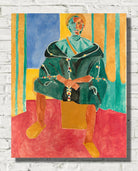


Henri Matisse Print, The Seated Riffian (1912)
Couldn't load pickup availability
The Seated Riffian (1912) by Henri Matisse
Henri Matisse's The Seated Riffian (Le Rifain assis) (1912) is one of the monumental portraits produced during the artist's transformative visits to Morocco. A seated man from the Rif region of northern Morocco fills almost the entire canvas, his richly patterned clothing, dark green forms and strikingly simplified face transformed through Matisse's increasingly confident use of colour and flattened pictorial space.
Painted between November and December 1912, the original is an imposing oil on canvas measuring more than two metres high. Today it belongs to the Barnes Foundation in Philadelphia.
Available as a Henri Matisse fine art print, framed print or canvas wall art, The Seated Riffian combines monumental portraiture with the remarkable colour relationships that made Matisse one of the defining artists of twentieth-century modernism.
Matisse in Morocco
Matisse travelled to Morocco during 1912 and 1913, working principally in and around Tangier.
The journeys came at an important moment in his development. His concentrated Fauvist period had already passed, yet the liberation of colour achieved through Fauvism remained fundamental to his work.
Morocco provided Matisse with different landscapes, architectural forms, textiles, clothing and qualities of light. These experiences encouraged him to explore increasingly simplified compositions in which broad areas of colour could carry much of the expressive force of the painting.
Among the works associated with these visits are landscapes, window paintings, café scenes and portraits including The Seated Riffian.
Who Is the Seated Riffian?
The title refers to a man from the Rif, the mountainous region of northern Morocco.
The Barnes Foundation describes the subject as a tribesman from the Rif Mountains whom Matisse painted during his 1912 visit to Morocco.
The man's individual identity is not securely established in the museum record, so the painting should not be treated as a conventional named portrait.
Instead, Matisse concentrates upon the physical presence of the sitter, the shape of his clothing and the relationship between figure and surrounding colour.
A Monumental Figure
One of the most striking characteristics of The Seated Riffian is its enormous scale.
The original measures approximately 200.3 × 160.7 cm. The seated man therefore occupies a canvas considerably larger than the average domestic portrait.
He dominates the composition from top to bottom.
There is little surrounding space to distract from him. His body forms a broad central mass, while clothing, hands, face and background are organised into large areas of colour.
This monumental treatment gives the sitter an imposing physical presence despite the apparent stillness of his pose.
Colour Rather Than Conventional Modelling
Matisse does not attempt to model the figure through subtle transitions between light and shadow in the traditional academic manner.
Instead, colour performs much of the structural work.
Deep greens, blues and darker tones establish the broad shape of the body, while the face is dramatically simplified.
The clothing becomes particularly important. Decorative motifs and contrasting borders interrupt the large mass of green and help articulate the sitter's pose.
Figure and costume consequently become inseparable from the overall colour structure of the painting.
This approach reflects one of Matisse's central artistic ideas: colour did not need merely to reproduce what the eye saw. It could organise the entire composition.
From Fauvism to the Moroccan Paintings
The Seated Riffian was painted around seven years after Matisse's revolutionary summer at Collioure with André Derain.
His style had changed substantially.
The broken brushwork and rapidly juxtaposed colours of the early Fauvist landscapes had increasingly given way to larger, calmer colour areas and more monumental forms.
Yet the underlying principle remained closely connected with Fauvism.
Matisse still refused to make colour subordinate to natural appearance.
In the Moroccan paintings, however, this freedom is combined with a stronger concern for simplification, stillness and pictorial structure.
The Seated Riffian therefore provides an excellent example of how Matisse developed beyond Fauvism without abandoning its most important discoveries.
The Face of the Seated Riffian
The sitter's face is one of the most memorable areas of the painting.
Rather than describing every feature in detail, Matisse reduces the head to a comparatively small number of strong colour divisions and outlines.
The treatment appears almost mask-like when compared with conventional European portraiture of the period.
This simplification shifts attention away from anatomical description towards the overall relationship between face, clothing and background.
The effect is characteristic of Matisse's increasingly radical approach to portraiture: individual features remain recognisable, but they are subordinated to the needs of the complete composition.
Pattern and Clothing
Clothing plays an unusually important role in The Seated Riffian.
The broad garment creates much of the figure's overall silhouette, while decorative borders and patterned elements supply smaller areas of visual activity.
Matisse had a lifelong fascination with textiles.
Carpets, fabrics, screens, patterned dresses and decorative materials recur throughout his interiors and portraits. They allowed him to connect the human figure with its surroundings through colour and ornament.
In The Seated Riffian, costume is not incidental detail. It is a major structural element of the painting.
Matisse, Morocco and Historical Context
Matisse's Moroccan paintings were produced during a period of European colonial expansion in North Africa.
Morocco became a French protectorate in 1912, the same year in which The Seated Riffian was painted.
European artists had long represented North Africa through the tradition usually described as Orientalism, often emphasising difference, spectacle and an imagined sense of exoticism.
Matisse's Moroccan works form part of this broader historical context and should be viewed with that history in mind.
At the same time, his principal formal concerns were increasingly centred upon colour, pattern, simplification and the relationship between figure and surface.
In The Seated Riffian, detailed anecdotal storytelling is largely absent. The sitter is presented frontally and monumentally, with the painting's impact deriving primarily from colour, form and presence.
The Painting's Early Exhibition History
The Seated Riffian was shown soon after Matisse returned from Morocco.
In April 1913 it appeared in the exhibition Henri-Matisse, Tableaux du Maroc et Sculpture at Galerie Bernheim-Jeune in Paris, where it was catalogued as Le Rifain assis.
The work was subsequently exhibited in Berlin and Rome and later appeared in important international Matisse exhibitions.
Its early exhibition history demonstrates that the painting formed an integral part of the group through which Matisse presented the artistic results of his Moroccan experience.
From Matisse's Studio to the Barnes Foundation
The painting remained with Matisse for several years after its creation.
It subsequently passed through several important modern-art collections and dealers.
Paul Rosenberg had the painting by 1919, and it later belonged to Danish collector Christian Tetzen-Lund.
It then passed to Parisian dealer and collector Paul Guillaume.
On 19 January 1925, Albert C. Barnes purchased The Seated Riffian from Guillaume.
It has remained part of the Barnes collection ever since.
The Seated Riffian at the Barnes Foundation
Today the original painting belongs to the Barnes Foundation in Philadelphia, accession number BF264.
It forms part of one of the world's most important collections of works by Matisse.
Albert Barnes was an early and enthusiastic collector of modern European painting, and Matisse became exceptionally well represented within the collection.
The scale of The Seated Riffian makes it particularly commanding within the distinctive ensemble displays for which the Barnes Foundation is known.
Original Artwork Details
- Artist: Henri Matisse (1869–1954)
- Title: Seated Riffian
- French title: Le Rifain assis
- Date: Between November and December 1912
- Medium: Oil on canvas
- Dimensions: 200.3 × 160.7 cm (78⅞ × 63¼ inches)
- Collection: The Barnes Foundation, Philadelphia
- Accession number: BF264
About Henri Matisse
Henri Matisse was born in Le Cateau-Cambrésis, France, in 1869 and became one of the most influential artists of twentieth-century modernism.
Originally trained in law, Matisse turned to painting and studied in Paris, including under Gustave Moreau at the École des Beaux-Arts.
His decisive breakthrough came during the early twentieth century when he and artists including André Derain began using intense, non-naturalistic colour with unprecedented freedom.
Their controversial paintings shown at the 1905 Salon d'Automne contributed to the emergence of Fauvism.
Matisse subsequently moved far beyond the concentrated Fauvist period.
His career encompassed monumental figure paintings, decorative interiors, portraits, still lifes, Moroccan subjects, experimental paintings of the 1910s, the Nice-period odalisques and finally the extraordinary cut-paper compositions of his later years.
Across these changes, colour, rhythm, simplification and the relationship between figure and surrounding space remained central to his art.
Explore more works in GalleryThane's Henri Matisse prints collection.
Henri Matisse's Painting Style
Expressive Colour
Matisse treated colour as a structural and emotional component of painting rather than simply a means of reproducing natural appearance.
Simplified Form
Figures and objects are frequently reduced to the shapes and lines Matisse considered essential.
Pattern
Textiles and decorative surfaces repeatedly play an active role in his compositions rather than functioning merely as background detail.
Flattened Space
Matisse often reduced conventional three-dimensional depth so that figures, furniture, landscape and pattern operated more strongly across the flat surface of the canvas.
Monumentality
In works such as The Seated Riffian, simplification does not diminish the figure. Instead, the broad areas of colour and reduced detail give the sitter an unusually powerful physical presence.
Displaying The Seated Riffian in Your Home
A The Seated Riffian print by Henri Matisse makes a particularly strong statement because of its vertical format and imposing central figure.
The painting's deep green, blue and dark tones work effectively against warm white, cream, stone, putty and pale neutral walls.
Natural timber, walnut, dark wood and restrained brass accents can complement its sophisticated palette without competing with the artwork.
The vertical proportions make it particularly useful above a console table, on a tall hallway wall, beside a fireplace or as the principal artwork within a portrait-led gallery wall.
Because the composition is already visually powerful, surrounding décor can remain relatively restrained.
The Seated Riffian Prints, Framed Prints and Canvas Wall Art
GalleryThane offers The Seated Riffian by Henri Matisse in a range of print sizes and presentation formats.
Choose a fine art paper print for a traditional presentation, add a professionally made frame and mount for ready-to-display wall art, or select a canvas option for a more contemporary finish.
GalleryThane prints and frames its artwork in-house using archival art stocks, pigment inks and carefully selected framing materials.
All orders for unframed fine art prints and original paintings are dispatched within 2 working days of receipt of payment.
Orders for custom framed prints are dispatched within 4 working days.
All orders are fully tracked from dispatch to delivery at your home or business.
All print and original painting orders are fully insured against loss or damage in transit. We refund or replace any damaged or lost orders.
Buy with confidence - read what our satisfied customers have to say - Reviews
Fine art papers are printed without any additional white border Please let us know at the time of ordering if you would like a small additional white border.
Rolled canvas options have an additional white border of approximately 2.5 inches (7cm) on all 4 sides to aid stretching.
Ready to hang canvas panels are stretched on 1.5 inch deep solid pine frames from sustainable forestry sources. The image is mirrored on all 4 sides to give an aesthetically pleasing finish.
Why not have us gift wrap your order and attach a personalised message to the recipient. Available for all orders. Each order is hand wrapped in high quality gift wrap with meatllic ribbon and bow. Your personalised message is printed on a card which is included with your order.
Have your hand wrapped gift delivered directly to the recipient.
Full tracking and insurance included with every order.
Please note design may vary depending upon availability
Just purchase the gift wrap option HERE
Why Choose GalleryThane?
- Printed and framed in-house
- Free UK delivery
- Free EU an USA delivery on orders over £200
- Tracking and insurance included in every order
- Fast 1-3 day dispatch
- Gift wrapping service available
- Gallery quality materials
- Sustainable, eco-friendly packaging
- Great customer support
Explore related collections
What makes our Prints and Canvas Panels so special

Latest Giclee Printing Technology
We have invested in the latest wide format print technology to produce museum quality giclee prints utilising the highest quality pigment inks to give outstanding colour reproduction.

Museum Quality Archival Fine Art Papers
We print on the finest quality fine art papers with textured, smooth and lustre finishes for prints which last a lifetime.
From aceo miniatures to 40x80 inch large format, every print has our lifetime quality guaranteee.

Solid Wood Frames, Cotton Canvas
All of the wood for our canvas panels and frames is responsibly sourced from manages forests. Our cotton canvas is completely seedless for the highest quality reproduction possible.
Multi-column

Have Your Gift Wrapped


Choose a Custom Frame
Popular Collections


EU Representative
Manufacturer
LucasAbstract t/a GalleryThane
15 Campion Way, Bingham NG13 8TR UK
sales@gallerythane.com
EU Authorised Representative
Westwood Sourcing
Fellenoordstraat 52, Unit 2.38
4811 TJ Breda, Netherlands
info@westwoodsourcing.com