


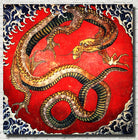
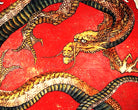
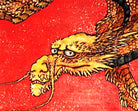
Matsuri Yatai Dragon, Katsushika Hokusai, Japanese Fine Art Print
Couldn't load pickup availability
Katsushika Hokusai – Matsuri Yatai Dragon Prints
Discover the dramatic imagination of Hokusai's late career with a Matsuri Yatai Dragon print. Far removed from the familiar landscapes of The Great Wave and Thirty-Six Views of Mount Fuji, this extraordinary dragon originates from a large ceiling painting Hokusai created in 1844 for a festival float in Obuse, Japan.
The powerful coiling dragon fills a brilliant red field, its twisting body and intense expression demonstrating that Hokusai's creativity remained remarkably vigorous when he was well into his eighties.
Available from GalleryThane as fine art print and canvas options, the image offers a striking way to explore the mythological and hand-painted side of Hokusai's work.
The Higashimachi Festival Float
The original dragon was painted for the ceiling of the **Higashimachi festival float** in Obuse, Nagano Prefecture.
The float itself dates from 1806, but its ceiling was later altered to accommodate two monumental paintings by Hokusai: a Dragon and a Phoenix.
Hokusai produced the pair in 1844 while staying in Obuse late in his life.
They remain associated with the Hokusai-kan museum in Obuse, where the historic festival floats and their extraordinary ceiling paintings are preserved.
Painting Style
A Hokusai Painting – Not a Woodblock Print
The original **Matsuri Yatai Dragon is a painting**, not an ukiyo-e woodblock print.
This distinction makes it particularly valuable for understanding Hokusai's wider career.
Although his internationally famous reputation rests heavily on printed works such as The Great Wave, Hokusai was also an accomplished painter who continued producing ambitious hand-painted works into old age.
The GalleryThane product reproduces this painted design as wall art while preserving the dramatic character of the original composition.
The Dragon and Phoenix
Hokusai conceived the Dragon together with a companion Phoenix ceiling painting.
The two works were deliberately contrasting.
The Dragon occupies an intensely fiery red field, while the Phoenix is associated with a much darker indigo-toned setting.
The Hokusai-kan explains this contrast in relation to the complementary principles of Chinese yin-yang thought, giving the pair both decorative impact and symbolic balance.
The Dragon in East Asian Art
Dragons occupy an important place within East Asian mythology and visual culture.
Unlike the destructive monsters common in some Western traditions, East Asian dragons are frequently connected with water, clouds, rain and powerful natural forces.
Such associations made the subject particularly appropriate for Hokusai, an artist repeatedly fascinated by waves, storms, waterfalls and moving water.
The twisting dragon also gave him an opportunity to display the energetic line and fluid movement that characterise so much of his art.
Hokusai in Obuse
Hokusai developed an important connection with the town of Obuse during the final decade of his life.
He visited the area at the invitation of Takai Kōzan, a wealthy local merchant, artist and supporter who provided Hokusai with opportunities to work.
The festival-float ceiling paintings belong to this extraordinary late period.
According to the Hokusai-kan, Hokusai was 85 by traditional Japanese age reckoning when he completed the Dragon and Phoenix in 1844.
Rather than becoming conservative with age, his work remained ambitious, colourful and technically demanding.
Late Hokusai and the Pursuit of Improvement
Hokusai famously remained dissatisfied with his own artistic progress even in old age.
His late paintings demonstrate an artist still seeking new challenges rather than simply repeating the commercially successful landscapes of his earlier career.
The Matsuri Yatai Dragon is therefore particularly valuable within a Hokusai collection because it reveals a different medium, different subject and different phase of the artist's life.
Hokusai Dragon Wall Art
A Hokusai dragon print creates a markedly different interior effect from his blue Mount Fuji landscapes.
The intense red background provides warmth and visual energy, making the work suitable as a strong standalone focal point.
It works especially well against neutral, charcoal, deep blue or dark green walls and suits contemporary, eclectic, Japanese-inspired and maximalist interiors.
The near-square composition can also provide useful visual contrast within a gallery wall dominated by horizontal Japanese woodblock landscapes.
About Katsushika Hokusai
Katsushika Hokusai (1760–1849) was a Japanese artist whose extraordinary output included woodblock prints, paintings, illustrated books and thousands of drawings.
His career extended across more than seventy years and was characterised by constant reinvention.
Hokusai became famous for landscapes such as The Great Wave off Kanagawa, but his interests were far broader. Dragons, supernatural figures, birds, flowers, waterfalls and scenes of everyday life all occupied important places within his work.
The paintings he created in Obuse during his eighties demonstrate the extraordinary vitality of his final decade and provide an important counterpart to the printed landscapes for which he is best known.
Frequently Asked Questions
When did Hokusai create the Matsuri Yatai Dragon?
Hokusai painted the Dragon in 1844 during a stay in Obuse, Japan.
Is the original Matsuri Yatai Dragon a woodblock print?
No. The original work is a hand-painted ceiling image created for a festival float.
Where was the Dragon painted?
It was created for the Higashimachi festival float in Obuse, Nagano Prefecture.
Did Hokusai create another painting for the same float?
Yes. The Dragon was paired with a Phoenix ceiling painting.
How old was Hokusai when he painted the Dragon?
The Hokusai-kan records him as aged 85 according to traditional Japanese age reckoning when the Dragon and Phoenix were created in 1844.
Where is the original Matsuri Yatai Dragon?
The historic festival float and Hokusai ceiling paintings are preserved at the Hokusai-kan in Obuse.
Why are dragons important in Japanese and East Asian art?
Dragons are traditionally associated with powerful natural forces, particularly water, clouds and rain, and appear frequently in East Asian religious and mythological imagery.
What interiors suit the Matsuri Yatai Dragon?
Its intense red ground and dynamic form make it particularly effective in contemporary, eclectic, Japanese-inspired and maximalist interiors.
All orders for unframed fine art prints and original paintings are dispatched within 2 working days of receipt of payment.
Orders for custom framed prints are dispatched within 4 working days.
All orders are fully tracked from dispatch to delivery at your home or business.
All print and original painting orders are fully insured against loss or damage in transit. We refund or replace any damaged or lost orders.
Buy with confidence - read what our satisfied customers have to say - Reviews
Fine art papers are printed without any additional white border Please let us know at the time of ordering if you would like a small additional white border.
Rolled canvas options have an additional white border of approximately 2.5 inches (7cm) on all 4 sides to aid stretching.
Ready to hang canvas panels are stretched on 1.5 inch deep solid pine frames from sustainable forestry sources. The image is mirrored on all 4 sides to give an aesthetically pleasing finish.
Why not have us gift wrap your order and attach a personalised message to the recipient. Available for all orders. Each order is hand wrapped in high quality gift wrap with meatllic ribbon and bow. Your personalised message is printed on a card which is included with your order.
Have your hand wrapped gift delivered directly to the recipient.
Full tracking and insurance included with every order.
Please note design may vary depending upon availability
Just purchase the gift wrap option HERE
Why Choose GalleryThane?
- Printed and framed in-house
- Free UK delivery
- Free EU an USA delivery on orders over £200
- Tracking and insurance included in every order
- Fast 1-3 day dispatch
- Gift wrapping service available
- Gallery quality materials
- Sustainable, eco-friendly packaging
- Great customer support
Explore related collections
What makes our Prints and Canvas Panels so special

Latest Giclee Printing Technology
We have invested in the latest wide format print technology to produce museum quality giclee prints utilising the highest quality pigment inks to give outstanding colour reproduction.

Museum Quality Archival Fine Art Papers
We print on the finest quality fine art papers with textured, smooth and lustre finishes for prints which last a lifetime.
From aceo miniatures to 40x80 inch large format, every print has our lifetime quality guaranteee.

Solid Wood Frames, Cotton Canvas
All of the wood for our canvas panels and frames is responsibly sourced from manages forests. Our cotton canvas is completely seedless for the highest quality reproduction possible.
Multi-column

Have Your Gift Wrapped


Choose a Custom Frame
Popular Collections


EU Representative
Manufacturer
LucasAbstract t/a GalleryThane
15 Campion Way, Bingham NG13 8TR UK
sales@gallerythane.com
EU Authorised Representative
Westwood Sourcing
Fellenoordstraat 52, Unit 2.38
4811 TJ Breda, Netherlands
info@westwoodsourcing.com